The Dance of the Loader#
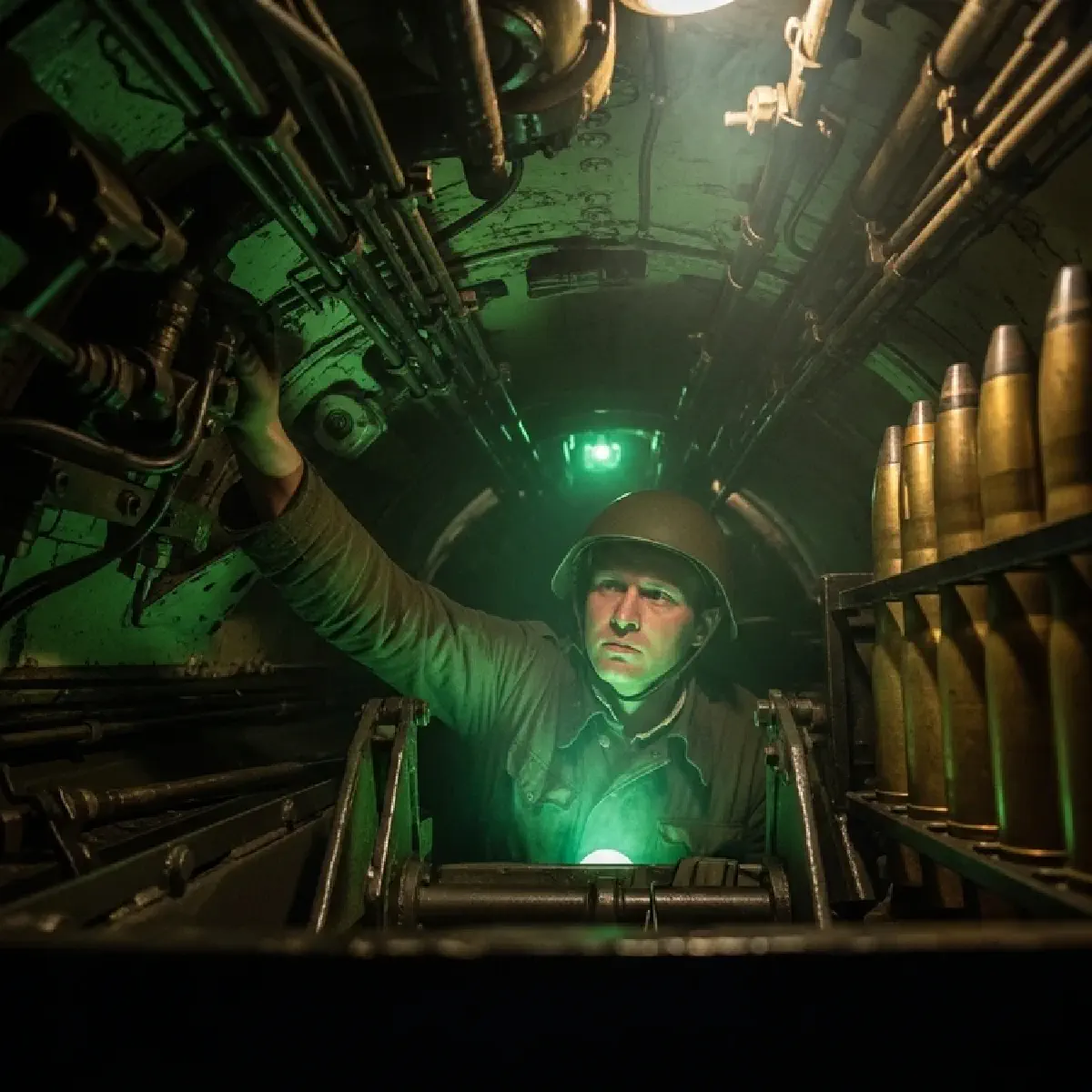
Inside the T-34/76, the loader performed what veterans described as a “complicated dance”. Because the tank lacked a turret basket—a rotating floor—the loader was forced to scramble over the tops of ammunition boxes as the turret turned. As the fight progressed, empty shell cases and rubber floor mats would clutter the workspace, making it nearly impossible to load the 76.2mm gun with efficiency. This environment was so physically taxing and poorly ventilated that loaders often passed out from inhaling gunpowder fumes during rapid fire.
The Thesis of Secondary Safety#
The T-34 design was a physical manifestation of a state philosophy that prioritized the weapon over the operator. Every revolutionary feature that enhanced the tank’s tactical profile, such as the low silhouette and sloped armor, came at the direct expense of crew space and safety. In the Soviet calculus of war, a tank’s survival was measured in kilometers of advance, while the crew’s comfort was treated as an unnecessary luxury. This trade-off resulted in “appalling” interior conditions that American engineers at Aberdeen described as “unfit for human operation”.
Explaining the System: The Ergonomic Gap#
Vision and Awareness#
The T-34 was notoriously difficult to see out of when the hatches were closed. Early periscopes were made of low-quality “organic glass” that provided a distorted, wavy image, forcing many drivers to fight with their hatches slightly open for survival. German commanders, who preferred to fight “heads-up” from their cupolas, found the Soviet tanks easy to ambush because their crews were virtually blind to their flanks. It was not until the 1943 Model that a commander’s cupola was finally introduced to address this fatal flaw.
Complicating Factors: The Gearbox Struggle#
Shifting gears in an early T-34 was a test of raw physical strength. The four-speed transmission lacked synchronized gearing, often requiring the radio operator to help the driver pull the gear lever into place. Shifting from 2nd to 3rd gear required an initial force of 46–112 kg (101–247 lbs), which was later reduced to 31 kg (68 lbs) in 1941. Drivers were so exhausted by the physical strain of driving that they could lose two to three kilograms (4.4–6.6 lbs) during a single long march.
Tracing the Consequences: The “Pirozhok” Hatch#
The early T-34/76 turret featured a single, massive hatch nicknamed the “pirozhok” (stuffed bun) by its crews. This heavy hatch was difficult to open under the best conditions, but if the tank was hit and the hatch jammed, it became a death trap. Wounded crewmen had virtually no chance of escaping through the single top opening. This lack of escape options, combined with the presence of internal fuel tanks, contributed to the T-34 suffering the highest tank losses in history, with over 44,900 units destroyed during the war.
Soldiers Serving the Machine#
The T-34 was a “vile” environment for its crew, but its ruggedness and simplicity allowed it to endure where more sophisticated machines failed. Soviet tankers lived in their vehicles for months, sleeping on the warm engine decks wrapped in tarpaulins to survive the Russian winter. They accepted the bruises, the poisoning from fumes, and the “inhuman harshness” of the controls as the cost of victory. Ultimately, the T-34 was a weapon designed to win a war of attrition, and in that brutal context, the lives of the crews were often treated as just another statistic in the march toward Berlin.