The Great Relocation#
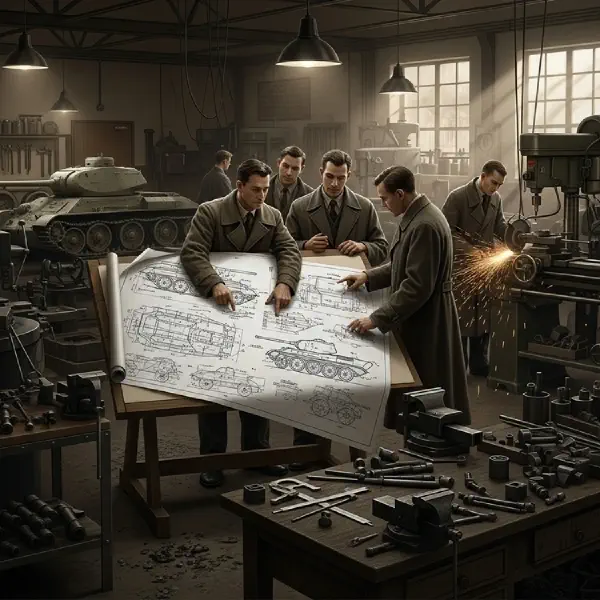
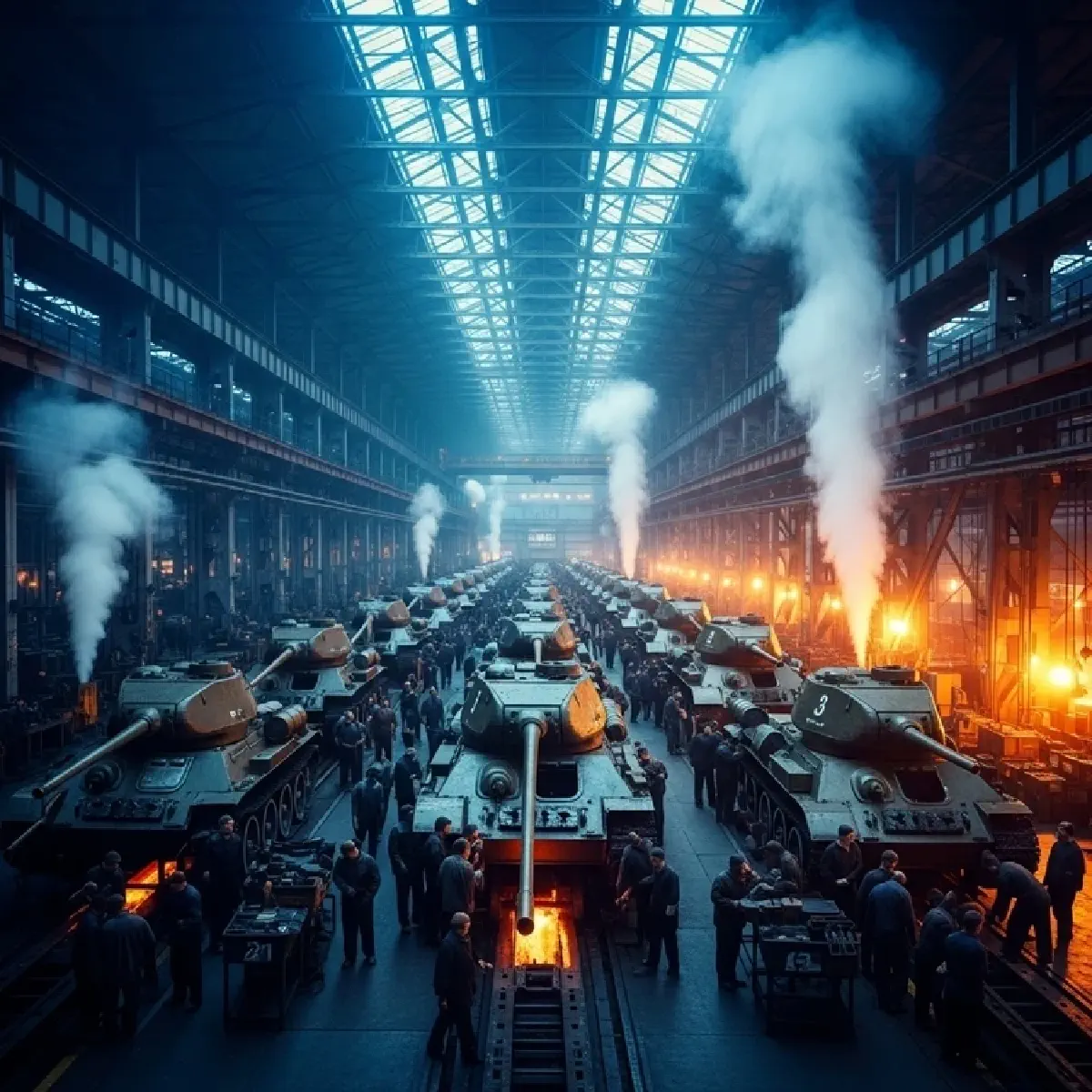
As the German Wehrmacht advanced toward Moscow in 1941, the Soviet leadership undertook one of history’s most massive industrial feats: the relocation of over 1,300 factories to the Ural Mountains. Workers and machinery from the Kharkiv Locomotive Plant were dismantled and shipped 1,700 miles (2,735 km) east to Nizhny Tagil, where they were re-established as Stalin Ural Tank Factory No. 183. This migration occurred with such haste that many workers were forced to assemble tanks in open air or under temporary roofs during the brutal winter of 1941–42. Despite this chaos, the Soviet Union managed to produce 12,500 T-34s in 1942 alone.
The Thesis of Industrial Pragmatism#
The Soviet production philosophy for the T-34 was defined by the mantra that “perfect is the enemy of good enough”. To ensure high volumes, engineers were expressly forbidden from making design changes unless they simplified or cheapened the production process. By removing over 5,800 parts and refining welding techniques, the cost of a single T-34 fell from 269,500 rubles in 1941 to 135,000 rubles in 1943. This pragmatism allowed the Soviets to overwhelm the German Panzerwaffe through sheer weight of numbers.
Explaining the System: Rationalized Manufacturing#
The Transition from Excavators to Armor#
The Uralmash Heavy Machinery Plant (UZTM) in Sverdlovsk had never produced military products before the summer of 1941, specializing instead in excavators and mining equipment. By March 1942, however, the plant began producing T-34 hulls and turrets through a decree from the State Defense Committee (GKO). Because foundries were overloaded, Uralmash engineers developed a “witty” solution: stamping the T-34 turret from a 45mm steel sheet using a massive 10,000-ton press. Although these stamped turrets cost twice as much as cast ones, they were structurally stronger and could be produced without waiting for limited foundry space.
Complicating Factors: Scarcity and Substitution#
Shortages of critical materials forced Soviet designers to make drastic compromises in the tank’s construction. When rubber supplies for road wheels were cut off by the German advance, factories adopted internally sprung, all-steel wheels that produced a deafening clattering sound. These “steam-engine” wheels were miserable for the crew but allowed production to continue without interruption. Prof. Evgeny Paton further accelerated production by introducing automated submerged-arc welding, which replaced slow hand-welding and increased the strength of armor joins.
Tracing the Consequences: The 80-Hour Tank#
By May 1944, Soviet factories were churning out 1,200 T-34-85s per month. The total production time for a single vehicle was slashed from 260 hours in 1941 to just 80 hours by late 1943. This rapid assembly line meant that the finish on non-critical parts was “appalling,” featuring rough casting marks and primitive welds. However, German engineers examining captured samples noted that the tank was “good where it needs to be,” with perfectly engineered guns and engines hidden inside a crude exterior.
A Victory of Logistics#
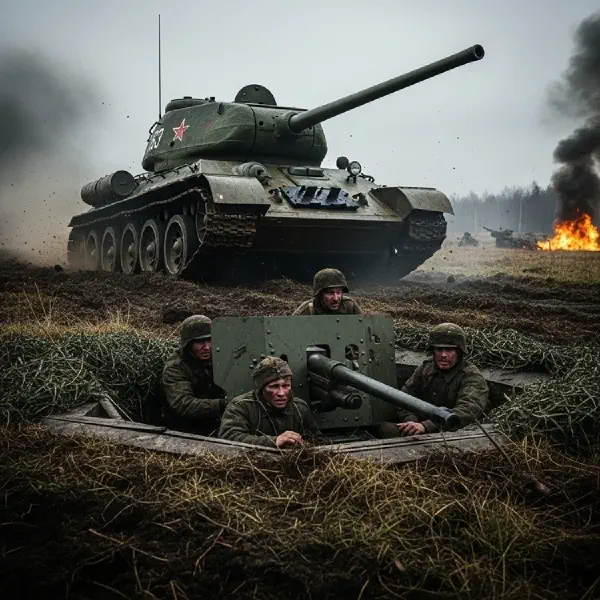
The Soviet industrial miracle turned the T-34 into the “supermarket tank” of the Second World War—a mass-produced weapon that favored availability over precision. While German manufacturers like Henschel and MAN focused on artisanal quality, the Soviets prioritized the “numbers game,” building over 84,000 T-34s across all variants. This industrial ruthlessness ensured that even if the T-34 was technically inferior to a Tiger one-on-one, the Red Army would always have ten tanks for every one the Germans fielded. The factory front, established in the snow of the Urals, was the true birthplace of the Soviet victory.