The Door Knockers of Rasani#
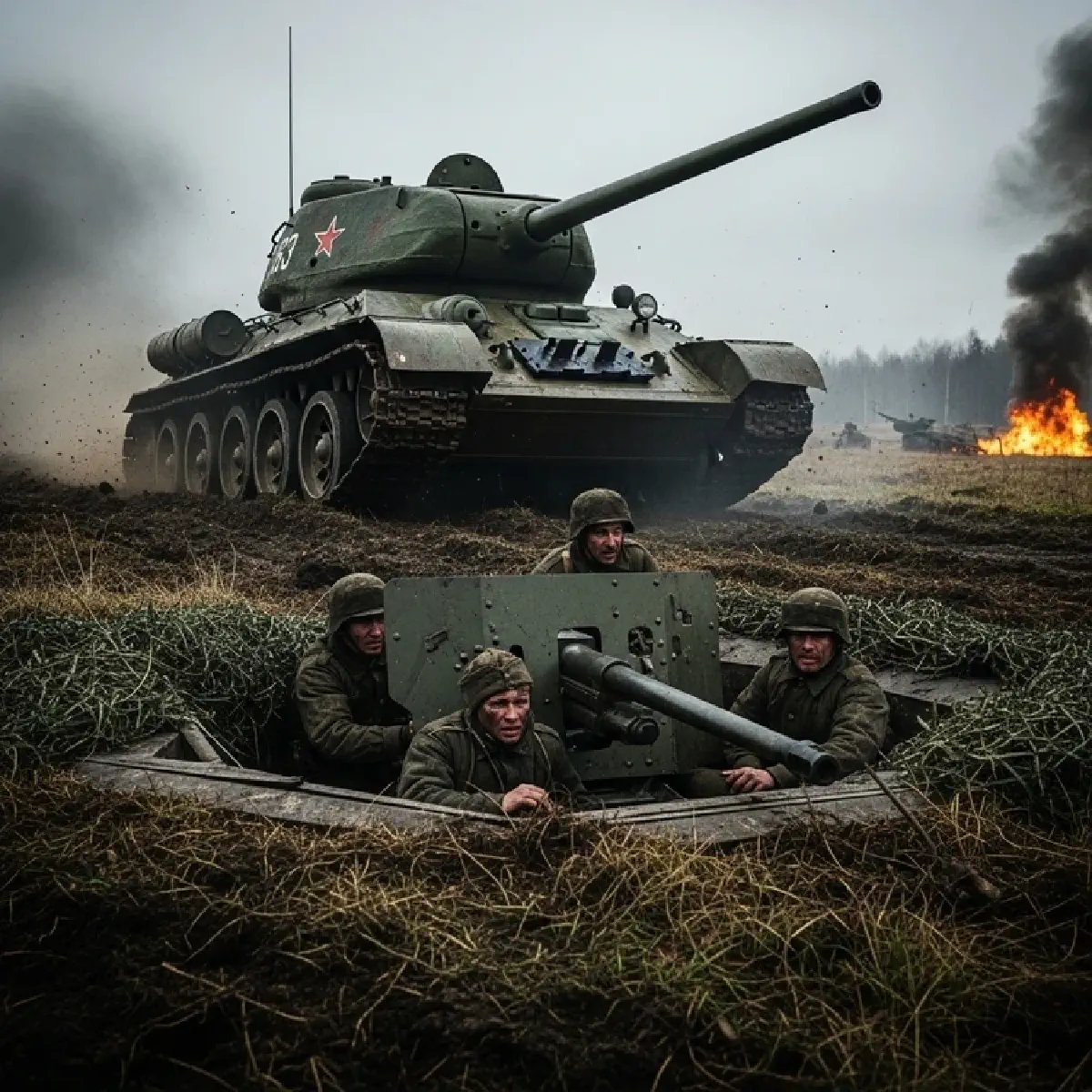
On June 23, 1941, German anti-tank crews near Rasani, Lithuania, fired their 3.7 cm PaK 36 guns 23 times at a single Soviet T-34. Every single round ricocheted off the tank’s 60-degree sloped frontal armor, leaving nothing more than “scratched paintwork”. The German gunners nicknamed their standard weapon the “Panzeranklopfgerät,” or tank door knocker, because it was useless against this new threat. This unexpected appearance of a superior tank sent a psychological shock through the Wehrmacht’s leadership. General Heinz Guderian later admitted that the T-34’s “vast superiority” changed the calculus of Operation Barbarossa immediately.
The Thesis of Mechanical Fragility#
Despite its tactical superiority, the T-34’s initial impact was undermined by catastrophic mechanical failure and abysmal crew training. In the first weeks of the 1941 invasion, the Soviet Red Army lost roughly 2,300 T-34s, often due to breakdowns rather than combat. While the design was a masterpiece on paper, the lack of radios, spare parts, and skilled commanders turned the “T-34 shock” into a logistical nightmare. The tank was a tactical winner but a systemic failure during its combat debut.
Explaining the System: Tactical Mismatch#
Armor vs. Inadequate Calibers#
The German Panzer III and IV tanks in 1941 carried guns that struggled to penetrate the T-34 at normal combat ranges. The short-barreled 75mm gun on the Panzer IV could only penetrate the T-34 at close range if it hit a flat portion of the turret. Conversely, the Soviet 76.2mm F-34 gun could pierce the front of German medium tanks at ranges over 1,000 meters (1,093 yards). This imbalance forced the Germans to rely on their 8.8 cm Flak guns in a direct-fire anti-tank role to stop the Soviet advance.
Complicating Factors: The Absence of Command and Control#
Only company commanders in early Soviet units were typically fitted with radio sets, leaving the rest of the tanks to coordinate using signal flags. This lack of communication meant that T-34 platoons often clumped together “like a hen with its chicks,” making them vulnerable to coordinated German flanking maneuvers. German commanders noticed that Soviet crews were extremely slow to find and engage targets. The T-34’s two-man turret forced the commander to also function as the gunner, denying him the situational awareness necessary to lead a unit effectively.
Tracing the Consequences: The 500-Kilometer March#
When the 8th Mechanized Corps marched 500 km (311 miles) toward Dubno in June 1941, half of its vehicles were lost to mechanical failure before reaching the battle. Clutches and transmissions were notoriously weak, requiring drivers to sometimes use hammers to shift gears. In many early battles, crews were seen carrying a spare transmission on the engine deck because they expected a breakdown. This reliability crisis meant that the T-34 was often a stationary bunker rather than a mobile weapon.
A Failure of Readiness#
The tragedy of the T-34 in 1941 was that it was a 1943 tank fighting with 1939 logistics. Typical crews went into battle with only 72 hours of classroom instruction and zero rounds of live-fire practice. Although the T-34 was the “finest tank in the world” according to German General von Kleist, its potential was wasted by a state that had prioritized production over personnel training. As the war progressed, the Soviets would refine the machine, but the summer of 1941 remains a stark reminder that technology alone cannot win a war.