The Grueling Drive to Moscow#
In early 1940, Mikhail Koshkin risked his health to prove the durability of his latest creation by driving two prototype A-34 tanks from Kharkiv to Moscow. The 2,000-kilometer (1,242-mile) journey occurred during a brutal winter, resulting in Koshkin contracting fatal pneumonia shortly after demonstrating the vehicle to the Kremlin. This demonstration was necessary to overcome resistance from military leaders who favored lighter, more traditional designs like the T-26. The prototypes successfully navigated snowstorms and mechanical trials, proving that the T-34 was the “universal tank” Stalin demanded. By September 1940, the first series-produced T-34s began rolling out of the Kharkiv Komintern Locomotive Plant (KhPZ).
The Thesis of Tactical Supremacy#
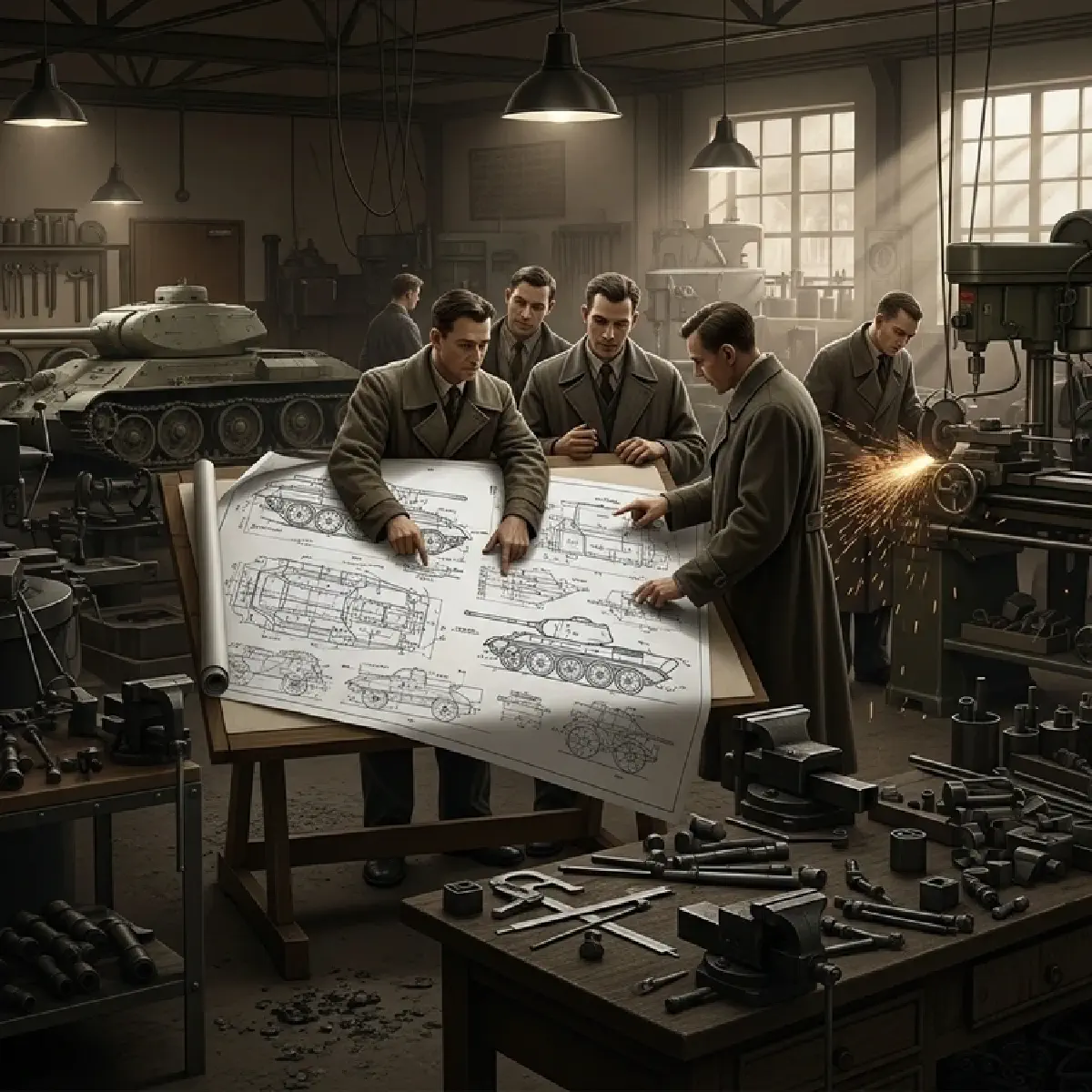
The T-34 was not merely an upgrade; it was a fundamental shift in armored warfare that balanced mobility, protection, and firepower through revolutionary design. While contemporaries relied on vertical armor, the T-34’s sloped 45mm (1.77 in) plating effectively doubled its protection against horizontal projectiles. This design philosophy ensured that the Red Army possessed a vehicle that could survive the modern battlefield while remaining cheap enough for mass production. The birth of the T-34 signaled the end of the distinction between light cavalry tanks and heavy infantry support tanks.
Explaining the System: The Power of Three#
Integrating Speed and Strength#
The T-34’s mobility was anchored by the V-2-34 diesel engine, a 12-cylinder masterpiece providing 500 horsepower (370 kW). This aluminum-block engine was significantly lighter and more fire-resistant than the petrol engines used by German and earlier Soviet designs. Coupled with J. Walter Christie’s wide-spring suspension, the tank could reach road speeds of 53 km/h (33 mph). Wide tracks measuring 500 mm (19.7 in) ensured a low ground pressure of 0.72 kg/cm², allowing it to traverse mud and snow where German panzers often bogged down.
Complicating Factors: Political and Military Purges#
The development of the T-34 occurred under the shadow of the Great Purge, which decimated the Soviet officer corps and engineering bureaus. Constantine Chelpan, the primary designer of the V-2 diesel engine, was arrested and executed by the NKVD for alleged espionage in 1938. This political instability meant that technical improvements were often delayed by a fear of disrupting production quotas. Consequently, early T-34s suffered from poor vision devices and vision slits that forced commanders to expose themselves during combat.
Tracing the Consequences: Lessons from Spain and Mongolia#
The T-34 design was forged from blood-soaked lessons in the Spanish Civil War and against the Japanese at Khalkhin Gol. Soviet theoreticians realized that the BT series and T-26 were dangerously vulnerable to anti-tank rifles and Molotov cocktails due to their thin armor and petrol engines. These conflicts emphasized the need for a “shell-proof” tank that could withstand the low-velocity 37mm guns common at the time. The resulting A-32 prototype was evolved into the T-34 precisely to address these specific battlefield failures.
A Legacy Written in Steel#
The T-34 Model 1940 was a clean and elegant design that prioritized survival in a way Western observers at Aberdeen Proving Ground found remarkable yet crude. It carried the 76.2mm (3 in) L-11 gun, which was later replaced by the more powerful F-34, capable of penetrating any German tank in service in 1941. As production shifted to massive scales, the T-34 would become the mainstay of the Red Army’s Deep Battle strategy. This tank did not just participate in the war; it redefined the limits of what a medium tank could accomplish. Future conflicts would look back at this 1940 debut as the moment the modern tank was truly born.