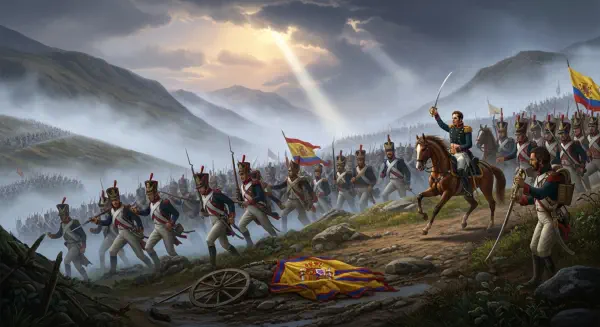
The Spanish Empire officially ended in 1898, when the last flags were lowered over Cuba, Puerto Rico, and the Philippines. The guns fell silent. The treaties were signed. The empire was pronounced dead.
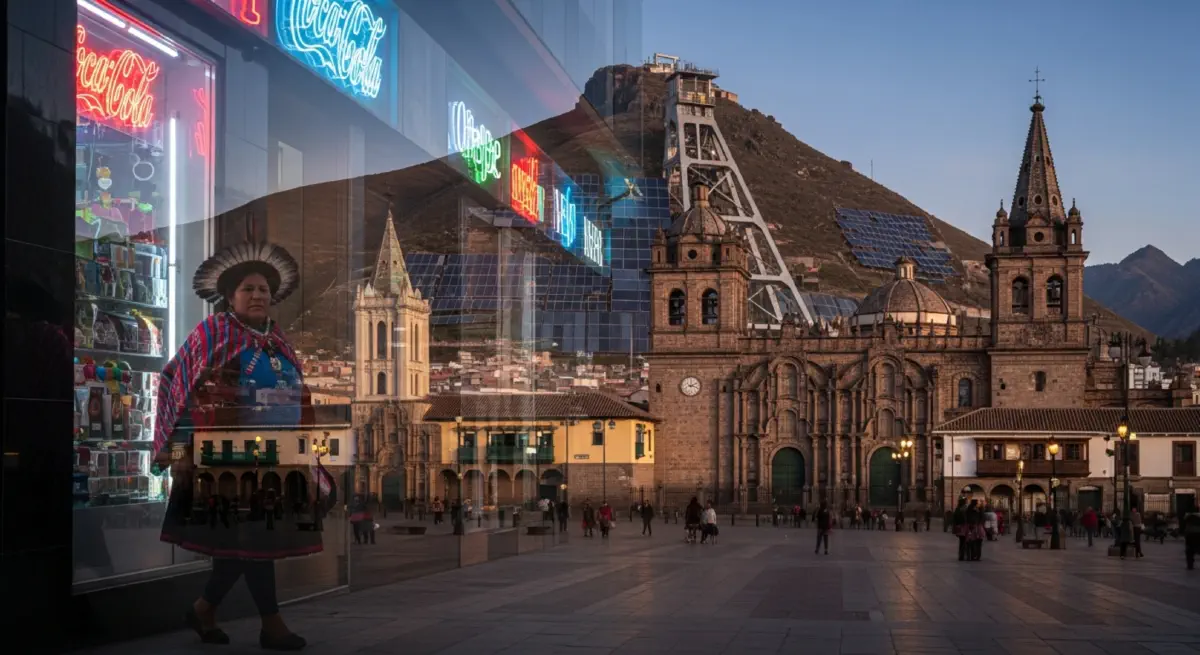
But empires are not like people. They do not simply die. They transform. Their institutions, their habits, their hierarchies—they seep into the soil and grow up again as something new. The Spanish Empire is gone. But its operating system still runs much of the world.
This is the story of the ghost in the machine: how the cogs of conquest kept turning long after the empire collapsed.
🗣️ Language: The Empire's Most Successful Export#
The Spanish language is the empire's greatest victory. Today, nearly 500 million people speak Spanish as their native language. It is the second-most spoken native language in the world, after Mandarin Chinese. It is the official language of 20 nations.
By the numbers:
| Region | Spanish speakers (approx.) | Percentage of population |
|---|---|---|
| Mexico | 130 million | 98% |
| United States | 42 million native, 58 million total (including heritage speakers) | 13–18% |
| Colombia | 51 million | 99% |
| Argentina | 45 million | 98% |
| Spain | 47 million | 98% |
| Philippines | 3 million (native-like proficiency, but declining) | <3% |
Why did Spanish fade in the Philippines while thriving in the Americas? Because the colonial project was different. In the Americas, Spain sent millions of settlers, built universities, and forced conversion. In the Philippines, fewer than 10,000 Spaniards ever settled permanently. Spanish remained the language of the elite, but never penetrated the masses. When the United States took over in 1898, it replaced Spanish with English in schools. Today, only about 3 million Filipinos speak Spanish, most as a heritage language—a ghost of a ghost.
⛪ Religion: The Faith That Refused to Die#
The Catholic Church that the Spanish Empire built in the Americas is still standing. In fact, it is larger, more vibrant, and more influential than the Church in Spain itself.
Catholicism in Latin America today:
- Approximately 460 million Catholics live in Latin America and the Caribbean—about 40% of the world's total Catholic population.
- In Mexico alone, over 90 million people identify as Catholic.
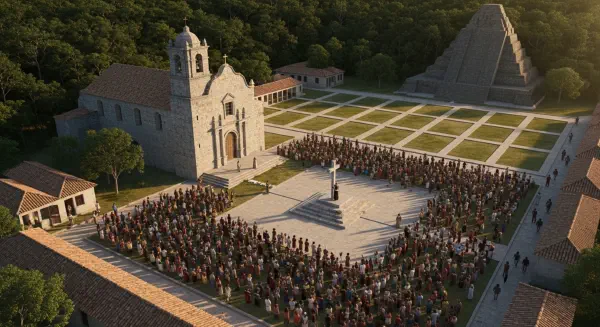
- Every major Latin American city is still organized around its central plaza and catedral—the colonial grid plan imposed by the Laws of the Indies.
- Saints' days, processions, and pilgrimages still mark the rhythm of life.
But the Church today is not the same institution Spain created. It has transformed—just as the empire transformed.
Liberation Theology (1960s–present) In the 1960s and 1970s, a movement of Latin American priests and theologians—influenced by Marxist thought and the example of Che Guevara—argued that the Church had a "preferential option for the poor." Liberation theology called for political action against poverty, dictatorship, and injustice. It was condemned by Pope John Paul II in the 1980s, but it had already transformed Catholic social teaching. The ghost of Bartolomé de las Casas, the Dominican friar who defended Indigenous rights in the 1500s, was alive and well.
Pentecostal Competition In the past 40 years, Pentecostal Protestantism has exploded across Latin America. Today, about 20% of Latin Americans identify as Protestant (mostly Pentecostal), up from single digits in 1980. The Catholic Church is no longer the monopoly it once was—but it remains the majority.
The colonial Church also left a legacy of abuse. The Catholic Church in Latin America protected dictators, covered up child sexual abuse, and opposed contraception, abortion, and LGBT rights. In countries like El Salvador, bishops blessed death squads. In Chile, the Church defended Pinochet. The ghost of the Inquisition—the desire to control minds and bodies—has not entirely faded.
🏘️ Land and Labor: The Hacienda Never Died#
The Spanish Empire's economic system was built on two pillars: control of land and control of labor. Those pillars still stand.
The persistence of latifundia (large estates):
| Country | Percentage of agricultural land owned by top 1% of landowners | Gini coefficient for land (0=equal, 1=concentrated) |
|---|---|---|
| Paraguay | 80% | 0.93 |
| Brazil | 45% | 0.84 |
| Colombia | 52% | 0.86 |
| Chile | 55% | 0.87 |
| Mexico (post-revolution, 1917–1992) | 65% (after reform, reduced; now rising again) | 0.75 (estimated) |
These numbers would be familiar to a colonial encomendero. The names have changed—hacienda, fazenda, estancia—but the pattern remains: a few families own most of the land. The majority work for them, often in conditions not far from debt peonage.
On January 1, 1994—the day NAFTA took effect—the Zapatista Army of National Liberation (EZLN) rose up in Chiapas, Mexico. Their demand: land, justice, and dignity for Indigenous peoples. Their slogan: "¡Ya basta!" (Enough!). The rebellion was a direct echo of Indigenous resistance to colonial land dispossession—five centuries later.
👥 Race: The Caste Calculus Without Labels#
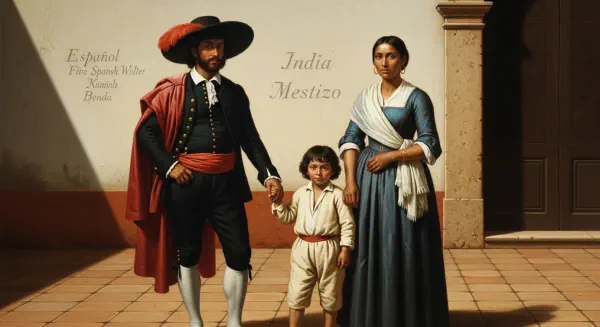
The sistema de castas is no longer law. But its effects are everywhere.
Colorism in Latin America today:
- Income inequality by skin color: In Brazil, white workers earn 2.5 times more than Black workers. In Colombia, the gap is similar. In Mexico, people with lighter skin earn 38% more than those with darker skin, even when education and occupation are the same.
- Political representation: Across Latin America, Indigenous and Afro-descendant peoples are dramatically underrepresented in parliaments, cabinets, and judiciaries.
- Social mobility: The darker your skin, the harder it is to rise. This is not a coincidence—it is the inheritance of a system that assigned value by race.
The myth of mestizaje (racial mixing) Many Latin American nations—Mexico, Brazil, Venezuela, Colombia—promoted mestizaje as a national ideology in the 20th century. The story went: We are all mixed. There is no racism here. We are one people.
But as historian María Elena Martínez has shown, the ideology of mestizaje often serves to erase Indigenous and Black identities. It says: You are not separate. You are part of the nation. Now stop demanding rights. The caste calculus was not abolished—it was renamed.
In the 1990s and 2000s, Indigenous movements across Latin America demanded recognition, autonomy, and reparations. Bolivia elected its first Indigenous president, Evo Morales (2006–2019). Ecuador recognized the rights of nature, inspired by Indigenous cosmologies. Colombia established special Indigenous territorial reserves. The ghosts of the encomienda and the mita are still being exorcised.
🏛️ Governance: The Colonial DNA of Latin American Politics#
Spanish colonialism did not just extract silver and save souls. It also planted the deep structure of Latin American governance: centralized, hierarchical, and suspicious of horizontal cooperation.
Borrowed (and altered) institutions:
| Colonial institution | Modern successor | How it changed (or didn't) |
|---|---|---|
| Viceroy | President (strong executive) | Remained powerful; Latin American presidents have more authority than US or European executives |
| Royal Audiencia (high court) | Supreme Court | Often weaker; subject to executive interference |
| Cabildo (town council) | Municipal government | Little real power; central government dominates |
| Intendant system (tax collection) | Finance ministry | Still extractive; corruption remains endemic |
| Patronato Real (royal church control) | Catholic Church-state agreements | Weakened, but still influential (e.g., abortion bans, religious education) |
Caudillismo: The dictator as colonial legacy The Spanish Empire created a political culture of personal loyalty to el patrón (the boss)—the viceroy, the governor, the encomendero. After independence, that loyalty transferred to caudillos (strongmen) like Santa Anna in Mexico (11 non-consecutive presidencies), Rosas in Argentina, and dozens of others across the continent. The caudillo was the ghost of the viceroy—without the legal constraints.
Augusto Pinochet's 17-year dictatorship in Chile was in many ways a colonial institution dressed in modern clothes: concentration camps in the Atacama Desert (where silver was once mined), torture modeled on Inquisition techniques, and a legal system that answered to one man. When Pinochet died in 2006, his supporters called him a patriot. His critics called him the last Spanish viceroy.
🌎 The Philippines: The Forgotten Colony#
Spanish rule in the Philippines lasted for 333 years (1565–1898)—longer than in most of Latin America. But its legacy is often overlooked.
What Spain left in the Philippines:
- Family names: In 1849, Governor General Narciso Clavería ordered the distribution of Spanish surnames to Filipinos. That's why many Filipinos have names like Santos, Reyes, Garcia—without any Spanish ancestry.
- Christianity: The Philippines is the only overwhelmingly Christian nation in Asia (about 90% Christian, mostly Catholic). This is Spain's single most enduring legacy.
- Local governance: The barangay (village) system, the provincia, the municipio—all adapted from colonial structures.
- Language: About 3 million Filipinos still speak Spanish or Chavacano (a Spanish-based creole). Many more use Spanish loanwords in Tagalog and other languages.
- Architecture: Spanish colonial churches, stone houses, and walled cities (Intramuros in Manila) still shape the urban landscape.
But the Philippines is not Latin America. The colonial project there was always smaller, thinner, less transformative. The American occupation (1898–1946) and Japanese occupation (1942–1945) added other layers. The ghost of Spain in the Philippines is fainter—but it is still there.
The Basílica de San Sebastián in Manila is the only all-steel church in Asia, designed by Spanish architects and assembled in Belgium. It is a perfect metaphor for Spanish colonialism in the Philippines: European in origin, industrially produced, and shipped across the ocean—but now utterly, irrevocably Filipino.
🇪🇸 Spain Itself: The Colonizer Colonized#
The empire also left its mark on Spain—a mark that Spaniards have spent two centuries trying to erase.
The Spanish identity crisis: European or American? For centuries, Spain was an empire. After 1898, it was just a country. The "Disaster of 1898"—the loss of Cuba, Puerto Rico, and the Philippines—plunged Spain into a national identity crisis that lasted for decades. The writers of the Generation of '98 (Unamuno, Baroja, Machado, Azorín) asked: What is Spain without its empire?
The Franco regime (1939–1975) and colonial nostalgia Francisco Franco, the fascist dictator who won the Spanish Civil War (1936–1939), explicitly tried to revive the glories of the Spanish Empire. His regime used imperial imagery, celebrated the Día de la Hispanidad (October 12, the anniversary of Columbus's first landing), and promoted a heroic, whitewashed version of colonial history. Franco's Spain was an empire in its own imagination—even though all the colonies were gone.
The reckoning (21st century) In recent years, Spain has begun to confront its colonial past. In 2021, Mexico's President Andrés Manuel López Obrador asked Spain (and the Vatican) to apologize for the conquest and its atrocities. Spain refused, sparking a diplomatic freeze. In 2022, Colombia's new leftist government asked for similar apologies. In 2023, Bolivia formally declared that Spain no longer had the right to interpret its history.
The debate over statues, apologies, and reparations has finally reached Spain. The empire's ghost is no longer just haunting its former colonies. It is haunting the colonizer, too.
The Spanish Empire's legal protections for Indigenous peoples—however imperfect—created precedents that international law later built upon. The 2007 United Nations Declaration on the Rights of Indigenous Peoples (UNDRIP) echoes arguments made by Las Casas and the School of Salamanca five centuries earlier: that Indigenous peoples have rights to their lands, cultures, and self-determination. Even the ghost of empire can be used against itself.
💀 The Machine That Won't Stop#
The Spanish Empire was a machine: a system of interlocking cogs designed to extract wealth, enforce obedience, and produce loyalty. That machine is gone. But its components were never destroyed. They were merely repurposed.
- The encomienda became the hacienda became the latifundio—still concentrating land in a few hands.
- The mita became debt peonage became forced labor in the lithium mines of the Andes.
- The casta calculus became colorism became the unspoken hierarchy of Latin American society.
- The Patronato Real became the alliance between Catholic Church and conservative politics.
- The caudillo became the dictator became the strongman president.
The machine does not need a Spanish king to turn. It runs on inertia, on inequality, on the habits of mind drilled into millions over three centuries. The machine is not evil. It is just very, very hard to stop.
🕯️ Endnote: The Empire We Live In#
The Spanish Empire is gone. But we live in the world it made.
The Spanish language connects half a billion people. The Catholic faith shapes the morals of hundreds of millions. The legal codes, city plans, and land titles of a dozen nations still follow colonial templates. The racial hierarchies of the casta system still determine who gets wealth, who gets power, and who gets justice.
Understanding the Spanish Empire is not an exercise in guilt or nostalgia. It is an exercise in diagnosis. Until we understand the machine, we cannot hope to dismantle it—or to decide which parts are worth keeping.
The cogs keep turning. Turn with them, or be crushed by them. Choose.
End of Series. Thank you for reading "How the Cogs of Conquest Turned."
Further Reading:
- Language: Wikipedia. Spanish language, Hispanosphere
- Religion: Pew Research Center. "Religion in Latin America" (2014)
- Land and Labor: Wikipedia. Latifundium, Gini coefficient
- Race and Colorism: Telles, Edward. Pigmentocracies (2014); Wikipedia. Race and ethnicity in Latin America
- Philippines: Wikipedia. Spanish influence on Filipino culture
- Spain Today: Wikipedia. Disaster of 1898, Generation of '98