For three hundred years, the Spanish Empire had survived everything: the Protestant Reformation, the rise of England and France, the loss of its European supremacy, the bankruptcy of its treasury a dozen times over. It had bent. It had cracked. But it had never broken.
Then, between 1808 and 1826, it collapsed like a house of cards. Not because of foreign invasion alone. Not because of a single battle. But because every gear in its imperial machine—the silver engine, the loyalty trade, the legal labyrinth, the information filter—failed at the same time.
This is the story of how the machine tore itself apart.
🔧 The Bourbon Reforms: Fixing the Machine by Breaking It#
The collapse did not begin with a revolution. It began with an attempt to modernize.
For most of the 18th century, Spain's Bourbon kings—especially Charles III (r. 1759–1788)—tried to remake the empire in the image of French absolutism. The Bourbon Reforms were intended to make administration more efficient, to extract more revenue, and to reassert royal control over what had become semi-autonomous colonial elites.
What the Bourbons changed:
| Reform | Mechanism | Unintended Consequence |
|---|---|---|
| New viceroyalties (New Granada, 1739; Río de la Plata, 1776) | Decentralized administration | Created new power centers, new resentments |
| Intendant system (1760s–1780s) | French-modeled officials directly responsible to Crown | Bypassed creole elites, who lost local control |
| Free trade within empire (1778) | Opened more ports to direct Spanish trade | Boosted colonial economies, but also creole self-confidence |
| Expulsion of the Jesuits (1767) | Jesuits expelled from all Spanish territories | Education collapsed, creoles lost their sons' teachers, and the Crown made powerful enemies |
| New taxes (alcohol, tobacco, playing cards, sales tax increases) | Increased revenue to pay for military and bureaucracy | Alienated consumers, sparked revolts |
| Monopoly on tobacco, gunpowder, playing cards | State control of profitable goods | Created resentment among merchants and widespread smuggling |
The reforms achieved one goal: they extracted more money. Silver production surged. Trade expanded. Royal revenues from America increased fivefold between 1750 and 1800. But the reforms also accomplished something the Bourbons never intended: they made the colonies resentful, self-aware, and organized.
The Bourbons also reformed colonial defenses, creating formal militias staffed by creoles for the first time. These militias would later form the backbone of insurgent armies. The Crown armed its own executioners.
⛓️ The Revolt of the Elites: When the Loyalty Trade Stopped Working#
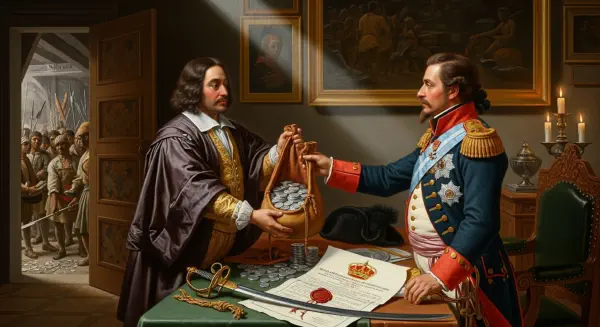
The Loyalty Trade—the sale of offices, titles, and privileges that had bound creoles to the Crown for centuries—began to fail under the weight of Bourbon centralization.
What the Crown did:
- Reserved the highest offices (viceroy, archbishop, captain general) for peninsulares (Spain-born Spaniards)
- Replaced experienced creole officials with inexperienced Spanish appointees
- Increased taxes on trade, mining, and agriculture—hurting creole profits
How creoles interpreted these actions:
- As an insult: they were being treated as second-class citizens in their own homeland
- As a betrayal: they had funded the empire with their taxes and their blood
- As a theft: the Crown was taking their money and giving them nothing in return
Historian Natalia Sobrevilla Perea notes that the Bourbon Reforms "brought to the fore the contradictions within the Hispanic monarchy and gave rise to a sense of proto-nationalism" among creoles. By 1800, many creoles no longer thought of themselves as "Spaniards who happened to live in America." They thought of themselves as Americans.
👑 The Decapitation: Napoleon and the Missing King#
On May 2, 1808, Napoleon's armies marched into Madrid. Within days, King Charles IV and his son Ferdinand VII had been forced to abdicate. Napoleon placed his own brother, Joseph Bonaparte, on the Spanish throne.
The Spanish people refused to accept a French puppet. They created juntas (local councils) to govern in the name of the imprisoned Ferdinand. Spain dissolved into a brutal guerrilla war against the French—the Peninsular War (1808–1814).
For the American colonies, the crisis was existential. The king was gone. Who ruled?
Spanish authorities in America insisted: We do. In the king's name. Creole elites responded: Then we will form our own juntas. Also in the king's name.
The legitimacy of Spanish rule had been decapitated. Napoleon had removed the head of the empire. The body—the Americas—began to move on its own.
When Napoleon invaded Portugal in 1807, the Portuguese royal family fled to Brazil. By 1815, Rio de Janeiro became the capital of the Portuguese empire. Spanish Americans watched this and asked: If the Portuguese can do it, why can't we?
⚔️ The Wars of Independence (1809–1826): A Continent in Flames#
The wars that followed were not clean revolutions. They were brutal, complex civil wars that pitted creole against creole, royalist against patriot, and class against class.
Key phases of the wars:
| Phase | Years | Key Events |
|---|---|---|
| 1. Juntas and backlash | 1808–1814 | Juntas formed across America; royalist counter-offensives; brutal violence |
| 2. Restoration and reconquest | 1814–1820 | Ferdinand VII returns; sends armies to reconquer colonies; war intensifies |
| 3. Final independence | 1820–1826 | Spanish army mutinies; creole armies win decisive victories |
These were not "natives versus Spaniards." In many regions, royalist forces were majority creole and Indigenous. The wars pitted creole against creole, family against family. In Venezuela, Bolívar's "War to the Death" (1813) ordered the execution of all peninsulares—and any creoles who fought for Spain.
🦁 The Liberators: Bolívar, San Martín, and Sucre#
Two names dominate the story of South American independence: Simón Bolívar and José de San Martín. But they were not alone.
Simón Bolívar (1783–1830) A Venezuelan creole, Bolívar lost his wife, his fortune, and his homeland before finally defeating the Spanish in a series of brilliant campaigns. By 1825, he had liberated Venezuela, Colombia, Ecuador, Peru, and Bolivia (named after him). He dreamed of a united Spanish America—a single nation from Mexico to Argentina. That dream died with him.
José de San Martín (1778–1850) An Argentine creole who had fought against Napoleon in Spain, San Martín led an epic march across the Andes (1817), liberated Chile, and captured Lima, the royalist capital. He handed command to Bolívar not out of weakness, but out of a belief in unity.
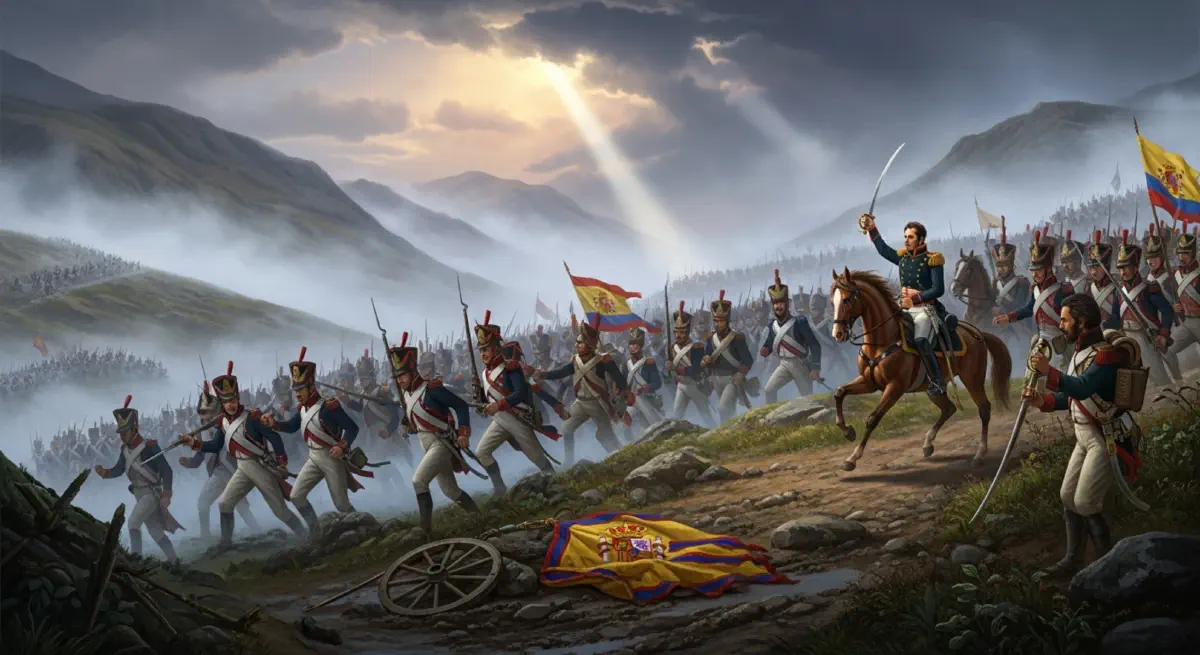
Antonio José de Sucre (1795–1830) Bolívar's most brilliant general, Sucre defeated the last major Spanish army at the Battle of Ayacucho (December 9, 1824). The victory effectively ended Spanish rule in South America.

The Battle of Ayacucho, December 9, 1824
- Patriot forces commanded by Sucre: ~5,800 men
- Royalist forces commanded by Viceroy José de la Serna: ~9,000 men
In less than two hours, the patriot army destroyed the royalists. They took the viceroy himself prisoner. It was the war's final decisive battle.
When news reached Spain, the government knew: the American empire was gone.
💀 The Aftermath: A Hollow Crown#
Did Spain try to fight back? Yes.
In 1815, Ferdinand VII—restored to the throne after Napoleon's defeat—sent 30,000 Spanish soldiers across the Atlantic to reconquer the colonies. It was the largest expeditionary force Spain had ever assembled.
By 1820, most of those soldiers were dead—from disease, from combat, from desertion. And in Spain itself, a military mutiny forced Ferdinand to accept the liberal Constitution of 1812 (which he had rejected). The mutineers refused to fight to restore an absolute monarchy in America.
The great powers of Europe—Austria, Russia, Prussia, Britain—reorganized the continent after Napoleon's defeat. They confirmed Ferdinand VII's restoration. But they provided no help in reconquering America. Britain, in fact, actively promoted Latin American independence to open new markets for its industrial goods.
By 1826, the Spanish flag flew only over Cuba, Puerto Rico, and the Philippines—the last fragments of a three-hundred-year empire.
📉 Why the Machine Failed: A Systems Analysis#
The collapse of the Spanish Empire was not a single event but a cascade of system failures. Each gear broke in sequence.
The Silver Engine (Article 2) broke first. Potosí's production collapsed starting in 1796—the tailings ran out, mercury supplies were cut off by war, and drought and famine ravaged the region. The Spanish treasury, which had depended on American silver for centuries, had nothing to fall back on.
The Loyalty Trade (Article 7) broke second. Bourbon centralization drove creole elites—the empire's most powerful allies—into opposition. By 1810, many creoles calculated that independence would serve their interests better than continued Spanish rule.
The Legal Labyrinth (Article 1) broke third. The elaborate constitutional system that had held the empire together for centuries required a legitimate monarch at its head. Napoleon removed that monarch. When Ferdinand returned, he tried to rule as an absolute king—rejecting the liberal compromise that had made the system work. The machinery seized. The empire froze.
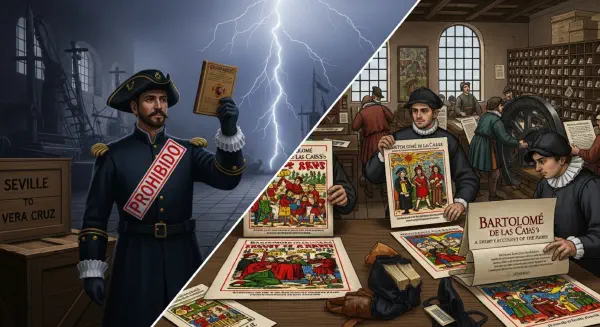
The Information Filter (Article 6) broke last. Spain's enemies had amplified its atrocities for centuries. But after 1808, even Spanish liberals—fighting against the absolutist Ferdinand—joined in condemning the empire. The Black Legend merged with liberalism, republicanism, and nationalism. The empire had no defenders left.
graph TD
A[Silver collapse 1796] --> D[Crown revenue falls]
B[Creole alienation 1780s–1800s] --> E[Loyalty trade fails]
C[Napoleon invasion 1808] --> F[Monarchy decapitated]
D --> G[No resources for reconquest]
E --> H[Creoles join independence movements]
F --> I[No legitimate authority]
G --> J[Empire collapses 1810–1826]
H --> J
I --> J
🌱 Path Dependence: The Empire's Ghost#
The disappearance of the Spanish Empire did not mean the disappearance of its institutions.
The new nations of Latin America inherited:
- The legal system: The Laws of the Indies remained the basis of law in many places for decades.
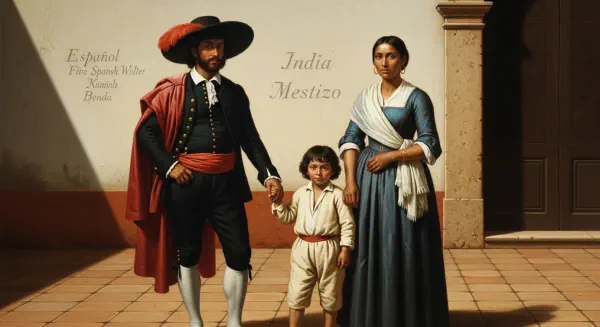
- The caste hierarchy: Racial classifications persisted, even without legal force.
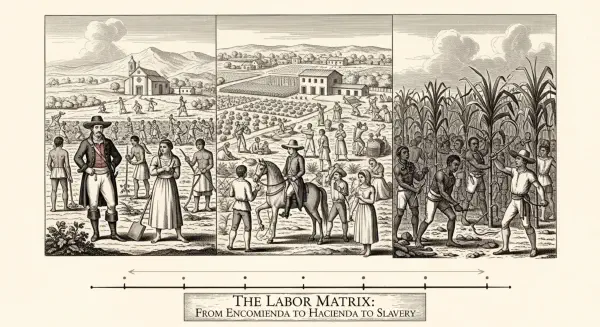
- The hacienda system: A handful of families continued to control most of the land.
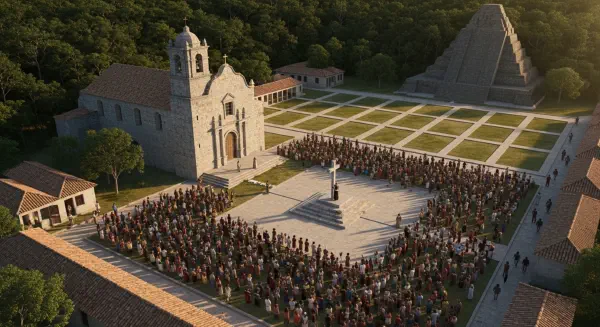
- The Catholic Church: It remained the dominant social and political institution.
- The extractive economy: Silver, sugar, coffee, and guano replaced each other as export commodities—but the pattern of dependency on foreign markets remained.
In 1825, Bolívar famously said: "He who serves a revolution plows the sea." He meant that building stable nations after independence was harder than winning independence itself. The new Latin American republics struggled for decades with civil wars, caudillo dictatorships, and economic instability. The empire's collapse had created a vacuum. And nature—human and political—abhors a vacuum.
💎 Endnote: The Machine You Cannot Turn Off#
The Spanish Empire was not destroyed by its enemies. It was destroyed by the contradictions within its own systems: a silver economy that enriched rivals, not itself; a loyalty trade that alienated its most loyal subjects; a legal labyrinth that could not survive the absence of a king; and an information filter that lost the war of reputation.
When Napoleon removed the crown, the machine kept turning for a while. But each gear was already broken. The whole thing simply stopped.
Yet the machine was never fully shut down. Its parts—the laws, the hierarchies, the habits of mind—were salvaged and rebuilt into new structures. The republics of Latin America are, in many ways, the Spanish Empire's final form. Not a single empire, but a dozen pieces—all still following the old logic.
The cogs keep turning. They just turn in different places now.
Next in the Series: Turn Nine: The Ghost in the Machine – Colonialism's Long Shadow Today
Further Reading:
- Primary Source: Simón Bolívar, Cartagena Manifesto (1812) and Jamaica Letter (1815)
- Overview: Wikipedia. Spanish American wars of independence
- Bourbon Reforms: Wikipedia. Bourbon Reforms
- Peninsular War: Wikipedia. Peninsular War
- Key Battle: Wikipedia. Battle of Ayacucho
- Legacy: Wikipedia. History of Latin America (19th century)