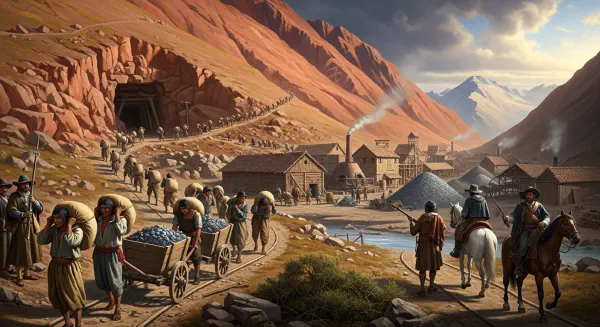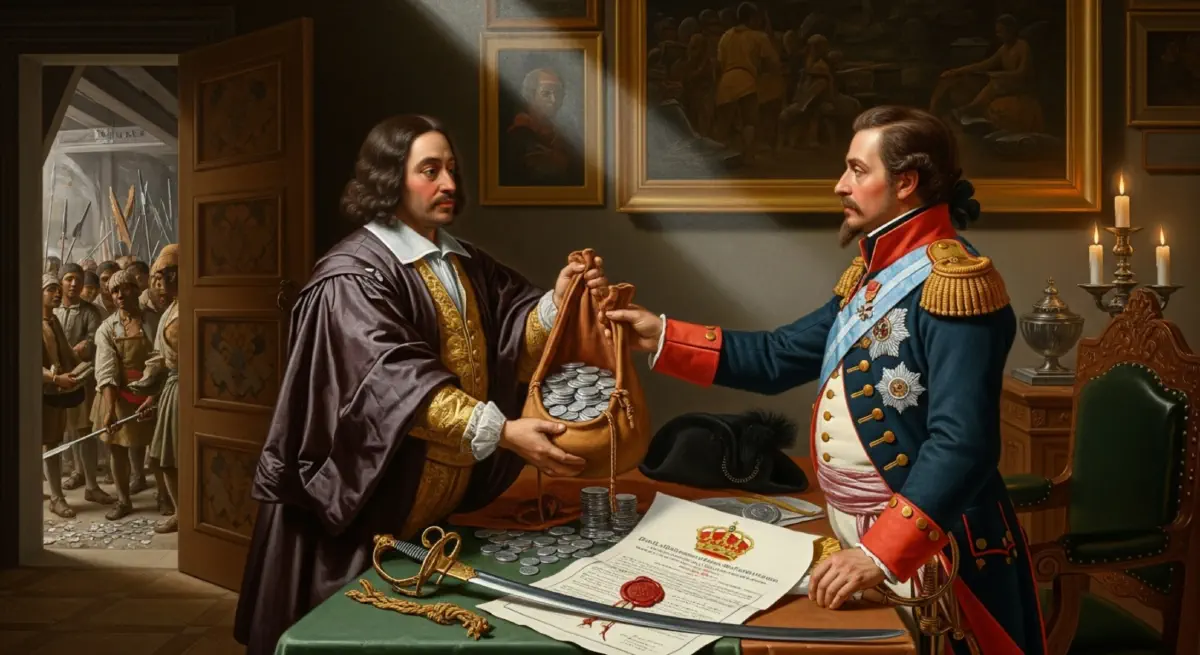
The conquistadors were gone. The rebellions had been crushed. Now came the hard part: holding onto an empire the size of a continent with an army too small to guard every town and a treasury too empty to pay for more.
The Spanish solution was as cynical as it was brilliant. Instead of fighting every local strongman, Spain bought them. Titles, offices, tax exemptions, trade privileges, military ranks, even coats of arms—all were for sale to the right buyer. The empire became a vast loyalty market, where the currency was royal favor and the price was political submission.
This is the story of the Loyalty Trade: how Spain turned its most dangerous enemies into its most reliable allies.
🎩 The Sale of Offices: Everything Had a Price#
In Spain's American colonies, almost every government position could be purchased. From lowly notaries to powerful judgeships, from treasury officials to military commands—the Crown sold offices to raise revenue and reward loyal subjects.
The system was called venta de oficios (sale of offices), and it operated on a staggering scale. By the seventeenth century, an estimated 20 to 25 percent of all colonial administrative posts were filled through purchase rather than merit.
Sample prices (late 1500s–1600s, in pesos):
| Office | Typical Price | Modern Equivalent (approx.) |
|---|---|---|
| Notary public (small town) | 500–1,000 | $50,000–100,000 |
| Regidor (town council member) | 1,000–3,000 | $100,000–300,000 |
| Treasurer (provincial) | 5,000–10,000 | $500,000–1 million |
| Corregidor (district governor) | 10,000–25,000 | $1–2.5 million |
| Alcalde mayor (senior magistrate) | 15,000–40,000 | $1.5–4 million |
| Judge of the Royal Audiencia (high court) | 30,000–60,000 | $3–6 million |
Why would the Crown sell its own authority? Because the treasury was perpetually empty. Spain fought wars continuously across Europe and the Mediterranean. Selling offices turned future officials into investors in the imperial project—they paid upfront, then recouped their investment (and more) through fees and exploitation during their terms.
The system had predictable consequences. Purchased officials were generally less qualified, more corrupt, and more interested in recouping their investment than in governing justly. As one Spanish official complained in 1635, "These offices are sold to the highest bidder, and those who buy them are often merchants or their agents who know nothing of justice and care only for profit."
But the Crown tolerated—even encouraged—this corruption. Why? Because every peso paid for an office was a peso that did not need to be raised through taxes on the powerful. It was a way of taxing the rich indirectly, while binding them to the empire through self-interest.
👑 Indigenous Nobles: Co-opting the Conquered#
Perhaps the most ingenious aspect of the Loyalty Trade was its application to Indigenous elites.
The Spanish did not eliminate existing native power structures. They captured them. Indigenous nobles—the caciques (chiefs) in the Caribbean and Mexico, the kurakas in the Andes—were recognized by Spanish law as principales (principals), a noble class separate from commoners.
What Indigenous nobles received:
- Tax exemptions from the head tax (tribute) that common Indigenous people paid
- Right to bear arms and ride horses (privileges denied to most natives)
- Spanish-style coats of arms (over 300 were granted in the 1500s alone)
- Use of the honorific "Don" before their names
- Exemption from forced labor drafts (mita/repartimiento)
What the Crown received in return:
- Loyalty: Indigenous nobles became the local agents of Spanish rule, collecting tribute, organizing labor drafts, and suppressing rebellions
- Legitimacy: By ruling through existing authorities, Spain could claim continuity rather than conquest
- Intelligence: Indigenous nobles spied on potential revolts and reported them to colonial authorities
Co-opting Indigenous elites also preserved their power for future rebellions. In the 1780 Túpac Amaru rebellion in Peru, the rebel leader José Gabriel Condorcanqui (Túpac Amaru II) was himself a kuraka—a descendant of Inca royalty who had been educated in a Jesuit school and wielded the very authority Spain had granted. The Loyalty Trade created its own enemies.
By the numbers: In the Viceroyalty of Peru alone, over 500 Indigenous noble families received official recognition in the sixteenth and seventeenth centuries. In Mexico, thousands of cacique lineages were incorporated into the colonial system. Some families still claim these titles today.
💰 The Comprador Class: Creoles and the Price of Power#
The largest group recruited into the Loyalty Trade was neither Spanish-born officials nor Indigenous nobles, but the criollos—people of pure Spanish descent born in the Americas. By 1700, criollos outnumbered peninsulares (Spain-born Spaniards) by a ratio of perhaps 10 to 1 in most colonies. They were rich, educated, ambitious—and locked out of the highest positions, which the Crown reserved for peninsulares.
To prevent criollo resentment from turning into rebellion, the Crown sold them lower and mid-level offices in staggering numbers:
- By 1687, over 70 percent of regidor (town council) positions in the Indies were filled by purchase
- In the Royal Audiencia of Mexico, between 1687 and 1750, at least 60 percent of magistrates were criollos (many had purchased their positions)
- In the Audiencia of Lima, half of the judges were native-born by the mid-1600s
This was not generosity; it was containment. The Crown calculated that a criollo with a comfortable post and a steady income was less likely to lead a revolution. For two centuries, the calculation worked.
🔄 The Feedback Loop of Sale#
The sale of offices created a self-reinforcing cycle that defined colonial governance.
graph TD
A[Empty royal treasury] --> B[Crown sells offices]
B --> C[New officials extract wealth from colonies]
C --> D[Complaints of corruption reach Spain]
D --> E[Crown launches investigations]
E --> F[Officials bribe investigators]
F --> G[No real change]
G --> A
Every attempt to reform the system failed because the system's beneficiaries were too powerful to dislodge. The sale of offices turned colonial administration into a self-perpetuating oligarchy of wealth, not merit.
The most lucrative purchases were governorships. In the early 1600s, the governorship of Caracas sold for 15,000 ducats (about $2 million today). In return, the governor could expect to extract 60,000–80,000 ducats over his term—a return of 300–400 percent, provided he survived disease and political rivals.
🎖️ Noble Titles for Sale: The Marquis's Price#
The highest form of loyalty purchase was the noble title. Between the 1500s and 1800s, the Spanish Crown granted over 1,500 noble titles in the Americas, most of them after 1700 when the royal treasury grew desperate.
Who bought titles:
- Sugar planters in Cuba (fearing slave revolts, eager for status)
- Silver miners in Mexico and Peru (converting mineral wealth into social standing)
- Merchant-bankers in Lima and Mexico City (seeking entry into high society)
- Military officers (rewarded for loyal service with a title instead of a pension)
What a title cost:
| Title | Average Price (pesos) | Modern Equivalent |
|---|---|---|
| Simple knighthood (hábito) | 5,000–10,000 | $500,000–1 million |
| Barony | 20,000–40,000 | $2–4 million |
| County | 50,000–100,000 | $5–10 million |
| Marquisate | 100,000–300,000 | $10–30 million |
The conde de Regla, Pedro Romero de Terreros, a Spanish-born miner in Mexico, purchased his county title in 1768 for 100,000 pesos. His family went on to become one of the richest in New Spain, financing both the Crown and the independence movement. Titles bought loyalty—but not forever.
⚔️ Military Commissions: The Ultimate Loyalty Test#
The military was the Crown's last line of defense against rebellion. But the army was expensive. So the Crown sold officer commissions to wealthy criollos, starting in earnest in the late 1600s.
By the 1700s, a captaincy in a colonial militia cost between 3,000 and 8,000 pesos. A colonelcy could run 20,000 to 50,000 pesos. In return, the purchaser received a uniform, a title, social prestige—and the obligation to suppress any uprising among the lower classes.
This system turned America's wealthiest men into the empire's first responders against revolt. When the Túpac Amaru rebellion threatened Spanish rule in Peru in 1780, it was criollo-led militias, not Spanish regulars, who did much of the fighting against the insurgents. The Loyalty Trade had armed its own clients to protect the empire.
📉 When the Trade Backfired#
The Loyalty Trade was not a permanent solution. It contained three fatal flaws:
1. Resentment of the Excluded The highest offices—viceroy, archbishop, captain general, president of the Audiencia—remained reserved for peninsulares. Criollos who had purchased every other office still hit a glass ceiling. By the late 1700s, many educated criollos concluded that only independence would give them what purchase could not.
2. Economic Drain Money spent on offices and titles was money not invested in productive enterprises. Spanish America developed a rent-seeking elite more interested in status than in industry. When independence came, these elites had no experience building factories or banks—only experience extracting wealth from others.
3. Corruption as Governance The sale of offices normalized bribery, fraud, and abuse. Generations of colonial officials viewed their posts as investments to be recouped, not responsibilities to be honored. When the imperial system collapsed, these same officials simply transferred their loyalties to new masters—often with no change in behavior.
💎 Endnote: The Long Shadow of the Trade#
The Loyalty Trade kept the Spanish Empire afloat for 300 years. It transformed potential rebels into pillars of the system. It gave Indigenous nobles a stake in their own subjugation. It turned criollo wealth into imperial loyalty.
But it also poisoned the well. After independence, Latin America inherited a political culture where public office was treated as private property, where corruption was the norm rather than the exception, and where elites expected privileges rather than responsibilities.
When Bolívar wrote that "he who serves a revolution plows the sea," he might have been describing the Loyalty Trade's legacy: an elite so accustomed to buying power that they could not imagine governing without selling it.
The Spanish Empire is gone. But the habit of trading loyalty for favors—that particular gear—keeps turning in places its inventors never intended.
Next in the Series: Turn Eight: The Fall – Systems Collapse and Path Dependence
Further Reading:
- Primary Source: Archivo General de Indias, Venta de oficios records (digitized collections)
- Overview: Wikipedia. Venta de cargos (Sale of public offices)
- Indigenous Nobility: Wikipedia. Cacique, Kuraka
- Noble Titles: "Títulos nobiliarios americanos" (Spanish Nobility Association)
- Legacy: "Corruption in Latin America" (various academic sources)