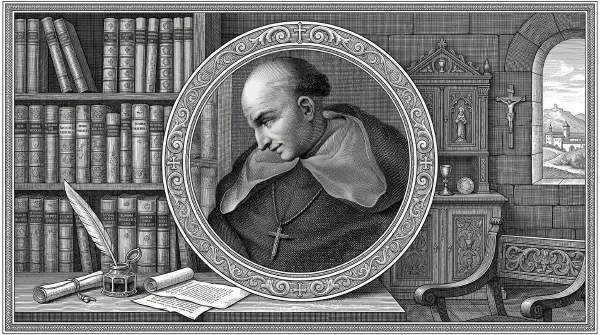

In 1552, a short, angry book by a Spanish Dominican friar became the most explosive publication of its age. A Short Account of the Destruction of the Indies by Bartolomé de las Casas described, in horrific detail, the slaughter, torture, and enslavement of Indigenous peoples by Spanish colonists. It was meant to shock the conscience of King Charles V—and it did. The New Laws of 1542 were its direct result.
But Las Casas could not control where his words traveled. Within decades, his account was being reprinted, translated, and illustrated in Protestant England and the Dutch Republic—not to save Indian souls, but to destroy Spain's reputation. The weapon Las Casas had forged against conquistadors was now being turned against his own country. This is the story of the Information Filter: a machine designed to control the flow of ideas across the Spanish Empire, which failed catastrophically in the most important propaganda war of the sixteenth century.
📖 The Weapon Spain Gave Its Enemies#
The Black Legend—la leyenda negra—is the enduring image of Spain as uniquely cruel, fanatical, and bloodthirsty. Its roots lie in the sixteenth century, when Spain's European rivals (England, the Dutch Republic, and Protestant Germany) waged a coordinated propaganda war designed to demonize the Spanish Empire, minimize its discoveries, and counter its global influence.
Here is the irony: the raw material for this propaganda came from Spain itself.
Las Casas, a former encomendero who renounced his land and slaves after witnessing atrocities in Hispaniola, wrote his Short Account as an internal reform document. He believed the Crown would act if it knew the truth. And for a time, it did. The New Laws of 1542, which severely restricted the encomienda system, were a direct result of his lobbying efforts.
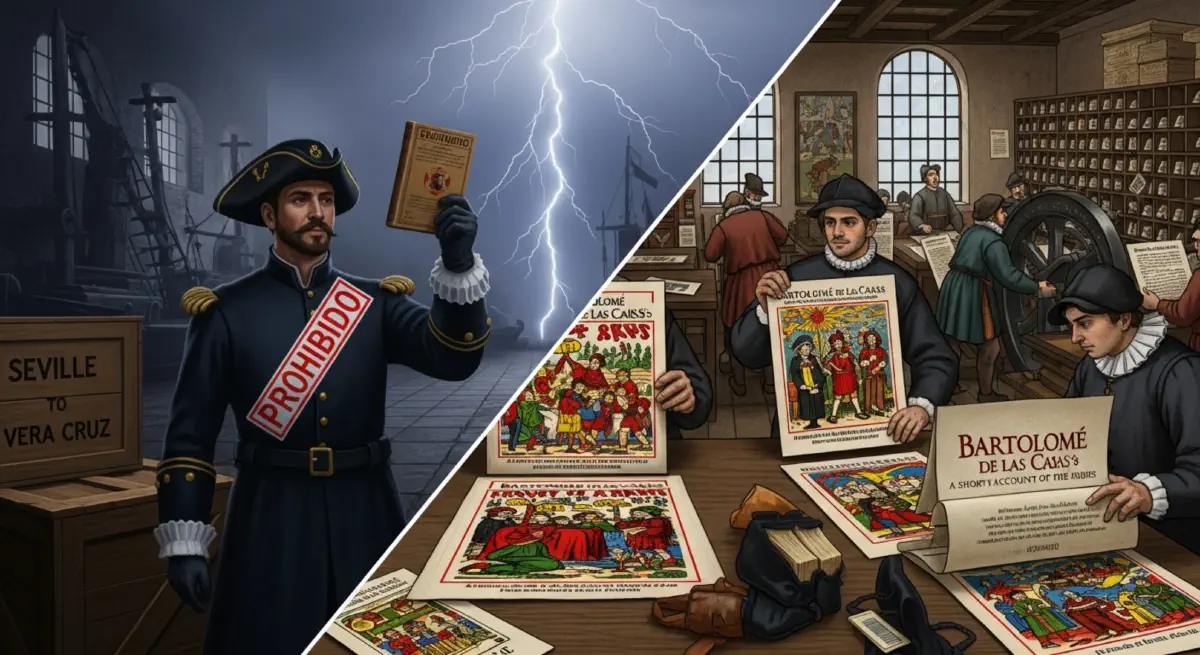
But Las Casas could not foresee that his work would be translated into Dutch, English, French, and German within decades. During the Eighty Years' War (1568–1648), when the Dutch were fighting for independence from Spain, Dutch and English propagandists seized on Las Casas' accounts as proof of Spanish monstrosity. They added lurid woodcut illustrations of Spaniards feeding babies to dogs and cutting off hands—images that became seared into European memory. The "Short Account" became the "Bloody Account."
Historian Harm den Boer argues that the Black Legend did not originate in England, but in the Netherlands. "It formed part of an authentic psychological war against the Spanish Monarchy," he writes, crafted by Dutch propagandists during the Eighty Years' War. English propagandists later adopted and amplified these tropes during the Anglo-Spanish War (1585–1604).
🛡️ The Containment Machine#
Spain would need a defense against the Black Legend. It built one: a coordinated censorship and information-control apparatus spanning three continents.
Printing Press Restrictions (1502–1558) The Spanish Crown had always been wary of the printing press. A 1502 pragmatica by the Catholic Monarchs established prior censorship of all printed materials, with licenses required from both state and church authorities. This system was exported to the Americas.
In New Spain, the arrival of the first printing press was carefully managed. Viceroy Antonio de Mendoza made an exclusive contract with Seville-based printer Juan Cromberger to operate the only press in the colony. A royal cédula of 1542 formalized this monopoly, granting the Cromberger family exclusive rights to run the press for ten years—and a monopoly on exporting books to the colony, which they could sell at a 100 percent markup. Juan Pablos, a printer from Brescia sent by Cromberger, could only print materials that had received licenses from both ecclesiastical and civil authorities.
This was censorship before printing—what scholars call "preventive censorship." It put the Crown, not just the Inquisition, in control of what ideas entered the colonial bloodstream. The press was not eliminated; it was domesticated, turned into a tool of governance rather than a threat to it.
Inquisition Edicts (1551–1820) The Inquisition maintained Indices of Prohibited Books beginning in 1551, periodically updated through public edicts posted on church doors and town squares. A Mexican Inquisition edict from 1809—the same year Mexico began its march toward independence—banned 55 works. The list included standard Protestant texts, but also histories that were "anti-monarchical" and books about the French Revolution, reflecting the Crown's fear that revolutionary ideas would cross the Atlantic.
More revealingly, the edict also banned theatrical plays deemed seditious. One banned play, "El Negro Sensible" ("The Sensible Black Man"), highlighted the evils of slavery. Its main character, an enslaved man named Catúl, argued that the souls of Black men and white men were equal. The Inquisition understood that such ideas could spark rebellion.
Customs Inspections (1556–1800s) Every ship entering Spanish American ports was subject to a visita—a customs inspection of all cargo, including books. A royal decree of 1556 ordered treasury officials to "exercise extreme care" in checking incoming vessels against sealed registers. "Profane books" (non-religious works) were repeatedly prohibited.
In the Philippines, censorship was even stricter. Manila customs officials impounded not just political texts but even mathematical books and dictionaries until someone "competent" could review them. The Catholic Index Librorum Prohibitorum, first compiled in 1557, was used by the Philippines Comision de Censura to determine what could be printed or imported. Even Daniel Defoe's Robinson Crusoe was deemed suspect.
✍️ The Printed Word as Loyalist Tool#
Yet censorship alone is not control. The Spanish Empire also used the printing press as a weapon of persuasion.
The first book printed in the Americas (1539) was a catechism—no surprise. But over the following centuries, colonial presses produced thousands of religious texts, language primers for Indigenous languages, and administrative documents. These were not neutral texts; they were instruments of integration, designed to forge Catholic Spanish subjects out of diverse populations.
Studies of preventive censorship in sixteenth-century Mexico show that while the bureaucracy scrutinized manuscripts before publication, "published authors in Mexico enjoyed significant influence over the censorship, printing, and economic potential of their intellectual fruits". Colonial elites learned to work with the system, not against it. The printing press, so feared in Europe, was repurposed in the Americas as a technology of loyalty.
In the Philippines, between 1593 and 1648—the period when Spanish control of the archipelago was most contested—eighty-one publications appeared, primarily religious texts, language books, and historical accounts. This was not free expression; it was the selective deployment of print to solidify Imperial rule in a distant periphery.
📭 The Machine's Fatal Leaks#
For all its elaborate machinery, the Information Filter failed at its most crucial task: controlling Spain's reputation abroad.
The Black Legend succeeded because it exploited a fundamental asymmetry. Spain's enemies—England, the Dutch Republic—had nothing to lose by exaggerating atrocities and nothing to gain by pointing out that other empires (including their own) committed similar acts. Spain, meanwhile, had only its own record to defend. And that record, however nuanced, included real atrocities.
As Spanish historian Julián Juderías wrote in 1914 (coining the term "Black Legend"), the propaganda machine of Spain's rivals had created "an anti-Spanish and anti-Catholic" historiographical current that persisted into the modern era. The Black Legend was not pure fiction; it was selective amplification of Spanish self-criticism, stripped of context and comparison.
⚪ The White Legend: A Counter-Machine#
In the twentieth century, Spanish nationalism and Francoist historiography constructed a counter-narrative: the "White Legend" or "Rosy Legend." This approach presented an idealized image of Spanish colonial practices, emphasizing legal protections for Indigenous peoples and racial mixing.
But as critics point out, the White Legend focuses on Spanish law codes while ignoring "the copious documentary evidence that they were widely ignored". The encomienda, for all its legal protections for Indigenous people, "was largely a bad deal for indigenous peoples and marred with abuses".
Both the Black Legend and the White Legend are simplifications. The Spanish Empire was not uniquely evil, nor was it uniquely benevolent. It was a complex system of governance and extraction that produced both the Valladolid debates (among the first calls for universal human rights) and the mita mines (among the most brutal forced labor systems in history).
💎 Endnote: The Echoes of a Failed Filter#
The Information Filter was the most ambitious information-control system of its age. It regulated presses, banned books, inspected cargo, and published edicts. It shaped what colonists read, what priests preached, and what officials thought.
But the filter could not control what Europe read. And Europe read Las Casas.
The Black Legend became the foundational narrative of Spanish colonialism for much of the English-speaking world—a narrative that still shapes popular understanding today. It is not entirely wrong, but it is incomplete. It leaves out the complex debates within Spain itself, the legal systems that (however imperfectly) protected Indigenous rights, and the simple fact that every empire of the age (English, Dutch, French, Portuguese) was built on violence and forced labor.
The Information Filter's greatest failure was not internal but external: the empire could constrain what its own subjects read, but it could never win the propaganda war beyond its borders. In the battle for global reputation, Spain lost. And it has never fully recovered.
Next in the Series: Turn Seven: The Loyalty Trade – How the Empire Bought Off Elites
Further Reading:
- Primary Source: Bartolomé de las Casas, A Short Account of the Destruction of the Indies (1542/1552)
- Overview: Wikipedia. Black Legend
- Counter-Narrative: Wikipedia. White Legend
- Print Culture: Cambridge University Press, A History of Mexican Literature (chapter on early print culture)
- Philippines: Ambeth Ocampo, "Censorship in the Philippines" (Philippine Daily Inquirer, 2022)