Imagine an institution that registered your birth, solemnized your marriage, received your confession, educated your children, judged your heresies, and buried your body. An institution that owned more land than any other, lent money at interest, and answered ultimately to a king three thousand miles away. An institution with its own courts, its own police, and its own jails.
That institution was not the state. It was the Church.
In colonial Latin America, the Catholic Church was not merely a powerful institution. It was the single most important institution, period. "Everyone who lived in the region was nominally a member of the Church," writes historian John F. Schwaller. "The Church controlled all aspects of life from birth, through marriage, until death."
⚙️ The God Machine: How the King Became the Pope's Boss#
The foundation of the Church's power in the Americas was a unique arrangement: the Patronato Real (Royal Patronage). Through a series of papal grants in the early 1500s, the Spanish Crown received unprecedented authority over Church affairs in its overseas territories—in exchange for funding missionary activities.
What did this mean in practice?
The Spanish king—not the Pope—appointed bishops, archbishops, cathedral chapters, and even local parish priests in the Americas. The king controlled church revenues, approved the construction of churches and monasteries, and oversaw missionary programs. This was a power no other Catholic monarch in Europe possessed.
🏠 The Reducción: When Salvation = Relocation#
The most powerful tool of mass conversion was not the sermon—it was forced resettlement.
Across the Spanish Americas, missionaries gathered dispersed Indigenous populations into planned villages called reducciones (or congregaciones). The stated goal was noble: to concentrate people for efficient evangelization and protection from exploitation. The actual effect was social engineering on a massive scale.
By the early 1600s, in the Viceroyalty of Peru alone, the Spanish had established perhaps as many as one thousand new Indigenous villages containing at least 1.5 million residents.
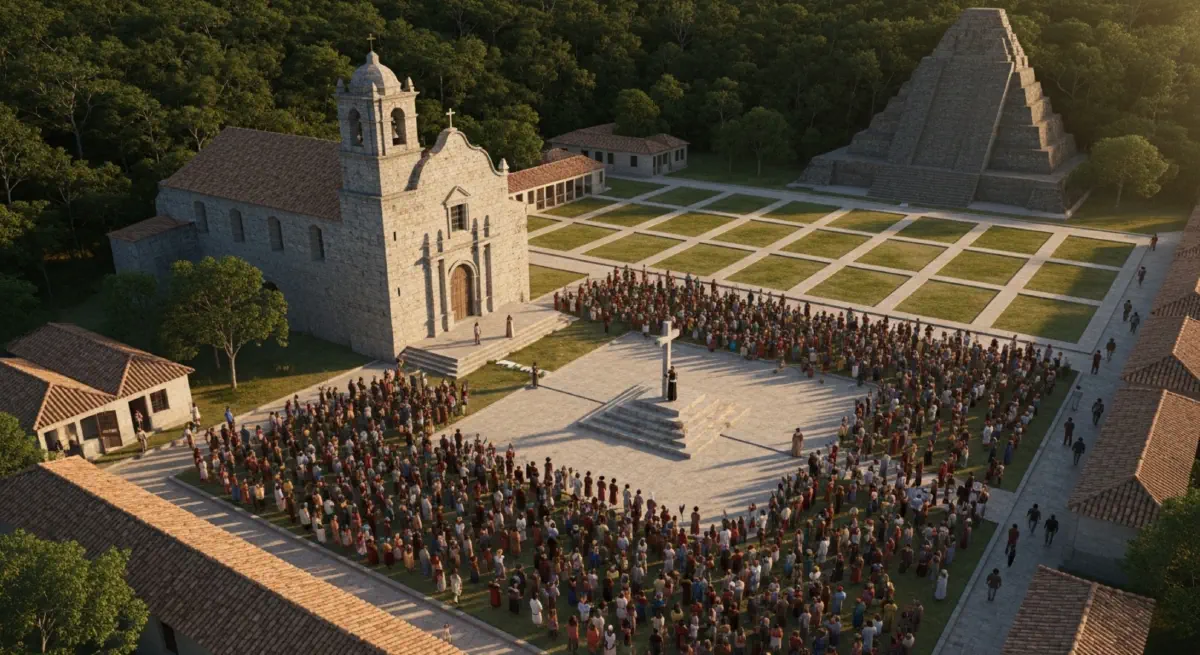
Each reducción followed a rigid Spanish grid plan: a central plaza, a church on one side, the cabildo (town council) on another, and straight streets radiating outward. Indigenous residents were required to attend daily Mass, learn the catechism, and adopt European dress and customs. The goal was to reshape not just belief, but everyday life—from sleeping patterns to food preparation to sexual morality.
The Franciscans, who arrived in Mexico as early as 1524, called their mission the "Spiritual Conquest of Mexico." They built massive open-air chapels called capillas abiertas that could hold thousands of Indigenous converts at once. These functioned as "theaters of conversion," where dramatic biblical scenes were performed alongside elaborate processions and the celebration of European holy days.
Their methods, however, were not uniform. The Franciscans often took a heavy-handed approach, destroying Indigenous temples and sacred objects, while the Jesuits, who arrived later, engaged in what historian Robert H. Jackson calls a "comparatively 'kinder and gentler' form of colonization"—learning local languages, adapting to Indigenous customs, and establishing schools for native elites.
⚖️ The Two Swords: Secular vs. Regular Clergy#
The Church in the Americas was not monolithic. It was a battlefield of competing jurisdictions.
On one side stood the secular (diocesan) clergy—parish priests, bishops, and archbishops who answered, through the Patronato Real, to the King of Spain. On the other stood the regular clergy—members of religious orders (Franciscans, Dominicans, Augustinians, Jesuits) who answered to their own internal hierarchies and ultimately to the Pope.
| Order | Approach to Indigenous Peoples | Key Strength |
|---|---|---|
| Franciscans | Heavy-handed, disruptive social policies, mass baptisms, destruction of sacred sites | Reached huge populations quickly |
| Dominicans | Intellectual emphasis, theological debate, produced scholarly treatises on natural rights | Defenders of Indigenous humanity (Las Casas) |
| Augustinians | Less documented, followed similar patterns to Franciscans | Church builders, architects |
| Jesuits | "Kinder and gentler," learned local languages, protected Indigenous communities from colonial exploitation | Schools, long-term loyalty of native elites |
This division was a feature, not a bug. The Crown could play one faction against the other, ensuring that no single religious authority became too powerful. Jurisdictional squabbles between bishops and friars were constant—and both parties often appealed to the king to resolve them.
🗡️ The Inquisition in the Americas: Spectacle, Not Slaughter#
When the Spanish Inquisition crossed the Atlantic, it arrived in a new form.
Three permanent tribunals were established in the Americas: Mexico City and Lima in 1570, and Cartagena (modern-day Colombia) in 1610. There was also an Inquisition tribunal in the Philippines, established even later. But the colonial Inquisition operated very differently from its notorious European counterpart.
The key distinction: The Inquisition did not generally prosecute Indigenous people.
The reasoning was theological. The Inquisition was designed to police heretics—people who had accepted Christianity and then knowingly rejected it. Early Church authorities debated whether Indigenous peoples could even be considered heretics, since they had never truly accepted the faith in the first place. Conveniently for the Crown, this meant that the vast majority of the colonial population was exempt from the Inquisition's most fearsome powers.
So who did the Inquisition pursue?
- Crypto-Jews (converted Jews secretly practicing Judaism)
- Protestants (rare, but present)
- Blasphemers (those who cursed God or the Virgin Mary—a common charge against drunkards and slaves)
- Bigamists (a surprisingly common crime in a mobile colonial society)
- Suspected witches and sorcerers (often Indigenous or African practitioners of folk healing)
Statistics from the Mexican Inquisition illustrate the relative mildness: although records are incomplete, one historian estimates that about 50 people were executed over the tribunal's 250-year existence (1571–1820), with 29 of those being "Judaizers" executed between 1571 and 1700.
By comparison, in Spain, thousands were executed. The American tribunals were less about death and more about public shaming, humiliation, and social control.
🏦 The Church as Landlord, Banker, and Tax Collector#
The Church's power was not just spiritual—it was economic.
Religious orders became the single largest landowners in the colonies, developing commercial agriculture on an enormous scale. The Jesuits, in particular, built vertically integrated economic empires: sheep production and weaving, grape cultivation and brandy production, even sugar plantations.
The Church also functioned as the colony's banker. Through the obra pía ("pious works"), the Church lent money at interest—technically forbidden by scripture, but widely practiced under various legal fictions—to merchants, miners, and landowners. The wealthy placed their fortunes in the Church's hands, earning spiritual credit and financial security.
Tithes (a 10% tax on agricultural production) were collected by Church officials and distributed to support the clergy, fund new church construction, and finance missionary expeditions. The Crown took a cut, of course, but the Church retained enough to make it one of the most powerful economic actors in the empire.
🔄 The Feedback Loop of Faith#
The Church's power over colonial life created a self-reinforcing cycle:
graph TD
A[Church legitimizes Crown via Patronato Real] --> B[Crown appoints bishops and controls revenues]
B --> C[Church becomes largest landowner]
C --> D[Church accumulates wealth and power]
D --> E[Church uses wealth to evangelize]
E --> F[More converts = more tithes = more wealth]
F --> A
Every element reinforced the others. More conversions meant more tithes, which meant more funding for missionaries, which meant more conversions. Crown appointments meant loyal bishops, who ensured that evangelization served royal as well as divine interests.
⚡ The Cracks in the Machine: Resistance and Syncretism#
But the conversion machine was never fully successful.
Indigenous peoples did not simply abandon their old beliefs. Instead, they syncretized—blending Catholic forms with Indigenous meanings. The Virgin Mary appeared on the site of the Aztec goddess Tonantzin, giving rise to the cult of Our Lady of Guadalupe (which the Church initially opposed and only later embraced). Andean peoples continued to worship huacas (sacred places and objects) while attending Mass. African slaves preserved their spiritual traditions beneath a thin veneer of Catholic observance, creating traditions like Santería in Cuba and Candomblé in Brazil.
The Church's attempt to impose a single, universal faith across the Americas instead produced thousands of local, hybrid beliefs. In trying to erase "idolatry," the clergy inadvertently created new forms of religious expression—forms that persist to this day. The conversion machine did not produce obedient clones. It produced creative survivors.
🔧 The Loose Bolts: Internal Tensions#
Even within the Church, the machine was not tightly assembled.
The secular clergy resented the power of the regular orders, and vice versa. Bishops fought with governors over jurisdiction. The Religious Orders competed with each other for the best "mission fields"—areas with the densest native populations. The Crown constantly worried about the Church's growing wealth and power, even as it relied on both.
And then there were the conscience-stricken few.
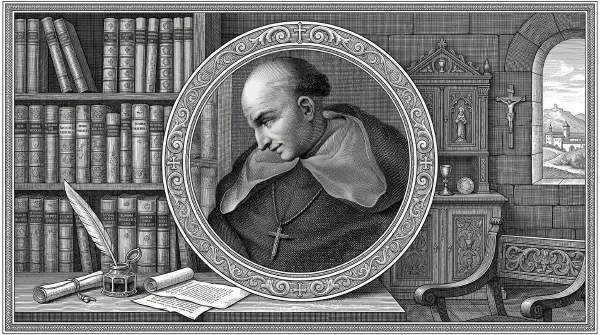
Bartolomé de las Casas, a Dominican friar who arrived in Hispaniola in 1502 as a layman, became the empire's most famous internal critic. After witnessing atrocities against the Indigenous Taíno people, he gave up his encomienda (a grant of forced Indigenous labor) in 1515 and spent the next 50 years fighting for Indigenous rights. His writings, particularly A Short Account of the Destruction of the Indies, painted such a devastating picture of Spanish cruelty that Spain's European enemies used them as propaganda for centuries. Even Las Casas was not pure—he initially advocated the importation of African slaves to "spare" Indigenous people, a position he later recanted. But his life demonstrates that the conversion machine could produce moral critics as well as obedient subjects.
💎 Endnote: The Machine's Ghost#
The Church's machinery of conversion and control was arguably the most sophisticated the world had ever seen. It combined legal authority (the Patronato Real), social engineering (the reducciones), spectacular performance (the open-air chapels and processions), economic power (land, credit, tithes), and selective terror (the Inquisition) into a seamless system of rule.
But like all machines, it produced outcomes its designers never intended: hybrid religions, resistant communities, and internal critics who would later fuel independence movements.
The conversion engine did not stop in 1820, when the Inquisition was formally abolished in the newly independent nations. It simply changed shape. The Catholic Church remains the largest landowner in many Latin American countries. Its bishops still weigh in on politics. Its holy days still mark the rhythm of life.
The gears keep turning.
Next in the Series: Turn Six: The Information Filter – Censorship, Propaganda, and the Black Legend
Further Reading:
- Primary Source: Bartolomé de las Casas, A Short Account of the Destruction of the Indies (1552)
- Overview: The Church in Colonial Latin America by John F. Schwaller
- Inquisition: Mexican Inquisition, Wikipedia
- Reducciones: "Indigenous Reducciones and Spanish Resettlement" by Tamar Herzog, Ler Historia (digital)
- Legacy: "Religion in Latin America and the Caribbean," The Latin American Diaries