Imagine a society where your legal rights, your tax rate, your marriage options, your career prospects, and even the clothes you could wear were determined by a single calculation: the fraction of Spanish blood in your veins.
This was not fiction. This was the sistema de castas—the caste system—of Spanish America. And it was, for its time, a marvel of bureaucratic engineering.
🧮 The Arithmetic of Purity#
At the top of the pyramid sat the peninsulares—Spaniards born in Spain. Below them, the criollos—people of pure Spanish descent born in the Americas. Below them, a dizzying array of mixed-race categories, each with its own label, its own rights, and its own social cost.
Here is the basic taxonomy, from "most Spanish" to "least":
| Caste Label | Composition | Social standing |
|---|---|---|
| Español | Both parents Spanish | Highest; full rights |
| Castizo | 3/4 Spanish, 1/4 Indigenous | High; can pass as Spanish |
| Mestizo | 1/2 Spanish, 1/2 Indigenous | Middle; limited rights |
| Cholo | 1/4 Spanish, 3/4 Indigenous | Low; often bound to land |
| Mulatto | 1/2 Spanish, 1/2 African | Low; restricted occupations |
| Zambo | 1/2 Indigenous, 1/2 African | Very low; often enslaved |
| Lobo | Mix of African and Indigenous | Bottom; considered "wild" |
| Indio | Pure Indigenous | Protected but subjugated |
| Negro | Pure African | Chattel slavery |
But the system was far more granular. Eighteenth-century casta paintings depict as many as sixteen distinct categories, each with absurdly specific names: tente en el aire, no te entiendo, torna atrás—terms that literally mock the people they label.

📐 Why So Many Labels? The Logic of Control#
Modern observers often see the casta system as mere racism. And it was. But it was also a functional tool of governance.
The system solved several problems for the empire:
1. Preventing Unity of the Oppressed A simple binary (white vs. non-white) would have united all non-Spaniards against the ruling class. By fracturing the non-Spanish population into dozens of tiny categories, each with slightly different rights, the empire prevented the emergence of a shared identity.
2. Creating Aspirational Loyalty A mestizo could, through wealth or royal favor, be reclassified as castizo. A castizo's children could become español. The ladder was steep, but it existed. This gave mixed-race elites a stake in the system.
3. Taxing and Tribute Collection Each caste paid different tribute rates. Indios paid a fixed head tax. Mestizos paid higher rates but had fewer obligations. Slaves paid nothing—they were property. The categories were fiscal tools.
Wealthy mixed-race individuals could purchase a gracias al sacar—a royal decree that legally changed their caste to español. The Crown set a high price, typically 1,000 to 2,000 pesos (several years' wages for a laborer). This turned racial passing into a revenue stream.
🎭 The Fluidity Within Rigidity#
Here is the paradox that confounds modern understanding: the casta system was simultaneously rigid (the categories existed in law) and fluid (people constantly moved between them).
Movement happened through:
- Marriage: A mestizo marrying an español produced castizo children—one step up.
- Wealth: A rich mulatto merchant could live as an español in all but legal record.
- Geography: Remote areas had looser enforcement. What mattered in Mexico City might be ignored in Chihuahua.
- Royal pardon: The gracias al sacar mentioned above, but also service to the Crown (military, administration) could grant upward mobility.
How rigid was it really?
| Aspect | Assessment |
|---|---|
| De jure (in law) | Very rigid. Laws specified who could wear silk, carry swords, attend universities, hold public office. |
| De facto (in practice) | Quite fluid. Courts accepted petitions for reclassification. Communities often ignored the finer distinctions. |
| For Africans and their descendants | Extremely rigid. The stain of African ancestry was almost impossible to erase, even after generations. |
Unlike the English colonies, Spanish America never adopted a formal "one-drop rule" (where any African ancestry makes you Black). But in practice, African ancestry was far harder to overcome than Indigenous ancestry. This reflects the empire's dual legacy: Indigenous people were conquered subjects, while Africans were property.
🖌️ The Paintings as Propaganda#
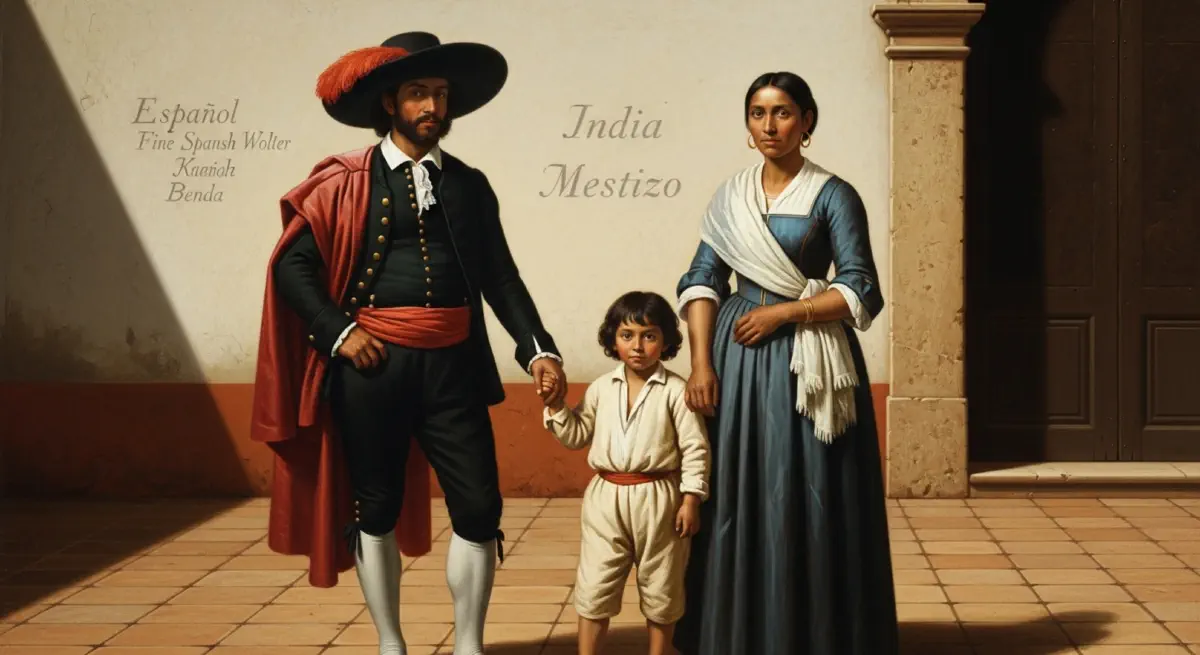
In the 18th century, a unique art form emerged in New Spain (Mexico): the casta painting. These multi-panel canvases depicted family groups, each labeled with a caste name, often showing the "correct" pairing of parents to produce a particular child.

Why did the Crown encourage (or at least tolerate) these paintings?
- Education: They taught newcomers how to read racial categories.
- Control: They reinforced the idea that the hierarchy was natural, even beautiful.
- Documentation: They served as a visual census, fixing identities in the public imagination.
But the paintings also subverted their own purpose. Many casta paintings include subtle critiques—Indigenous women holding European men captive, children looking miserably at their parents, categories with absurd names like "tente en el aire" (hold yourself in the air)—suggesting that even the artists understood the system's cruelty.
📊 The Demographic Reality#
How many people actually lived in each caste category? Demographics varied by colony and century, but here is a rough estimate for Mexico around 1750:
| Caste | Population | Percentage |
|---|---|---|
| Español (including criollo) | ~1,000,000 | 18% |
| Mestizo and castizo | ~1,500,000 | 27% |
| Indio | ~2,800,000 | 50% |
| Mulatto, zambo, lobo, negro | ~300,000 | 5% |
What the numbers don't show: the vast majority of the population never appeared in official records with their precise caste label. Labels were assigned by priests at baptism, by judges in court, by employers in contracts—but many Indigenous and mixed-race people simply lived as "la gente" (the people), ignoring the empire's arithmetic.
⚖️ The Courts as Racial Arenas#
One of the most fascinating features of the casta system: you could sue to change your caste.
Hundreds of lawsuits survive in colonial archives. A typical case: a merchant's son claims he is español; his rivals claim he is mestizo; witnesses testify about his grandmother's "purity." Lawyers argue about skin color, hair texture, family reputation. Courts rule, often inconsistently.
This litigation proves that the casta system was not simply imposed from above. It was negotiated in real time by people who understood its stakes: higher caste meant lower taxes, better jobs, access to universities, and the right to bear arms.
💎 Endnote: The Algorithm's Legacy#
The caste calculus was an information-processing system. It took a chaotic reality—millions of people of mixed ancestry, constantly moving, marrying, and changing—and reduced it to a manageable set of categories. It was, in effect, a social sorting algorithm running on human hardware.
The algorithm broke down in the 19th century. Independence movements rejected the Spanish hierarchy. New nations declared all people "citizens." But the habits of mind remained.
Visit any Latin American country today. Notice who holds power, who is poor, who is light-skinned and who is dark. The caste calculus has no legal force. But its weights and measures still shape every interaction.
Next in the Series: Turn Five: The Conversion Machine – How the Church Engineered Consent
Further Reading:
- Primary Source: Casta paintings at the Museo de América, Madrid (online collection available)
- Overview: Wikipedia. Casta
- Deep Dive: Wikipedia. Limpieza de sangre
- Legacy: Wikipedia. Race and ethnicity in Latin America