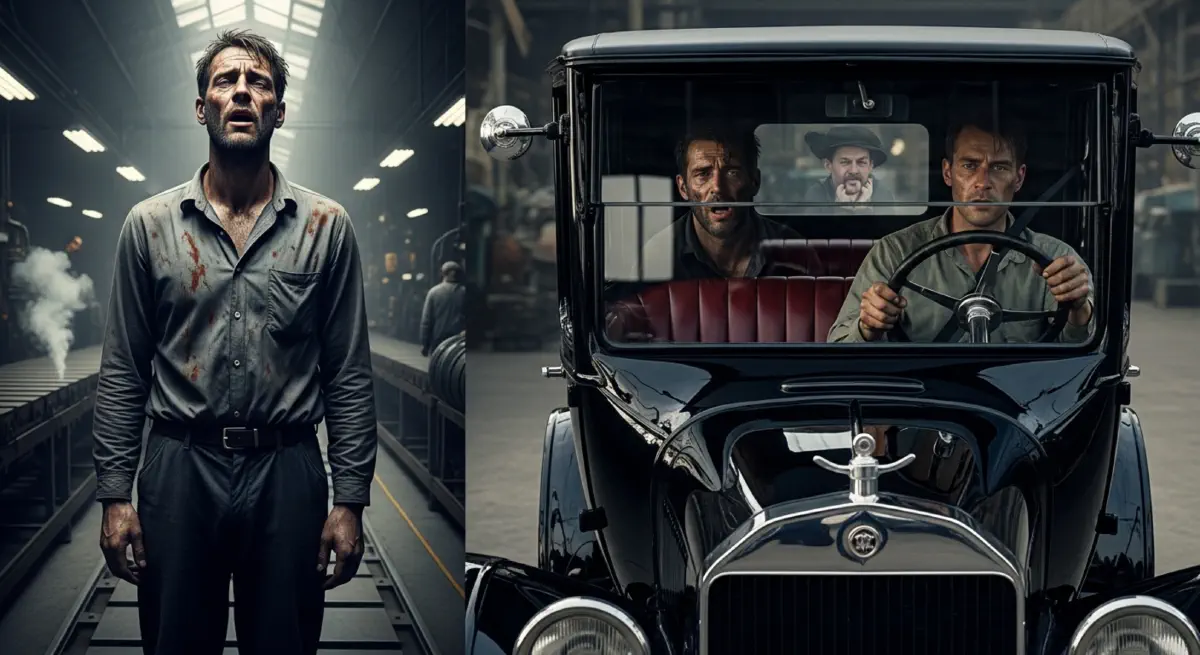
In 1913, on the assembly line at Ford’s Highland Park plant in Detroit, a man named Joe Bartel installed the same bolt on the same chassis every ninety seconds for nine hours. He did this two hundred forty times per shift, five days per week, fifty weeks per year. By 1916, when Henry Ford raised the daily wage to five dollars—double the prevailing rate—Bartel was earning enough to buy one of the cars he helped build. He drove it home, parked it on the street, and returned to the line the next morning to install more bolts.
The five-dollar day made Ford a hero. Magazine covers celebrated him as an industrial savior. Workers lined up by the thousands outside the factory gates. But inside, the turnover rate remained astonishingly high. Ford hired a sociology department—the first in corporate history—to investigate why men kept quitting jobs that paid twice the market rate. The sociologists interviewed workers and filed reports that the company quietly archived. The answer, repeated across hundreds of interviews, was that men felt like machines. They felt their souls draining out through their fingertips, shift after shift, bolt after bolt.
The five dollars was not enough. It could never be enough, because the problem was not economic. The problem was that the work itself consumed the worker, and no wage could compensate for that consumption. The men drank the salt water of high pay and remained thirsty.
The Invention of Enough#
The word “enough” has nearly disappeared from modern vocabulary. It survives in phrases like “enough is enough,” spoken when tolerance expires, but it no longer describes a state of satisfaction. This disappearance is not accidental. It was engineered.
The historian Susan Strasser, in her 1982 book Never Done: A History of American Housework, documents the transition. In 1900, the average American household owned fewer than two hundred distinct objects. Clothing was repaired, not replaced. Furniture was inherited, not upgraded. Food was preserved, not purchased pre-made. The concept of “enough” was built into daily life because resources were limited and the effort required to acquire them was immense.
By 1950, the average household owned more than one thousand objects. By 2000, the figure exceeded three thousand. This explosion did not happen because humans suddenly needed more things. It happened because the economy required constant growth, and constant growth required constant consumption, and constant consumption required the systematic elimination of “enough.”
The industrial designer Brooks Stevens coined the term “planned obsolescence” in 1954, defining it as “instilling in the buyer the desire to own something a little newer, a little better, a little sooner than is necessary.” He meant it as a positive contribution to the economy. He did not mean it as a critique. But the mechanism he named became the engine of modern consumer society. Products were designed to fail, to go out of style, to feel outdated within months, because a product that lasted was a product that stopped generating revenue. The thirst was manufactured.
The Dopamine Circuit#
The neuroscientist Wolfram Schultz, at the University of Cambridge, spent decades studying how the brain handles reward. He implanted electrodes in the midbrains of macaque monkeys and measured the firing of dopamine neurons while the animals learned to associate lights with apple juice.
At first, the dopamine fired when the juice arrived. Then, after training, it fired when the light flashed—the anticipation, not the reward. And if the juice did not come after the light? The dopamine dropped below baseline. The monkey experienced disappointment, a negative feeling, a craving for what it had been conditioned to expect.
Schultz published his findings in 1997, and the implications extended far beyond monkey brains. Human dopamine circuits operate identically. They respond not to reward but to the prediction of reward. The system is designed for a world of scarcity, where anticipation signaled an opportunity to secure resources. In a world of abundance, the same circuit produces perpetual dissatisfaction. Every advertisement is a flashing light. Every purchase delivers a brief dopamine hit—the juice arrives—and then the circuit resets, waiting for the next light.
The Ford worker installing bolts experienced the opposite: no light, no anticipation, no dopamine. Just repetition. But when he left the factory and saw advertisements for the car he built, the light flashed again. The circuit fired. He bought the car. The satisfaction lasted days. Then the circuit reset, and the next advertisement flashed.
The Paradox Named for Easterlin#
In 1974, the economist Richard Easterlin, then at the University of Pennsylvania, published a paper that became a landmark in behavioral economics. He analyzed survey data from nineteen countries, covering three decades, comparing reported happiness with GDP per capita. The result contradicted every assumption of classical economics.
Within countries, richer people reported slightly higher happiness than poorer people—though the difference was smaller than expected. But between countries, the correlation vanished. Americans in 1970 were not happier than Americans in 1940, despite GDP per capita nearly doubling. Japanese in 1987 were not happier than Japanese in 1958, despite a tripling of national income. Beyond a surprisingly low threshold—enough to meet basic needs—additional wealth produced no measurable increase in well-being.
Easterlin named this the “Easterlin Paradox,” and subsequent research has confirmed it across dozens of countries and five decades. The economist Betsey Stevenson and the late Justin Wolfers challenged the finding in 2008, arguing that a weak correlation exists even at high incomes. But even their revised analysis shows that the effect diminishes sharply after basic needs are met. A person earning fifty thousand dollars per year is significantly happier than a person earning fifteen thousand. A person earning five hundred thousand is barely happier than a person earning fifty thousand, and may be less happy if the cost of earning that income includes long hours, chronic stress, or eroded relationships.
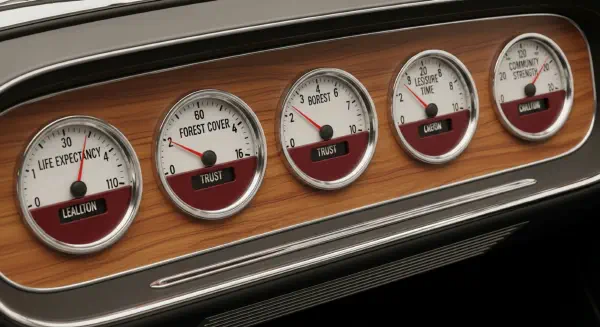
The paradox reveals the salt water mechanism at the population level. The economy grows. Incomes rise. Consumption expands. And reported happiness flatlines because the thirst resets with every raise, every purchase, every achievement. The glass is always full of salt water. The cells are always dehydrated.
The Self-Canceling Economy#
The economist Tibor Scitovsky, in his 1976 book The Joyless Economy, offered an explanation. He distinguished between comfort and stimulation. Comfort, he argued, comes from meeting needs and reducing discomfort. It has diminishing returns—once you are warm and fed and housed, additional comfort provides little benefit. Stimulation, by contrast, comes from novelty, challenge, learning, and connection. It does not diminish with repetition, because each new experience engages the brain differently.
The problem, Scitovsky observed, is that industrial economies are optimized for producing comfort, not stimulation. They generate endless variations of the same products, marketed as novel but delivering the same limited dopamine hit. They create jobs that provide income but not engagement. They measure success in units of comfort—square feet of housing, horsepower of vehicles, gigabytes of storage—while ignoring that stimulation is what humans actually need.
The result is a population that has never been more comfortable and never been more bored, anxious, and depressed. The salt water quenches the surface thirst while deepening the cellular one.
The Hidden Cost of Output#
The Ford worker who bought his Model T participated in a system that consumed him twice. First, it consumed his labor, reducing his work to a single repetitive motion that engaged none of his cognitive or creative capacity. Second, it consumed his wages, returning them to the company in exchange for a product that promised satisfaction and delivered only temporary relief.
The system was designed for throughput, not for human flourishing. It counted the cars produced and the wages paid. It did not count the atrophy of skills, the erosion of community, the quiet despair of men who spent their lives installing bolts. Those costs were externalized, pushed outside the accounting framework, made invisible by the meter stick itself.
And that invisibility was the point. A meter stick that counted everything would reveal the true cost of progress. A meter stick that counts only what can be sold allows the cost to disappear. The thirst becomes a feature, not a bug. It drives consumption. It drives growth. It drives the very economy that claims to serve us while slowly consuming us from within.