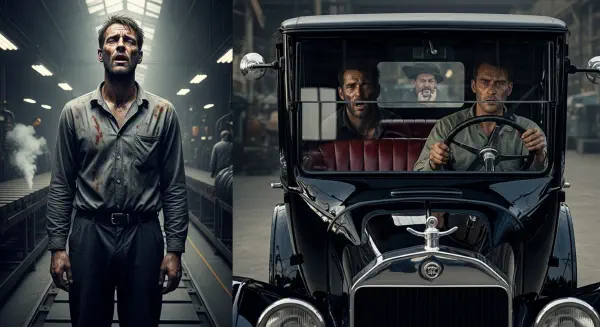
The limestone block weighed fifty tons. In 2580 BC, on the Giza plateau, a crew of forty men dragged it up a mud-slicked ramp using ropes made of papyrus. The heat that day reached forty-three degrees Celsius. A worker named Wehemka—we know this because his overseer scratched his name on a fragment of pottery found in the debris—lost his footing. The block shifted. Twenty-seven men died in the next thirty seconds. Construction continued the following morning.
We remember Hemiunu, the architect who designed the Great Pyramid. His statue sits in the Roemer- und Pelizaeus-Museum in Hildesheim, Germany, carved in limestone, his face calm, his body depicted with the soft folds of wealth and status. We do not remember Wehemka. We do not remember the twenty-seven. The pyramid rises 139 meters above the plateau, the only surviving wonder of the ancient world, and we call it a triumph of civilization.
This is the paradox we have never resolved. We measure the height of the stone. We do not measure the depth of the human cost. And that imbalance—the counting of outputs and the ignoring of inputs—has become the operating system for every society that followed.
The conventional story of progress is linear and reassuring. Hunter-gatherers became farmers. Farmers built villages. Villages became cities. Cities built empires. Each step upward brought taller buildings, more complex tools, greater economic output. The story suggests that we are, by definition, improving. But this narrative relies on a specific meter stick: the material one. It counts skyscrapers, GDP, patents filed, and miles of highway paved. It does not count crushed workers, emptied souls, or the strange phenomenon of wealthy societies whose suicide rates climb as their stock markets do.
The thesis of this investigation is simple and uncomfortable: we have been measuring civilization with the wrong instrument for five thousand years. We treat material output as synonymous with human progress, but the two have diverged so completely that they now move in opposite directions. The result is a population that drinks salt water and wonders why thirst never leaves.
The Edges of the Meter Stick#
The ancient Egyptians did not invent slavery—that dubious honor belongs to earlier Mesopotamian cultures—but they perfected the mobilization of human labor at a scale the world had never seen. The Greek historian Herodotus, writing two thousand years after the pyramids rose, claimed that one hundred thousand men worked for twenty years on the Great Pyramid. Modern Egyptologists, led by Mark Lehner of Ancient Egypt Research Associates, have revised that number downward to between twenty and thirty thousand. But they have also confirmed something more troubling.
Excavations of the workers’ cemetery at Giza reveal skeletons with healed fractures and unhealed ones. They show spines compressed by decades of lifting. They show arms whose muscle attachments grew so pronounced from repetitive strain that the bones themselves deformed. These were not slaves in the chained sense. They were conscripted laborers, fed and housed by the state, given provisions for the afterlife in some cases. They were also expendable. When a worker died, another took his place. The system was designed for throughput, not for human flourishing.
The Egyptologist Zahi Hawass, who spent decades excavating the pyramid builders’ tombs, puts it carefully: “They were not slaves, but they worked under obligation to the state.” The distinction matters less than the mechanism. The state measured its success in stone stacked. The individuals doing the stacking were a means to that end, countable only when they failed to show up.
The Gauge That Never Changed#
Fast forward four thousand three hundred years to 1870, Brooklyn, New York. Washington Roebling, chief engineer of the Brooklyn Bridge, lies paralyzed in his apartment at 110 Columbia Heights. He cannot walk, cannot stand, cannot visit the construction site he commands. Caisson disease—the bends—has destroyed his spine. He spent too long in the compressed-air chambers eighty feet below the East River, where workers dug the foundations through mud and boulders while pressure kept the water out.
The caissons were engineering marvels. They were also death traps. Workers entered through airlocks, spent shifts in pressures triple that of sea level, and emerged too quickly, forming nitrogen bubbles in their blood that lodged in joints and spines. The medical literature of the 1870s called it “the bends” because victims doubled over in agony. Official records list twenty deaths during construction. Unofficial estimates run higher. The bridge opened in 1883, its Gothic towers rising eighty-four meters above the water, its steel cables the thickest ever spun. The speeches called it a monument to human ingenuity. Nobody mentioned the men whose spines fractured to build it.
The pattern operates identically across millennia because the meter stick never changed. We measure the output. We ignore the input. The input is human.
The Refractive Index of Progress#
The economist Marilyn Waring, in her 1988 book Counting for Nothing, identified the mechanism with surgical precision. GDP, the universal metric of national success, counts only transactions that involve money. If a family cares for its elderly parents at home, GDP does not move. If that family hires a nurse to do the same work, GDP rises. If a forest stands, GDP records nothing. If that forest is cut and sold as timber, GDP celebrates growth. The system is not neutral. It actively rewards extraction and exploitation while ignoring preservation and care.
Waring, who served in the New Zealand Parliament at twenty-three and later earned a PhD in political economy, documented how this bias distorts entire economies. Unpaid household labor, estimated by the United Nations to be worth between ten and thirty percent of global GDP, simply disappears from the accounts. Volunteer work, community building, the thousand small acts that hold societies together—none of it registers. What registers is what can be sold. What registers is what can be stacked.
This is not merely an accounting quirk. It is a philosophy encoded in numbers. When a society decides that GDP is the measure of success, it also decides, whether consciously or not, that the things GDP excludes do not matter. The meter stick becomes the reality. The map becomes the territory.
The Question Buried in the Rubble#
We opened in the heat of Giza, watching twenty-seven men die under a fifty-ton block. That scene repeats, in different forms, across every century and every continent. Roman slaves in the quarries of Carrara, cutting marble for Trajan’s Column. Chinese laborers on the Grand Canal, drowning by the thousands in the mud. Indian workers on the railroads of the Raj, killed by heat and malnutrition while building the infrastructure of empire. American steelworkers in Pittsburgh, their lungs filling with particulates so they could manufacture the beams for skyscrapers.
The question is not whether these things happened. The question is why we built an entire definition of civilization around the outputs and systematically erased the inputs from our collective memory. The answer, which we will trace across the remaining three parts of this series, lies in the nature of the meter stick itself. It was designed by those who benefited from the stacking, not by those who did the lifting. It was designed to count what they valued and ignore what they used. And it was designed so effectively that we still use it today, five thousand years later, without ever asking whether it measures what we actually want.
The pyramid still stands. The workers are dust. And we call that progress.