The Burden of Modern Efficiency#
The modern automotive industry currently prioritizes a weight reduction of up to 30% through the deployment of advanced high-strength steel (AHSS). This aggressive light-weighting strategy places unprecedented demands on the structural integrity of safety-critical chassis and suspension components. Engineers utilize high-performance alloys to achieve thinner gauges without sacrificing strength, yet these materials exhibit an acute sensitivity to geometric imperfections. A fundamental paradox exists where the material’s laboratory strength parameters frequently fail to translate into operational longevity. The central question for the industry remains how microscopic deviations in manufacturing can compromise the macro-durability of heavy transit systems.
The Precision of Surface Integrity#
The fatigue performance of heavy transit structures is not an inherent material property but a geometric variable determined by the precision of the manufacturing process. Small defects produced during the industrial cutting phase act as localized stress raisers that drastically reduce the fatigue limit.
The Morphological Anatomy of Mechanical Blanking#
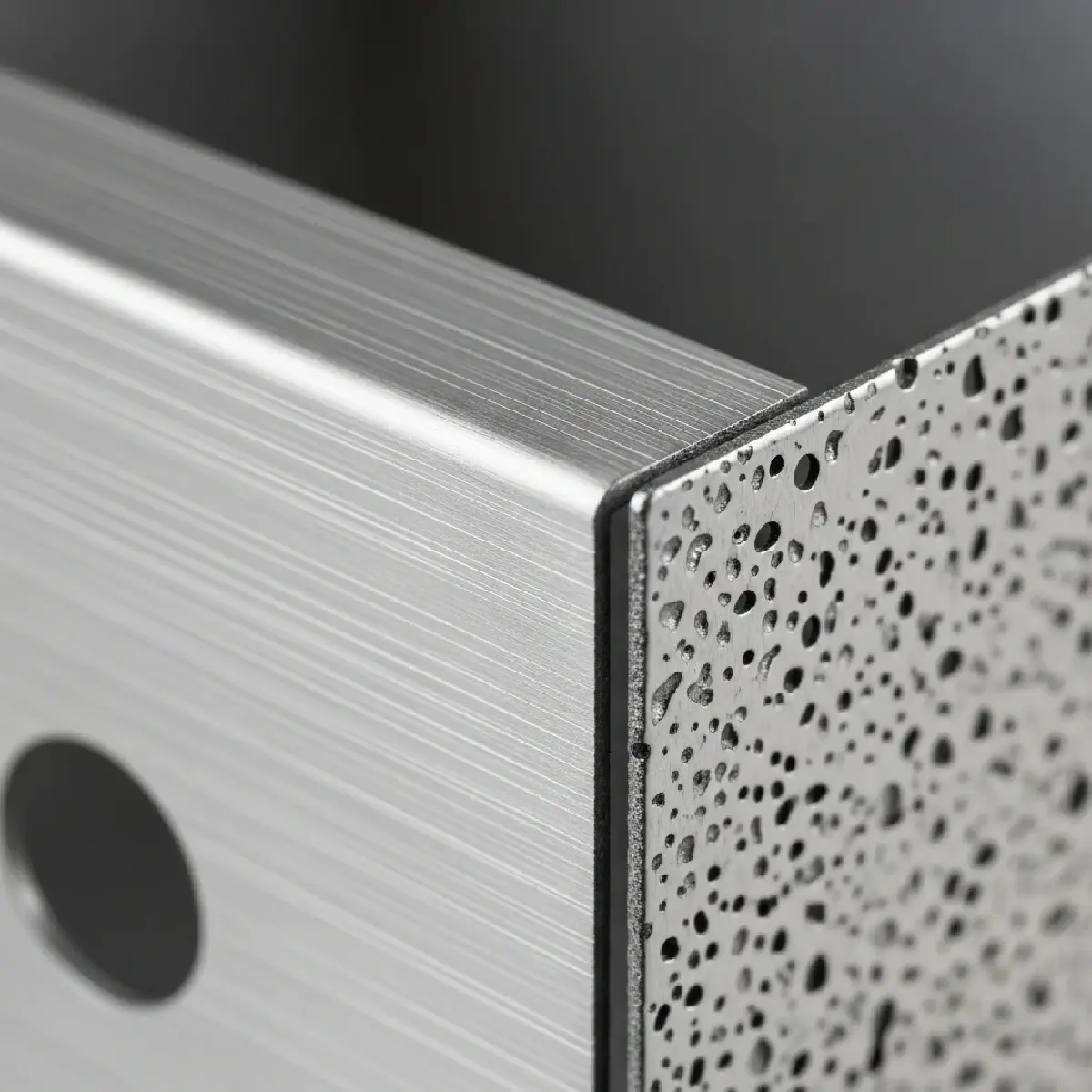
The mechanical blanking process dominates the manufacture of steel automotive profiles through the action of a punch and die. This process generates a cut-edge characterized by a smooth zone under compression followed by a fracture zone in tension. The clearance between these two tools, typically ranging from 5% to 15% of the sheet thickness, dictates the resulting surface quality. A high-quality edge displays a Ra roughness of 3.4 μm (133.8 μin) and a surface hardness increase of approximately 120 Hv. When the clearance exceeds 15%, the fracture zone expands, creating a “burr” feature on the underside of the component. These features create a profile of work-hardened surface notches that act as the primary nuclei for fatigue crack initiation.
The Thermal and Mechanical Crucible#
Laser cutting provides a flexible alternative to mechanical blanking but introduces its own set of structural complications. The interaction between the high-energy laser beam and the steel leads to the development of a heat-affected zone (HAZ). This region undergoes a metallurgical phase transformation into a brittle martensitic layer measuring up to 400 μm (0.015 in) in thickness. While this transformation increases the local hardness by 180 Hv, improper laser traverse speeds generate non-periodic surface striations. These striations function differently than mechanical notches; they tend to distribute rather than concentrate applied stress. Consequently, laser-cut edges often outperform mechanically blanked edges in high-cycle fatigue (HCF) scenarios unless high cutting speeds are utilized.
The Cumulative Cascade of Service Failure#
The lifecycle of a chassis component progresses from crack initiation to rapid propagation through the parent microstructure. In high-strength steels like DP600, cracks grow transgranularly, frequently forming daughter cracks perpendicular to the primary growth direction. Applied sinusoidal wave loads between 20 kN and 24 kN (4,496 and 5,395 lbf) induce gradual growth, whereas loads of 28 kN (6,294 lbf) lead to total structural failure within 1,000 cycles. This failure is exacerbated by the presence of tensile residual stresses within the fracture zone. Finite element (FE) models using the Coffin-Manson relationship provide the most accurate predictions for this initiation when mean-stress effects are accounted for via the Morrow correction.
The Architectural Mandate for Durability#
Reliability in heavy transit depends on a systemic audit of the near-edge microstructural properties. Advanced modeling techniques allow designers to increase their reliance on computer-aided engineering (CAE) instead of exhaustive physical testing. This transition reduces the time required to validate new, lighter-gauge AHSS structures for the automotive market. The industry must standardize the maintenance of punch-die clearances to ensure that the microscopic “notches” do not bypass safety margins. Future durability will be determined by the ability to reconcile rapid production rates with the mathematical requirements of edge integrity. Failure to control these manufacturing variables will inevitably lead to the premature fracture of safety-critical assemblies.