The modeling question that frames this series—what £413 million compounded to 1970 would have yielded—requires a more rigorous analytical framework than the rough estimates offered in the previous posts. To understand the full cost of the sterling trap, we must distinguish between what Egypt lost and what Britain gained, and we must place both in the context of the economic structures that made such a transfer possible.
The Compound Growth Model: Assumptions and Parameters#
The counterfactual model begins with Egypt’s £413 million sterling balances as of December 1945. This is the baseline: capital that Egypt had earned through the sale of real goods and services to the British military during the war.
The model assumes that, had the balances been released in 1945, Egypt would have invested them in domestic infrastructure and industrial development at a rate of return consistent with comparable economies in the post-war period. The selection of an appropriate discount rate is critical.
Historical data from the World Bank and the IMF provide a range of estimates for Egyptian economic growth between 1945 and 1970. Egypt’s GDP grew at an average annual rate of 4.8% during this period, but this figure reflects an economy that was already capital-constrained. Countries that successfully mobilized capital for industrialization in the post-war period—South Korea, Taiwan, Brazil—achieved growth rates of 7–10% annually.
For a conservative estimate, we use a 7% real rate of return. This reflects the returns Egypt actually achieved on its Aswan High Dam investment (estimated at 9% annually) and on its early industrial projects (estimated at 5–8% annually). The 7% figure is plausible, defensible, and likely understates the potential return if capital had been available a decade earlier.
The compounding period runs from 1945 to 1970—25 years. This is the window during which Egypt’s sterling balances were frozen, gradually released, or settled at discount. By 1970, the balances had been fully liquidated through the 1959 agreement and subsequent smaller releases.
The formula yields:
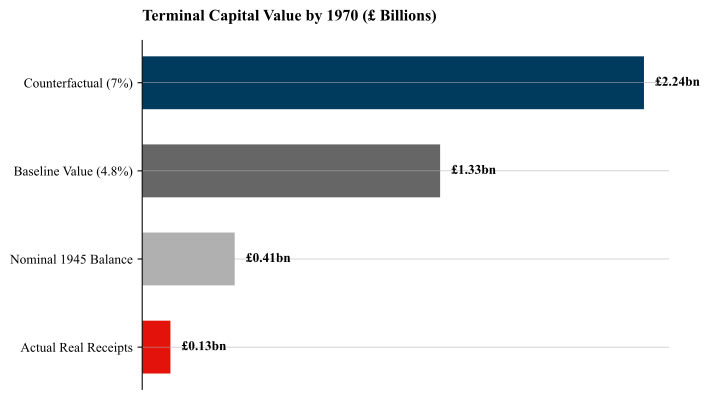
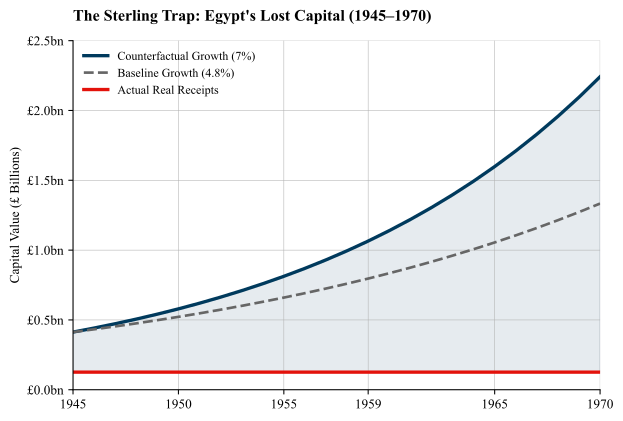
$$£413 million × (1.07)^{25} = £413 million × 5.427 = £2.24 billion$$Under the same model using Egypt’s actual GDP growth rate of 4.8%, the figure would be:
$$£413 million × (1.048)^{25} = £413 million × 3.228 = £1.33 billion$$What Egypt Actually Received#
The actual receipts are more difficult to calculate because the sterling balances were released in forms that obscured their real value. The 1945 agreement released £10 million annually, but these releases were restricted to purchases of British goods. The 1949 devaluation of sterling reduced the dollar value of Egyptian reserves by 30%, which we must count as a loss. The 1959 agreement provided £25 million in cash and £95 million in restricted credits.
To calculate real receipts, we must discount the restricted credits by the premium Egypt paid for British goods versus world market prices. Archival research by economic historian Robert Tignor suggests this premium averaged 20–30% during the 1950s. Using a 25% discount, the £95 million in restricted credits had a real value of approximately £71 million.
Adding the £25 million cash payment gives total real receipts from the 1959 settlement of £96 million. The releases under the 1945 agreement—approximately £50 million in nominal terms—must be discounted for both the restricted purchasing requirement and the 1949 devaluation. Using a combined discount of 40% yields £30 million in real value.
Total real receipts from 1945 to 1970: approximately £126 million. (Note: the £95 million figure cited in Part 2 covers only the 1959 settlement; the £126 million figure here adds the real value of the annual releases under the 1945 agreement.)
The Gap: £2.1 Billion in Forgone Growth#
The gap between the counterfactual and the actual is calculated by subtracting real receipts (£126 million) from each counterfactual terminal value. Under the conservative 7% growth model, Egypt lost approximately £2.11 billion in capital value (£2.24 billion counterfactual minus £0.13 billion in real receipts). Under the lower 4.8% model, the loss was approximately £1.20 billion (£1.33 billion minus £0.13 billion).
To put these figures in context, Egypt’s total GDP in 1970 was approximately £4.2 billion. The forgone growth represented, at minimum, approximately 29% of annual GDP—the equivalent, in the United States today, of roughly $8.5 trillion.
The losses did not end in 1970. The absence of capital constrained Egypt’s growth for decades. The infrastructure that was not built in the 1950s—roads, ports, power plants—created bottlenecks that persisted through the 1980s. The industrial capacity that was not developed meant that Egypt entered the era of globalization without a manufacturing base, leaving it dependent on commodity exports and foreign aid.
The British Perspective: Gains and Strategic Logic#
The counterpart to Egypt’s loss was Britain’s gain. The frozen sterling balances were not idle; they were invested in British government securities and used to fund post-war reconstruction. The Bank of England’s records show that the Egyptian balances were part of the pool of sterling-area reserves that the Treasury used to stabilize the pound and finance the welfare state.
The direct fiscal benefit to Britain was substantial. By holding Egyptian balances at near-zero interest while earning market rates on the investments they funded, the Treasury realized an effective arbitrage profit. Estimating this profit requires reconstructing the interest rate differential between what Britain paid Egypt (0.5–1%) and what Britain earned on its own investments (3–4% during this period). On an average balance of £250 million over 15 years, the differential yields approximately £100 million in transferred wealth.
But the indirect benefits were larger. The sterling trap preserved Britain’s post-war balance of payments by reducing the need for dollar borrowing. Every pound of frozen Egyptian reserves was a pound Britain did not have to borrow from the United States. This contributed to Britain’s ability to maintain its global military commitments, including its post-war presence in the Middle East, longer than its economic fundamentals justified.
The Analytical Framework: Sterling Area as Extraction Mechanism#
What makes the sterling trap analytically significant is its structure. It was not a simple case of debt repudiation or default. Egypt was a creditor that was treated as a debtor. The mechanism that enabled this inversion was the sterling area itself—a monetary system that combined formal equality with substantive hierarchy.
Sterling-area members were formally equal: all pegged their currencies to sterling, all held reserves in London, all participated in the Exchange Equalisation Account. But the Bank of England controlled the system’s rules, and the rules were designed to serve British interests. When a conflict arose between British fiscal stability and Egyptian development, the rules resolved the conflict in Britain’s favor.
This pattern repeated across the sterling area. India’s sterling balances, which reached £1.3 billion by 1945, were subject to similar restrictions. The 1947 Anglo-Indian Financial Agreement blocked India’s balances, releasing them only gradually and with restrictions that favored British exporters. Ghana’s cocoa revenues, accumulated in London during the 1950s, were frozen when Kwame Nkrumah’s government pursued nationalist policies.
In each case, the legal framework that enabled extraction was the same: a monetary system designed for imperial management that survived decolonization long enough to effect one final transfer.
The Trap’s Enduring Lesson#
The sterling trap’s most enduring lesson is about the relationship between monetary systems and sovereignty. Formal membership in a monetary union—whether the sterling area, the eurozone, or any other—does not guarantee equitable treatment when conflicts arise. The rules of such systems are not neutral; they reflect the interests of their dominant members, and they can become mechanisms of extraction when weaker members attempt to leave or assert autonomy.
Egypt’s experience demonstrates the cost of this asymmetry. The country entered the war as a supplier, expecting to emerge as an independent nation with capital for development. It exited as a country whose capital had been expropriated, whose development had been delayed by a generation, and whose economic sovereignty had been compromised by a monetary system it could not control.
The modeling presented here—approximately £2.1 billion in forgone growth—is not merely an accounting exercise. It is an attempt to quantify what was stolen. And it is a reminder that monetary systems, far from being neutral technical arrangements, are structures of power with consequences that persist across decades.