Institutional Collapse Power Vacuum Retornados
How a bloodless coup in Lisbon triggered one of the ugliest decolonisations in history – and sent half a million traumatised refugees flooding back to a country that had no place for them.
Prologue: The Telephone Call That Ended an Era#
At 12:45 a.m. on April 25, 1974, the director of Portugal’s state radio station, Rádio Clube Português, received an urgent telephone call. A voice said only: “Play ‘Grândola, Vila Morena’ – immediately.”
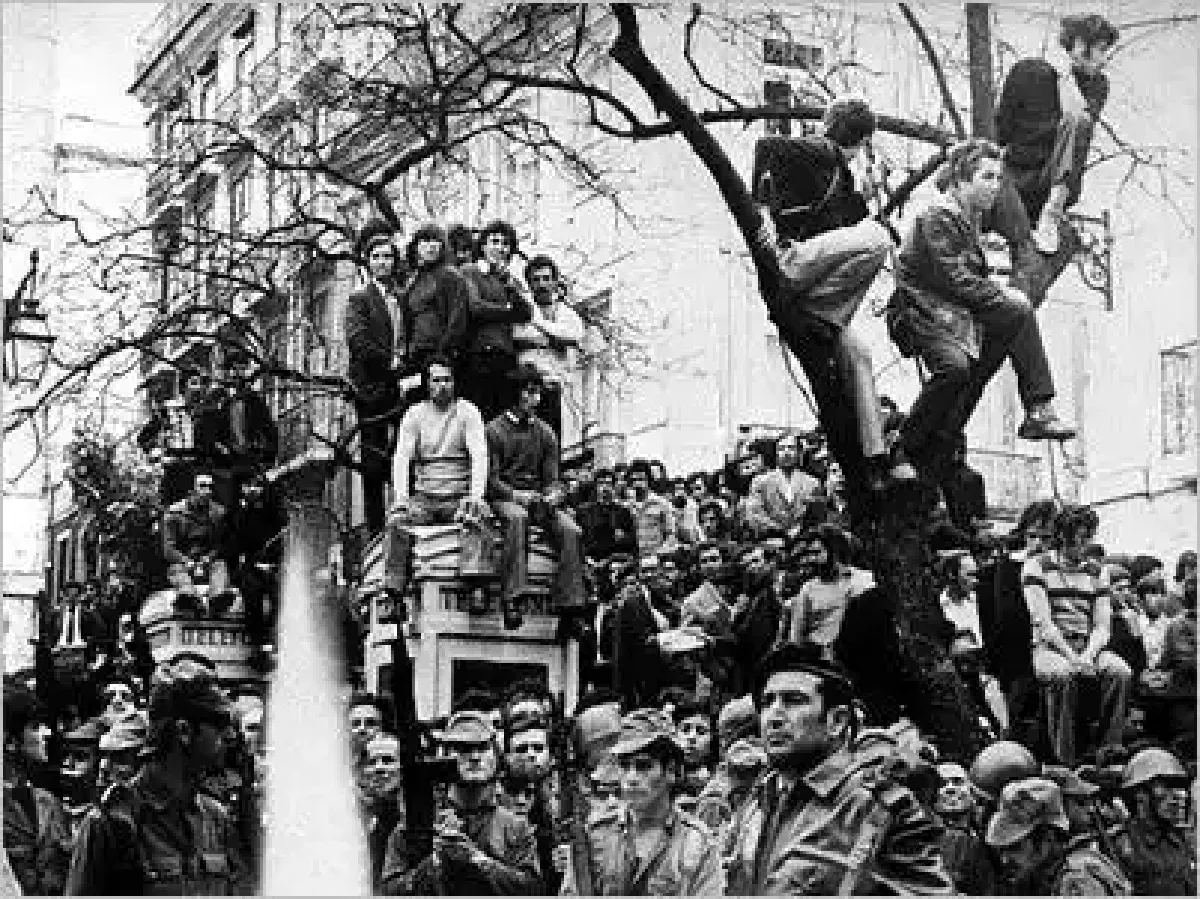
The song – a haunting folk ballad by the banned singer Zeca Afonso – had been pre‑arranged as the signal for a military coup. Within minutes, tanks rolled onto Lisbon’s cobbled streets. Soldiers handed out red carnations. By dawn, the forty‑year dictatorship of the Estado Novo had evaporated.
In Lisbon, crowds celebrated. In Luanda, Lourenço Marques (now Maputo), and Bissau, Africans danced in the streets. The wars, they believed, were over. Freedom was at hand.
What followed was not liberation but chaos. The Portuguese state – which had spent five centuries building an empire – had no plan for dismantling it. In the power vacuum, everything collapsed at once: governance, economy, and the fragile peace between rival independence movements.
This is the story of a revolution that ate its own children – and the birth of three bloody civil wars.
🎖️ Part I: The Revolution – Euphoria and Panic#
Two Weeks That Changed Everything#
The Movimento das Forças Armadas (MFA) – a secret network of 300 mid‑level captains – had planned a quick, surgical coup: remove the old guard, negotiate ceasefires, and grant independence within two years. They were not revolutionaries. Most were conservative soldiers who simply wanted to stop the bleeding.
But the coup, once launched, developed its own momentum. Crowds overwhelmed the plotters. Socialists and communists poured out of hiding. The MFA found itself dragged leftward – into land nationalisations, bank seizures, and wholesale decolonisation.
Key dates of the collapse:
April 25, 1974
Carnation Revolution topples the Estado Novo.May 1974
Ceasefire declared with PAIGC (Guinea‑Bissau); independence promised.June 1974 – April 1975
Mass exodus of Portuguese settlers from Angola and Mozambique begins.June 1975
Angola officially independent – but civil war starts within hours.July 1975
Cape Verde, São Tomé, Mozambique gain independence (peacefully, briefly).1975–2002
Angolan civil war drags on for 27 years, killing 500,000+.
The MFA’s biggest miscalculation: they assumed the colonies would transition smoothly to one nationalist movement each. In fact, each colony had multiple armed factions – and Portugal had spent decades crushing any form of political organisation that might have created a unified civil society.
When the Portuguese flag came down, the guns went up.
🌍 Part II: Angola – A Diamond‑Fuelled Inferno#
The Failure to Agree on Peace#
Angola was the richest prize: oil, diamonds, iron ore, fertile highlands. Three liberation movements claimed it:
| Movement | Ethnic base | Foreign backer (1975) |
|---|---|---|
| MPLA | Kimbundu, intellectuals | Soviet Union, Cuba |
| FNLA | Bakongo | China, Zaire (Mobutu) |
| UNITA | Ovimbundu | South Africa, later US |
Portugal’s transitional government, installed in January 1975, tried to broker a power‑sharing agreement. It failed within weeks. The MPLA seized Luanda; UNITA and FNLA attacked from the north and south. On November 11, 1975 – independence day – the MPLA declared itself the sole government. The world ignored it.
Then the Cubans arrived.
The human cost:
- 500,000 dead (direct war deaths)
- 1.5 million internally displaced
- 100,000 amputees (from landmines)
- 80% of infrastructure destroyed by 1990
The war only ended in 2002 – after UNITA leader Jonas Savimbi was killed in a skirmish. By then, Angola’s oil had made a few generals billionaires and left the rest of the country in ruins.
🌍 Part III: Mozambique – The Renamo Terror#
A Different Kind of Destruction#
Mozambique’s independence, on June 25, 1975, was briefly hopeful. FRELIMO, the dominant liberation movement, had a coherent socialist vision. Its leader, Samora Machel, spoke of building schools, clinics, and a united nation.
But two forces destroyed that dream:
1. Economic strangulation Portugal left in a panic. Within three months, 90% of Portuguese settlers fled – including all but a handful of engineers, doctors, and teachers. The economy, which had been entirely run by whites, collapsed. Cotton production fell by 80%. Tea exports vanished. The new government could not pay salaries.
2. Rhodesia and South Africa’s proxy war Ian Smith’s Rhodesia (now Zimbabwe) and apartheid South Africa saw FRELIMO’s socialism as a threat. They created a rebel army called RENAMO (Mozambique National Resistance). RENAMO had no ideology – only a mission: destroy everything. Its tactics: ambush buses, blow up bridges, rape and decapitate villagers, force children to become soldiers.
The maths of terror (1977–1992):
1 million civilians killed.
5 million displaced (30% of the population).
100,000 children abducted and forced to fight.
6 million landmines sown across the countryside, still killing today.
The war only ended in 1992, after a UN‑brokered peace treaty. But the damage was permanent. Mozambique remains one of the poorest countries on earth, its villages haunted by the ghosts of Portuguese abandonment.
👤 Part IV: The Retornados – Europe’s Forgotten Refugees#
Half a Million People, One Suitcase Each#
While Africans bled, another flood of refugees moved in the opposite direction: the retornados (the “returned ones”). These were Portuguese settlers – mostly poor, white, and terrified – who had been promised a colonial paradise and ended up fleeing for their lives.
Between April 1974 and December 1975, an estimated 500,000 to 600,000 Portuguese abandoned their homes in Angola and Mozambique. They arrived in Lisbon on cargo planes, fishing boats, and rusted trucks – often with nothing but a single suitcase and the clothes on their backs.
Who were they?
- 60% were small farmers, shopkeepers, and clerks – not plantation owners.
- Many had been born in Africa (the filhos da terra – children of the land).
- They had never seen continental Portugal. To them, Luanda or Lourenço Marques was home; Lisbon was a foreign country.
What awaited them?
- A Portuguese economy in free fall (inflation at 30%, unemployment at 15%).
- No housing – they lived in hotels, schools, even chicken coops.
- Social contempt – locals called them “retornados” with a sneer, blaming them for the colonial wars.
- No compensation – Portugal was too broke to pay even token reparations.
graph LR
    A[Colonial collapse] --> B[Mass flight of settlers]
    B --> C[Overcrowded Portuguese cities]
    C --> D[Unemployment & resentment]
    D --> E[Rise of far‑right politics]
    E --> A
The retornados never fully integrated. They formed tight communities in the suburbs of Lisbon and Porto, speaking African‑accented Portuguese, cooking Angolan muamba chicken, and telling their children stories of “the time before.” Many voted for far‑right parties. Some joined the Chega movement, which by 2024 had become Portugal’s third‑largest political force.
The empire had ended. But its trauma was being passed down to grandchildren.
🔁 Part V: The Mechanism – Why Instability Became Permanent#
Three Feedback Loops of Collapse#
The Portuguese decolonisation was not uniquely bloody – the French in Algeria, the Belgians in Congo, the British in Kenya also left chaos. But its mechanisms were distinct and remain instructive.
Loop 1: The Abandonment–Violence loop Portugal withdrew its entire state apparatus – not gradually, but overnight. No police, no judges, no tax collectors, no schoolteachers. The vacuum was filled by armed men. Violence became governance. And because violence was the only currency, no compromise was possible.
Loop 2: The Cold‑War proxy loop Both superpowers saw post‑colonial chaos as an opportunity. The US backed UNITA (Angola) and RENAMO (Mozambique) not because they liked warlords, but to keep out the Soviets. The Soviets backed the MPLA and FRELIMO. The result: wars that should have lasted two years lasted twenty.
Loop 3: The settler–trauma loop The retornados arrived in Portugal traumatised, impoverished, and convinced that African independence had been a betrayal. They passed this narrative to their children. Forty years later, Portugal has still not conducted a national reckoning with its colonial past. The left blames the retornados for imperialism; the retornados blame the left for losing the empire. Neither side listens.
📖 Epilogue: Two Graves, One Overgrown#
In 2012, a journalist visited the outskirts of Maputo, Mozambique. He found a cemetery that had once been Portuguese – full of settlers who had died in the 1960s and 1970s. Now the gates were rusted open, the headstones toppled. Goats grazed among the bones.
A hundred metres away, a newer cemetery: FRELIMO soldiers who had died fighting RENAMO. Their graves were also overgrown. The money for maintenance had run out in 1997.
Two generations of violence, separated by a patch of weeds. The Portuguese empire was gone. But the holes it left behind – in governance, in memory, in the human soul – remained unfilled.
In the final article, we will ask: Is it ever possible to bury an empire? We will trace the living legacies of Portuguese colonialism – from the streets of Lisbon to the studios of Afro‑descendant artists demanding a reckoning.
Continue to Article 6: The Unburied Empire →
Sources & Further Reading:
- Birmingham, David. The Decolonisation of Portugal’s African Empire (1995).
- Christensen, Steen. Post‑Colonial Civil Wars in Angola and Mozambique (2019).
- Fonseca, Joana. Retornados: Uma História Portuguesa (2019) – oral histories of the refugees.
- Mamdani, Mahmood. When Victims Become Killers (2001) – on the logic of post‑colonial violence.
Article 5 of 6. Next: How the empire’s ghost haunts the present – and the first stirrings of a reckoning.