The World That Closed In#
In 1798, Napoleon Bonaparte invaded Egypt. For the Ottoman Empire, the suzerain of Egypt, this was not just a military defeat. It was a systemic shock of a new and terrifying kind. A European power could project force across the Mediterranean, shatter a Mamluk army with disciplined volleys, and occupy a core province with unsettling ease. The shockwave rippled to Istanbul, but it was only one tremor in a gathering earthquake. The Ottoman state, along with its Safavid and Mughal counterparts, was not facing a single rival or problem. It was being slowly, inexorably compressed in a multi-axial vice—a simultaneous assault from multiple, mutually reinforcing directions that left no room for strategic maneuver.
This third installment examines the external catalyst that transformed internal rigidity into existential crisis. The “pressure” in the “Plateau + Pressure” model was not a linear force. It was a complex, overlapping set of challenges—geopolitical, economic, and ideological—that attacked the empire’s foundations concurrently. Unlike European states that could often externalize conflict or focus on one frontier, the Islamic empires found themselves surrounded, outflanked, and outmoded on all sides. Their stable, continental systems were uniquely ill-suited for a world where power had become fluid, financial, and global.
The Geometry of Strategic Overload#
The thesis here is one of asymmetric compression: A system optimized for stability in a slow-moving, land-based environment will fail when the environment itself becomes fast-moving, oceanic, and multi-polar. The Islamic empires did not gradually decline; they were systematically overwhelmed by a confluence of pressures that their architecture could not process. Each pressure vector alone might have been manageable. Their simultaneous convergence created a perfect storm with no calm eye, no single front on which to focus a response. The empire was not being pushed; it was being pressed from all sides until its structure buckled.
The Geopolitical Vise: Encirclement Without Respite#
For centuries, the Ottoman Empire’s primary security concern was a land rival to the east: Safavid Persia. This rivalry was a 300-year stalemate, a massive sink of resources and attention that produced containment without transformation. Unlike Europe’s wars, which spurred financial and technological leaps, the Ottoman-Safavid conflict was fought over similar terrain with similar tactics. It locked both empires into a costly, ideologically charged attrition that diverted energy from the more fundamental shift occurring to the west and north.
By the 18th century, new jaws of the vise snapped shut. To the north, a modernizing, expansionist Russia began a relentless southward push, threatening the Black Sea, the Caucasus, and eventually the Balkans—the Ottoman heartland. To the south and east, Mughal India fragmented, creating a vacuum that was steadily filled by the British East India Company. To the west, Austrian Habsburg pressure persisted. The empire was now in a permanent state of multi-front defense. There was no “empty” periphery—no New World or Africa—to which it could expand to relieve this pressure. Every frontier was a contested, hardening border. Strategic depth had evaporated.
The Economic Re-Routing: The Bypassing of a Civilization#
The empires’ wealth was built on controlling the terminus points of Eurasian land trade. The arrival of Portuguese carracks in the Indian Ocean in the 16th century was the first crack in this edifice. But the true collapse came with the maturation of Atlantic economies. By the 18th century, the vast flow of goods, silver, and later capital was increasingly bypassing the Middle East entirely. The Ottoman Empire went from being the crucible of global exchange to being its periphery.
This was more than a loss of customs revenue. It was a systemic demotion. The terms of trade turned decisively against manufactured goods from the empire. It was flooded with cheap European factory textiles, undermining local artisans. Its economies were relegated to exporting raw materials (cotton, silk, grain) and importing finished goods, a classic pattern of dependency. Furthermore, the silver inflation from the Americas wreaked havoc on traditional coinage and tax systems. The economic foundation of the plateau—profitable control over interior trade routes—was washed away by new oceanic currents of commerce. The empire was not just poorer; it was economically re-wired into a subordinate position in a nascent global capitalist system it did not control.
The Ideological Onslaught: A Crisis of Meaning#
Perhaps the most disorienting pressure was ideological. For centuries, the Sultan’s legitimacy rested on his dual role as successor to the Caliphs (protector of Islam) and guarantor of justice (adalet) in the circle of equity. Military success was proof of divine favor. The relentless, humiliating defeats by “infidel” powers shattered this narrative. If the Sultan-Caliph was God’s shadow on earth, why were his armies repeatedly routed by Christians?
This created a paralyzing legitimacy crisis. Reformers advocating for Western-style institutions were accused of importing un-Islamic, morally corrupt practices. Conservatives argued that defeats were a punishment for straying from pure tradition. The state was caught in a double bind: to survive, it needed to adopt the techniques of the West (secular law, conscript armies), but doing so undermined the traditional religious foundations of its own authority. European states had undergone their own secularizing transformations over centuries, often violently. The Ottoman state was forced to attempt this psychological and institutional revolution in decades, under the glaring, humiliating spotlight of military defeat. The result was often a brittle, schizophrenic identity.
The Reform Trap in the Pressure Cooker#
This multi-axial compression exposed the “reform trap” with cruel clarity. Every attempt at adaptation—the Ottoman Nizam-ı Cedid (New Order), the Tanzimat reforms—bumped against the entrenched institutions discussed in Part 2. But now, the stakes were higher and the clock was ticking.
- Military Reform threatened the Janissaries, leading to coups and backlash (e.g., the overthrow of Selim III in 1807).
- Legal and Administrative Reform threatened the ulama and the old bureaucracy, creating internal resistance and confusion.
- Fiscal Reform to fund these changes required crushing tax increases or foreign loans, sparking popular revolts and leading to debt dependency.
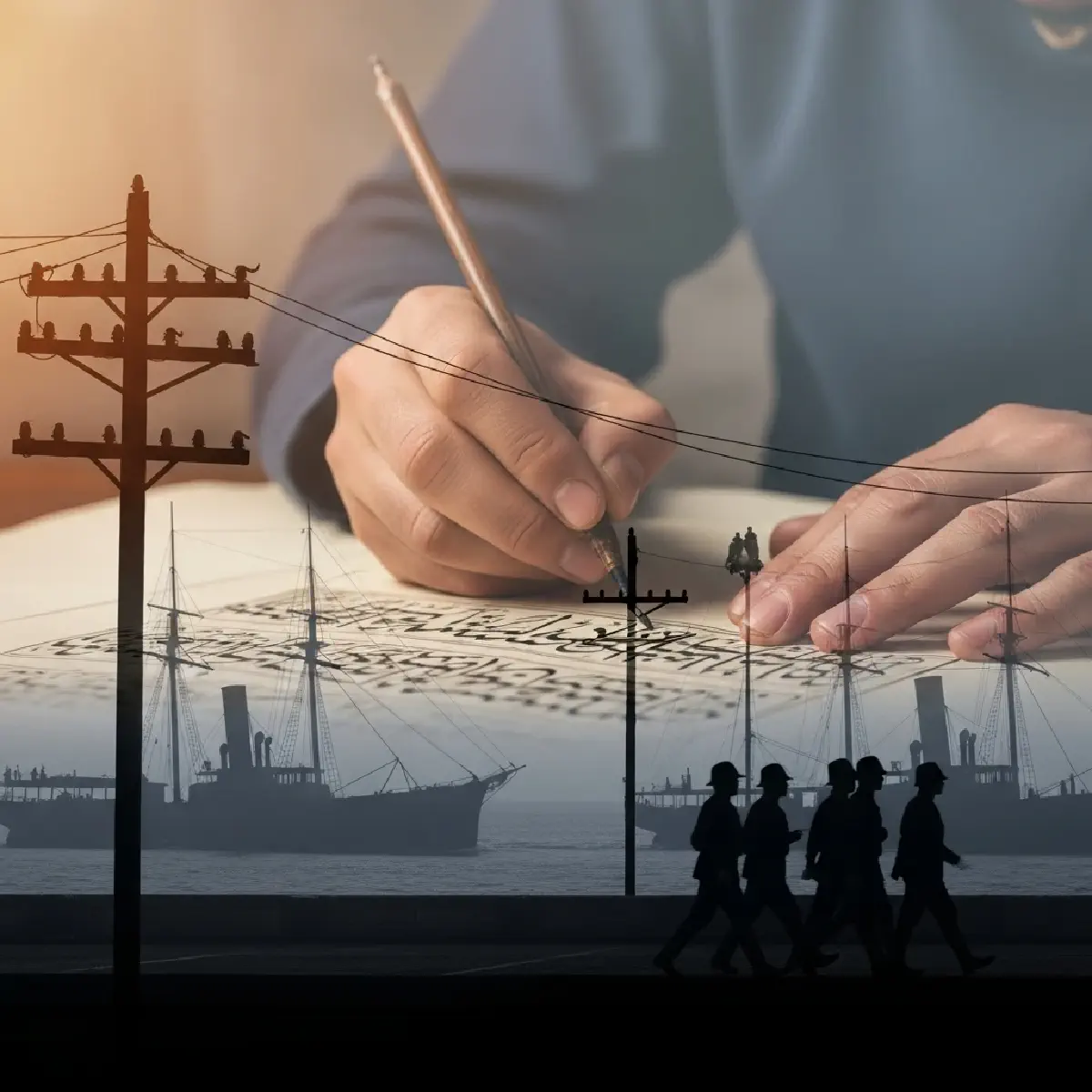
Worst of all, the reforms were piecemeal and additive. They aimed to graft modern capabilities (a new army, a new school) onto the old imperial body, not to replace its operating system. They were attempts to restore competitiveness, not to redefine the empire’s purpose. This was like trying to upgrade a sail-powered galleon to compete with steamships by adding a boiler to its deck. The fundamental design was wrong for the new environment.
The Compression Complete#
By the late 19th century, the vice had tightened beyond bearing. The empire was dubbed “the Sick Man of Europe,” a phrase capturing its total strategic passivity. Its sovereignty was hollowed out by “Capitulations” (extraterritorial rights for Europeans) and crushing foreign debt, administered by the Ottoman Public Debt Administration—a virtual European-run treasury within the state. Provincial notables acted as semi-independent rulers. Nationalist movements, fueled by the very European ideologies of self-determination the empire could not co-opt, tore at its Balkan and Arab territories.
The plateau was now a prison. The internal rigidities prevented a coherent response, while the external pressures eliminated the time and space needed for gradual evolution. The system, designed for autonomy and slow-moving change, was now defined by dependency and rapid, uncontrollable disintegration. All that remained was for a final, catastrophic shock to provide the coup de grâce. That shock arrived with the industrialized, total warfare of the 20th century, turning a prolonged systemic failure into a definitive, political collapse.