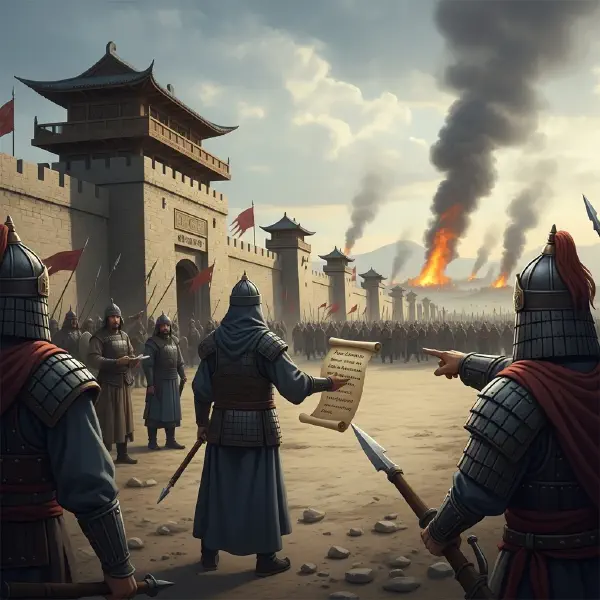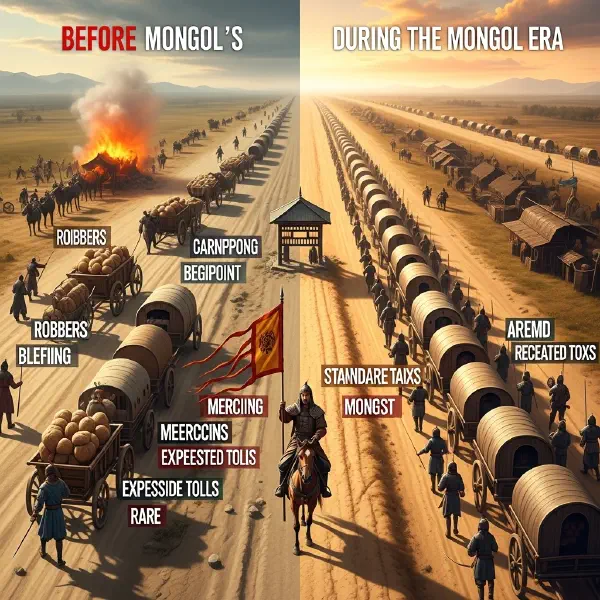
The Mongol Empire was not a traditional state but a parasitic swarm—a horde of coordinated predators that overwhelmed hosts through sheer numbers, mobility, and relentless pressure. Unlike sedentary empires that build infrastructure, the Mongols operated as a nomadic parasite, extracting resources from conquered territories while maintaining their core mobility. Their strategy was swarm intelligence applied to imperialism: decentralized units that could converge on targets, extract value, and disperse, leaving devastated but not permanently occupied hosts.
The Swarm Dynamics of Mongol Conquest#
The Mongol swarm operated through several key mechanisms:
Decentralized Horde Structure: The Swarm Units. The empire was divided into ulus (appanages) under Genghis Khan’s sons and grandsons, each operating semi-independently. This allowed for parallel conquests—while Ögedei Khan besieged Kaifeng, Batu Khan ravaged Europe. Each horde was a self-sufficient parasitic unit, capable of living off the land and extracting tribute.
Mobility and Speed: The Swarm’s Edge. Mongol horsemen could cover 100-150 km per day, allowing rapid redeployment. This mobility prevented hosts from mounting coordinated defenses. Cities like Baghdad fell not through siegecraft but through the swarm’s ability to isolate and overwhelm.
Psychological Warfare: The Swarm’s Terror. The Mongols cultivated a reputation for brutality (e.g., the sack of Baghdad, 1258), inducing surrender without battle. This was swarm psychology—individual hosts feared the collective wrath, leading to preemptive submission.
Resource Extraction and Redistribution: The Swarm’s Metabolism. Conquered territories were taxed heavily (often 10% of livestock and goods), with resources redistributed to maintain horde loyalty. This created a parasitic flow: wealth from sedentary hosts sustained the nomadic swarm.
The Swarm’s Vulnerabilities: From Horde to Empire#
The swarm model was devastatingly effective but carried inherent weaknesses:
Succession Crises: The Swarm’s Fragmentation. Genghis Khan’s death led to division among his sons, weakening the swarm’s unity. The empire fragmented into rival khanates, each pursuing its own parasitic agenda.
Sedentarization: The Swarm’s Mutation. As the Mongols conquered China and Persia, they adopted sedentary governance, diluting their swarm mobility. The Yuan Dynasty under Kublai Khan became a traditional empire, losing the horde’s parasitic agility.
Host Resistance: The Swarm’s Overextension. The swarm’s rapid expansion created vast frontiers that were impossible to defend. The Mamluks at Ain Jalut (1260) and the Japanese typhoons (“kamikaze”) demonstrated that even swarms can be repelled by concentrated, adaptive resistance.
The Mongol Legacy: Swarm Imperialism in Modern Times#
The Mongol swarm offers a model for understanding modern parasitic strategies. Contemporary examples include:
Corporate Raiding: The Financial Swarm. Hedge funds and private equity firms operate as swarms, converging on distressed companies, extracting value through leveraged buyouts, and dispersing.
Cyber Attacks: The Digital Swarm. DDoS attacks and botnets function as parasitic swarms, overwhelming digital hosts with coordinated traffic.
Migrant Waves: The Demographic Swarm. Mass migrations can act as parasitic swarms, overwhelming host societies’ resources and institutions.
The Mongol Empire’s story illustrates the power of swarm predation: overwhelming through numbers and mobility, but vulnerable to fragmentation and adaptation. In an age of global connectivity, swarm strategies remain a potent imperial tool.