
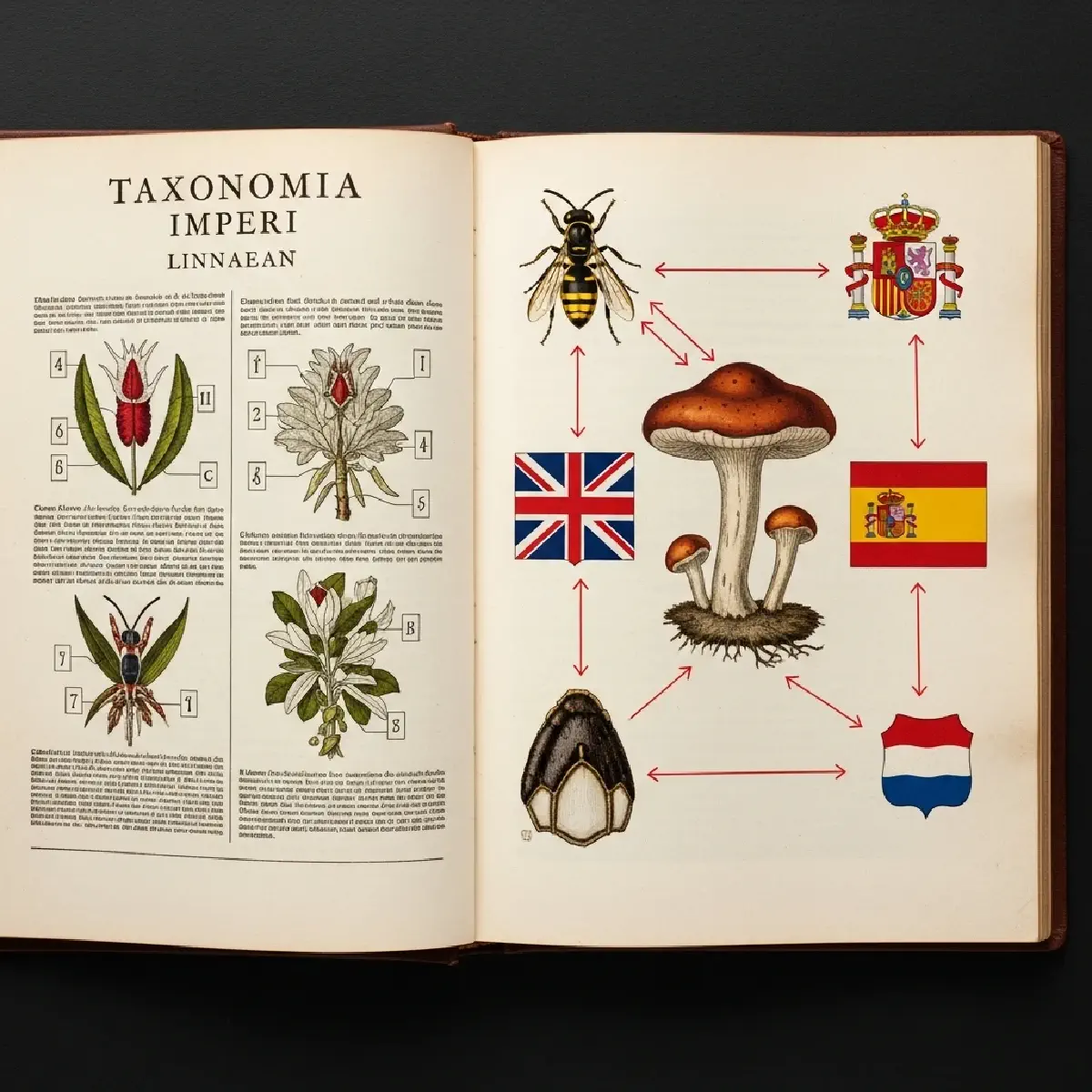
Historians traditionally classify empires by chronology, geography, or national origin: the Early Modern Spanish Empire, the 19th-Century British Empire. This tells us when and where, but not how. To understand the mechanics of conquest and control—the how—we must look to ecology. On the African savannah, lions, leopards, and hyenas are all apex predators, but they employ fundamentally different strategies: cooperative ambush, solitary stealth, and scavenging persistence. They occupy different ecological niches defined by their hunting methodologies. So too with empires.
This capstone series argues for a behavioral taxonomy of imperial power. By diagnosing empires through the biological models developed in this project—the Wasp, Cordyceps, Sacculina, Glyptapanteles, Horsehair Worm, Dicrocoelium, and Epomis protocols—we move beyond narrative to a functional, comparative science of geopolitics. This taxonomic lens reveals that an empire’s longevity, impact, and ultimate fate were less about its national character and more about the strategic niches it evolved to exploit and the inherent vulnerabilities of its chosen parasitic model.
From National History to Strategic Ecology#
The mega-series “Parasitic Mechanisms as Systems for Geopolitics” has built a toolkit for this taxonomy. Each model isolates a discrete mechanism of control:
- Neurological Hijack (Wasp): Seizing executive command.
- Ideological Reprogramming (Cordyceps): Rewriting host identity.
- Reproductive Castration (Sacculina): Neutering autonomous futures.
- Proxy Creation (Glyptapanteles): Cultivating internal defenders.
- Behavioral Engineering (Horsehair Worm): Inducing self-destruction.
- Supply-Chain Orchestration (Dicrocoelium): Managing tiered intermediaries.
- Deceptive Entrapment (Epomis): Baiting aggressive overreach.
No empire used only one strategy. But a taxonomic analysis reveals dominant strategies—the core, recurring plays in an empire’s handbook that defined its ecological niche. This approach allows us to compare the British and Spanish empires not as sequential powers, but as different “species” of predator that happened to hunt in overlapping territories during the same geological era.
The Unit of Analysis: The Imperial Strategy, Not the Imperial Flag#
This reframing yields powerful insights. It explains, for instance, why two empires in the same region (e.g., the Portuguese and Dutch in the Indian Ocean) could have such different legacies: they were applying different parasitic protocols to similar hosts. It clarifies why some empires were brittle and short-lived (specialists, like the Dutch VOC spice monopoly) while others were enduring and adaptable (generalists, like the British). Furthermore, it allows us to trace the co-evolution of predator and prey. As host states developed immunities or learned behaviors (like the Haitian Swarm), predators were forced to adapt their strategies or face extinction. The “Scramble for Africa” was not just a land grab; it was a radical shift in the predatory ecosystem, where industrial-age powers applied newly brutal forms of the Sacculina and Wasp doctrines to territories that had previously resisted through Swarm-like decentralization.
Classifying the Predators: A Preliminary Guide#
Applying this lens, we can propose a preliminary taxonomy of early modern European imperial “species”:
- The Strategic Polymorph (Britain): Master of multiple strategies, contextually applied.
- The Supply-Chain Engineer (Spain): Specialist in linear, rigid resource logistics.
- The Monoculture Specialist (The Dutch VOC): Focused on total control of a single resource node.
- The Proxy Manipulator (Portugal): Expert in factional politics and indirect control.
- The Conflicted Hybrid (France): Attempted ideological and extractive strategies without full commitment to either.
This series will develop this taxonomy, using each empire as a case study to validate the entire parasitic framework. We begin with the most adaptable—and therefore most dominant—predator of the modern era: the British Empire, a master of strategic polymorphism.