
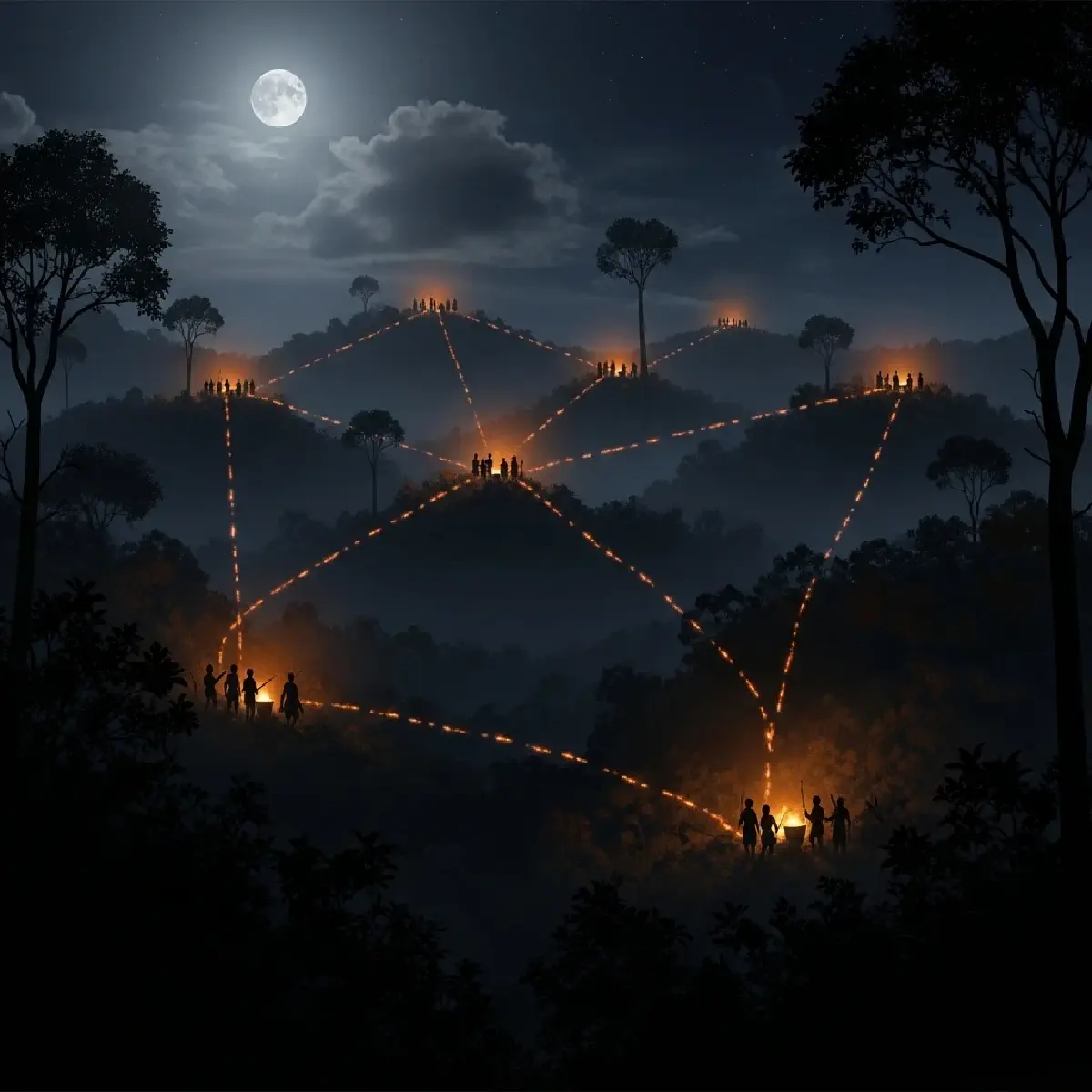
Deep in the mountainous mornes of Saint-Domingue, societies existed outside the grasp of the French colonial machine. They were called Maroons (from the Spanish cimarrón: wild, untamed)—enslaved Africans who had escaped the plantations. They were not merely fugitives; they were architects of a new social operating system. In hidden settlements like the palenques, they blended diverse African political and military traditions, creating decentralized, kinship-based communities. They were not a unified rebel army with a singular leader. They were a polycentric network of autonomous nodes, connected by runners, hidden trails, and shared resistance. When the Haitian Revolution erupted in 1791, it was not sparked by a vanguard in a capital, but by a secret network of Maroon leaders and plantation slaves communicating through Vodou ceremonies. The revolution was the swarm, scaling up.
The French plantation system was a textbook Sacculina-like parasite: it aimed to castrate the autonomy of the enslaved, redirecting every ounce of their energy toward monoculture sugar production. Its control was total, centralized, and brutally hierarchical. To survive, let alone resist, required a structure this parasite could not comprehend or crush.
The Swarm Structure of Maroonage#
Maroon communities exemplified swarm principles in action:
- Distributed, Autonomous Nodes: Isolated settlements in different mountain ranges (like Bahoruco and Cahos) operated independently. They had their own leaders (like François Mackandal or later, Romaine-la-Prophétesse), their own customs, and their own survival strategies. The French could destroy one settlement, but others persisted and could provide refuge.
- Redundant Knowledge and Leadership: Leadership was often situational and spiritual, not just military. A houngan (Vodou priest), a skilled hunter, or a formidable warrior could rise to prominence based on need. There was no single “king of the Maroons” whose capture would end the threat.
- Fluid, Networked Communication: Information traveled via a “bush telegraph” of runners and drum codes that could cross mountains faster than French soldiers on roads. This allowed for coordinated, surprise attacks and rapid dispersal.
Swarm Tactics: The Asymmetric Art of War#
When they engaged the French military, Maroons and the revolutionary armies they inspired did not fight in European lines. They invented a form of warfare perfectly suited to the swarm:
- Ambush and Raid (Pinching Attacks): Small, mobile bands would strike plantation outposts, seizing weapons and supplies, then vanish back into the terrain the French considered “wild” but which was home to the Maroons.
- Economic Sabotage (Targeting the Host’s Resource Flow): They burned cane fields, destroyed sugar mills, and poisoned plantation owners. They attacked the economic engine of the parasite directly.
- The Strategic Retreat and Dispersion: When faced with a superior French force, they would not defend fixed positions. They would dissolve into smaller groups, drawing the French into the mountains where disease, heat, and ambushes decimated the rigid columns.
This was not war as a contest of force; it was a war of systems. The French system required stability, predictability, and concentrated wealth to function. The swarm-like Maroon system thrived on mobility, ambiguity, and dispersal. The parasite was designed to extract from a stationary host; it had no answer for a host that fragmented, moved, and bit back from a thousand different points.
The Network Goes Viral: From Maroonage to Revolution#
The 1791 uprising saw the swarm logic jump from the marginalized Maroon communities to the heart of the plantation system itself. The secret planning at the Bois Caïman ceremony acted as a distributed activation signal. Revolts erupted across the Northern Plain not as a single army marching, but as a simultaneous, system-wide immune response. Leaders like Toussaint Louverture, who understood both the European and the Maroon ways, were able to scale the swarm, organizing these dispersed forces into a more coherent but still highly flexible military network that could outmaneuver and outlast not only the French, but later Spanish and British invaders.