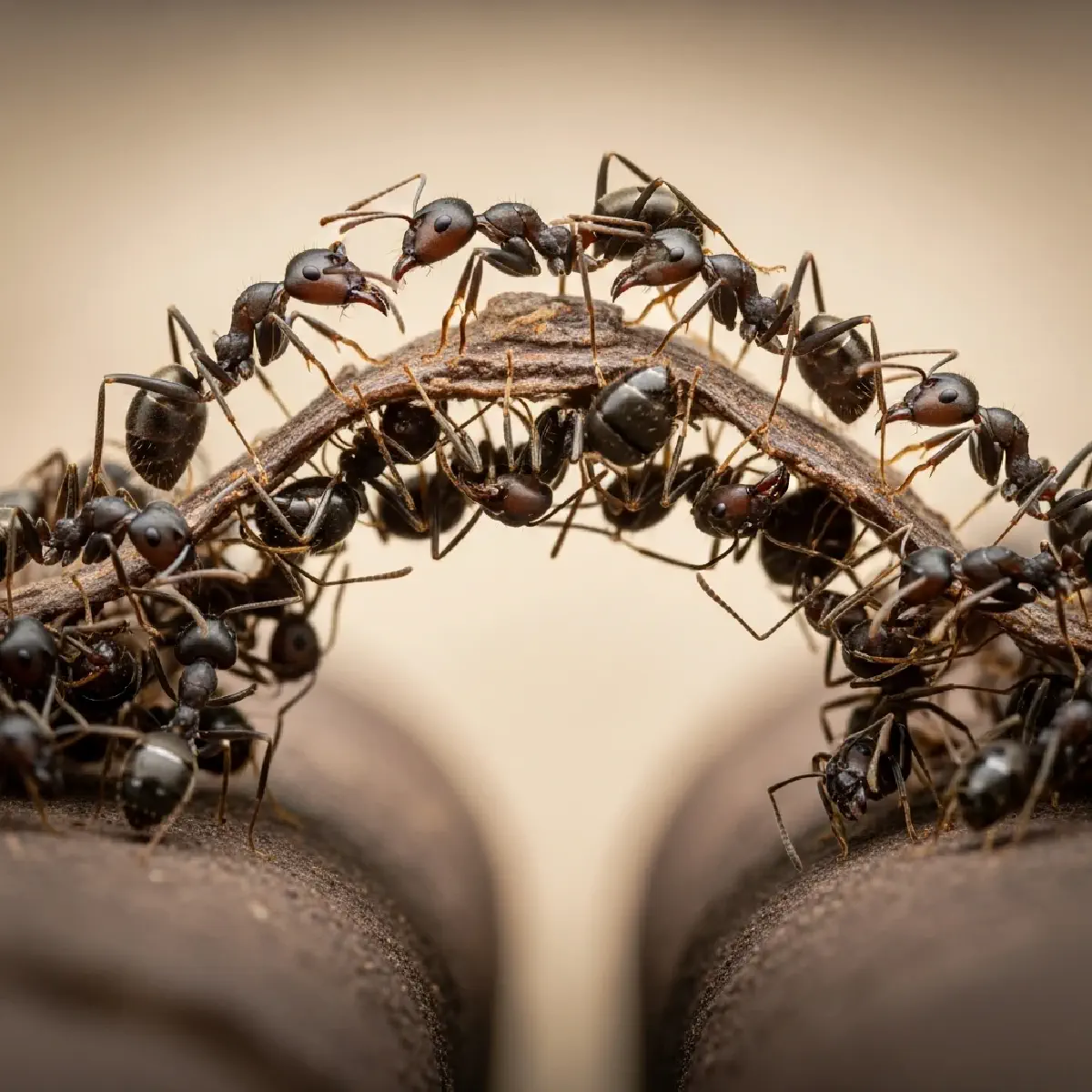
A column of army ants (Eciton burchellii) flows across the forest floor, a living river of purpose. There is no general, no central command post. Yet, the swarm intelligently navigates obstacles, overwhelms prey ten thousand times the size of an individual ant, and builds bridges with their own bodies. When a path is blocked, the flow reroutes seamlessly. If a section is destroyed, the colony reforms. This is not chaos; it is emergent order. The Swarm Imperative represents the most powerful defensive and adaptive counterpart to the parasitic models of control: a system where resilience and intelligence arise from distributed, decentralized networks, not top-down hierarchy. To understand how oppressed communities have historically resisted empires, we must first decode the logic of the swarm—a logic now mirrored in the internet’s architecture and the most potent modern insurgencies.
The swarm is defined by its structure and function. Its strength is the inverse of a centralized state or a parasitic controller. Where a parasite seeks a single point of control (the brain, the treasury, the palace), the swarm has no single point of failure. Its power is relational and collective.
The Principles of Swarm Intelligence#
Three core principles define swarm systems across biology, from ant colonies to neuronal networks:
- Distributed Control & Emergent Order: No single ant directs the raid. Each ant follows simple local rules (follow pheromone trails, carry food if found, attack if threatened). Complex colony-level behavior—foraging patterns, nest building, migration—emerges from countless local interactions. The intelligence is in the network, not in a leader.
- Redundancy & Anti-Fragility: Individual ants are expendable. The loss of hundreds does not cripple the system; it adapts. This redundancy makes the swarm anti-fragile. A centralized system becomes weaker with each blow to its core; a decentralized swarm can often become more adaptive and resilient through stress, as damage reveals new pathways and triggers distributed problem-solving.
- Rapid, Localized Information Flow: Ants communicate primarily through pheromones, a chemical network. Information about food or threat spreads rapidly through the colony via these local exchanges, not from a broadcast center. This allows for extremely fast, context-sensitive adaptation to changing conditions on the ground.
From Biology to Human Networks: The Structural Blueprint#
This blueprint translates directly into effective human resistance against parasitic control. A successful swarm-type resistance must embody:
- A Networked, Not Hierarchical, Structure: Multiple, semi-autonomous cells or communities connected laterally, not reporting up a single chain of command.
- Distributed Resilience: The loss of any one leader or stronghold does not collapse the movement. Knowledge, skills, and authority are spread across the network.
- Adaptive Tactics: The ability to shift strategies quickly based on local conditions, using methods that exploit the centralizer’s weaknesses (like guerrilla warfare, sabotage, and fluid disengagement).
History provides a stark contest between these models. The ultimate test case emerged in the late 18th century on the French colony of Saint-Domingue (modern Haiti). There, the most brutally efficient parasitic system ever devised—the racialized, industrialized sugar plantation—was confronted and ultimately dismantled not by a conventional army, but by a human swarm that had evolved in the mountains for generations: the Maroons.