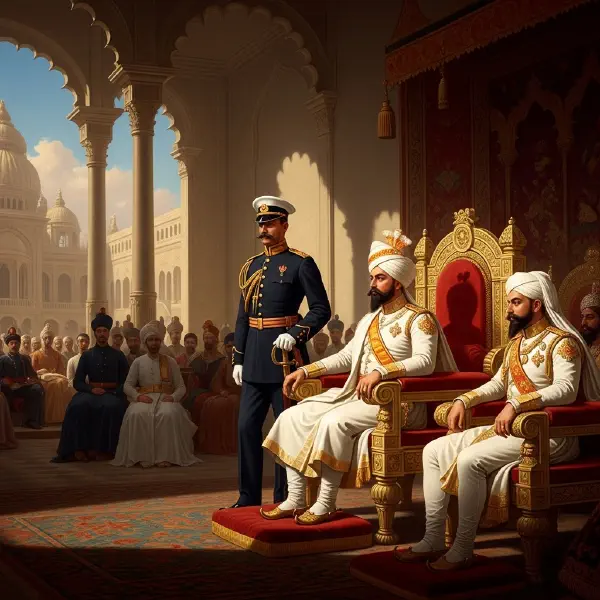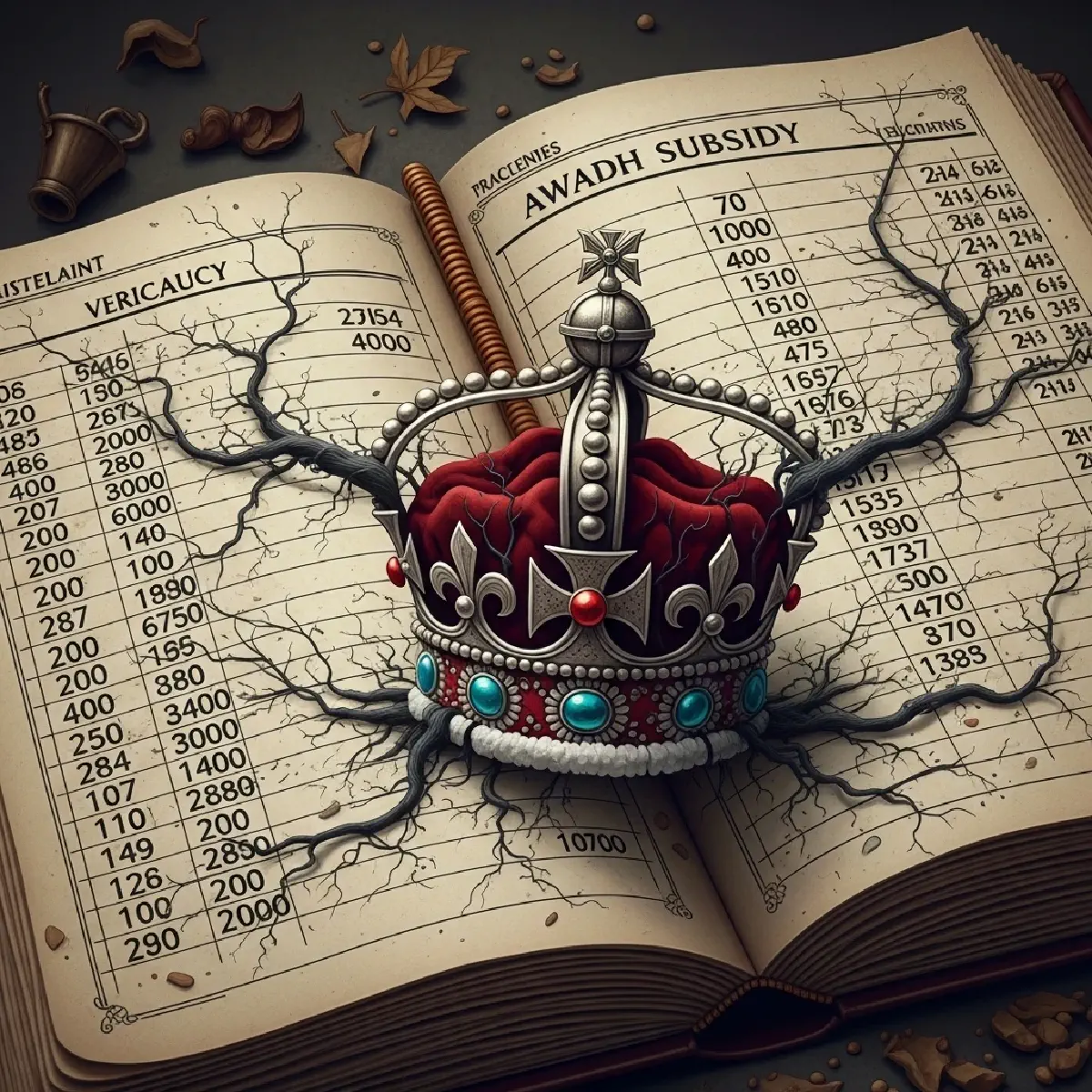
The Subsidiary Alliance system was not a static arrangement; it was a dynamic trap designed to tighten over time. The initial bait of security led inexorably to a state of chronic, engineered crisis. The ruler, stripped of military and diplomatic autonomy, now faced an inescapable financial vise. The annual subsidy, a fixed cost, collided with a shrinking revenue base, creating a debt spiral. This engineered insolvency was not a bug in the system; it was its core feature, providing the pretext for the final, consumptive phase of the Epomis Protocol: outright annexation under the Doctrine of Lapse.
The Debt Spiral: The Economic Engine of Entrapment#
A ruler like the Nawab of Awadh, having ceded rich districts to pay the subsidy, found his remaining lands less productive and more expensive to administer. Bad harvests or internal unrest—common in a strained polity—would cause revenue shortfalls. Unable to pay the British, he would take high-interest loans from EIC-approved bankers or, again, cede more territory. Each cycle weakened him further and strengthened the Company’s territorial and financial grip. The host state was being systematically asset-stripped. Its wealth was converted into the Company’s territorial control, which in turn generated more revenue to fund more subsidiary forces to entrap more states. It was a self-fueling imperial engine.
The “Aggression” of Insolvency: Framing the Pretext#
When a ruler inevitably fell behind on payments, the British framed this not as a consequence of their own extortionate terms, but as an act of bad faith and aggression. The ruler was accused of violating the sacred treaty. This provided the casus belli. British troops, already stationed within the state, would move from their barracks to seize the treasury or key forts. The “defensive” force revealed its true purpose as an army of occupation. The frog’s twitch of resistance—its attempt to dislodge the larva—was used to justify swallowing it whole.
The Doctrine of Lapse: The Ultimate Consumption#
The most cynical and effective final maneuver was the Doctrine of Lapse, aggressively applied by Governor-General Lord Dalhousie (1848-1856). This doctrine held that if a ruler died without a natural male heir (directly born of his body), the “lapsed” state would not pass to an adopted heir but would be annexed by the EIC. The doctrine violated centuries of Indian tradition where adoption was a sacred right.
This policy was the logical end-point of the Epomis Protocol. The Company, having reduced a state to dependency, would now consume it entirely upon a biological technicality. States like Satara (1848), Jhansi (1853), and Nagpur (1854) were annexed this way. The protocol was complete: the bait (protection) had been taken, the host had been immobilized (through financial and military dependence), and now, at the moment of natural vulnerability (the ruler’s death), the parasite absorbed the host’s territory directly. The “alliance” was exposed as a long-term predation strategy, with annexation as its pre-programmed conclusion.
The Host’s Impossible Dilemma#
Indian rulers faced a double bind with no escape:
- Reject the Alliance: Remain vulnerable to Maratha, Afghan, or rival Indian attacks without a powerful patron. This often led to military defeat and annexation anyway (as with the Kingdom of Mysore).
- Accept the Alliance: Enter the debt trap, lose sovereignty gradually, and face annexation either through insolvency or the Doctrine of Lapse.
The Epomis Protocol made resistance futile and compliance fatal. The system was designed so that every rational move by the host to preserve itself only deepened its entrapment. By the 1850s, the EIC controlled over two-thirds of the Indian subcontinent through this method, at a fraction of the cost and risk of open warfare. It was a conquest achieved not on the battlefield, but in the treasury and the treaty hall, one “aggressive” default or “lapsed” succession at a time.