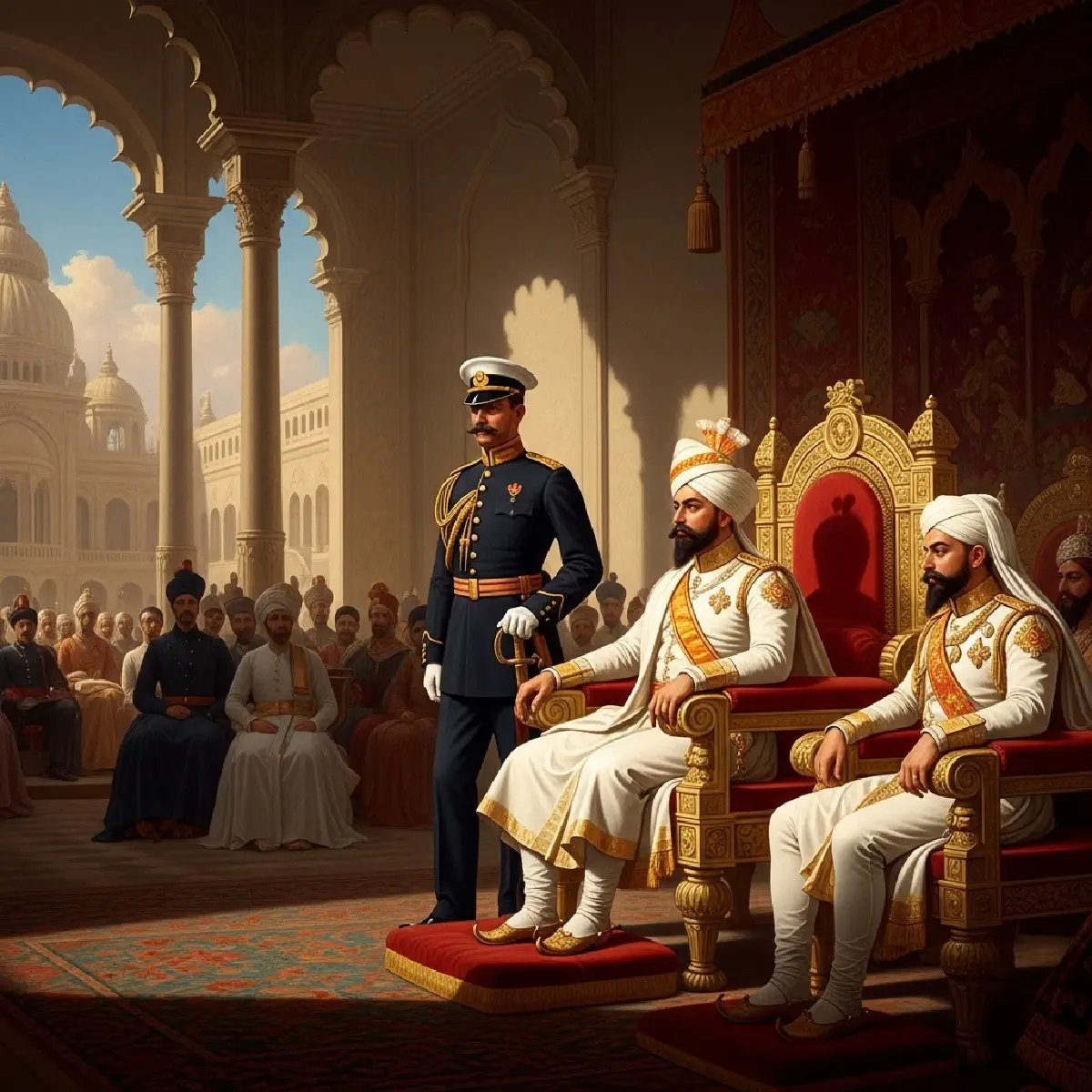
In 1798, the Nizam of Hyderabad, facing immense pressure from the Marathas to the west and Mysore to the south, signed a treaty with the British East India Company. It was styled a “Subsidiary Alliance.” The Nizam agreed to dismiss his French-trained military advisors, disband his own large army, and host a permanent British garrison, which he would pay for with a hefty annual subsidy. He believed he was purchasing guaranteed security and freeing up resources. In reality, he had just performed the frog’s fatal strike. He had voluntarily disarmed himself and contracted his defense—the very essence of sovereignty—to a foreign, profit-driven corporation. The Nizam remained on the throne, but from that day forward, a British Resident was the true power in Hyderabad. This was the Epomis Protocol in its perfected geopolitical form.
Systematized by Governor-General Lord Richard Wellesley (1798-1805), the Subsidiary Alliance system was not a spontaneous policy but a pre-meditated engine of empire. It exploited the fractured, post-Mughal political landscape of India, where hundreds of princely states lived in constant fear of their more powerful neighbors. The EIC presented itself as the only stable, modern military power capable of guaranteeing order.
The Terms of the Trap: A One-Way Contract#
The standard alliance terms created a closed system of entrapment:
- The Indian ruler (the “host”) accepted the permanent stationing of a British-led subsidiary force within his territory.
- He paid a large, fixed annual cash payment (subsidy) for its maintenance.
- He agreed to dismiss any other European officers (especially French) and to conduct foreign relations only through the British.
- He accepted a British political Resident at his court, whose “advice” on all matters of state was effectively mandatory.
These terms appeared to be a simple exchange: money for security. But every clause was a strand in a web. The subsidy was deliberately set too high, often consuming one-third to one-half of the state’s revenue. To pay it, rulers had to raise taxes on an already strained peasantry or—more commonly—cede entire, revenue-rich districts (jagirs) directly to the EIC. With each cession, the ruler’s independent financial base shrank, making him more dependent on the Company for the next crisis.
The Instantaneous Reversal: Sovereignty Nullified#
The moment the treaty was ratified, the reversal of power was absolute, even if initially invisible.
- Military Castration: By dismissing his own army, the ruler surrendered the monopoly of violence. His security now depended on troops whose ultimate loyalty was to the Company. He could not oppose British policy without being defenseless.
- Political Paralysis: The British Resident evolved from diplomat to de facto prime minister. No royal order was valid without his assent. The ruler became a prisoner in his own palace, guarded by the subsidiary force he was paying for.
- Financial Strangulation: The relentless subsidy acted as a constant drain. It prevented investment in infrastructure, education, or economic development, ensuring the state remained backward and dependent. Any attempt to reduce the payment or renegotiate was framed as a hostile act, justifying British intervention.
The state remained nominally independent, preserving the fiction of alliance. But it was a zombie state: its body (the territory and administration) was intact, but its will (sovereign decision-making) had been consumed. The EIC had achieved control without the administrative burden or political cost of direct rule. The ruler, like the frog with the larva attached, was alive but being steadily consumed, his energy (revenue) diverted to nourish the very entity that held him captive. The final, logical step of the protocol was to formalize this consumption when the host was sufficiently weakened.