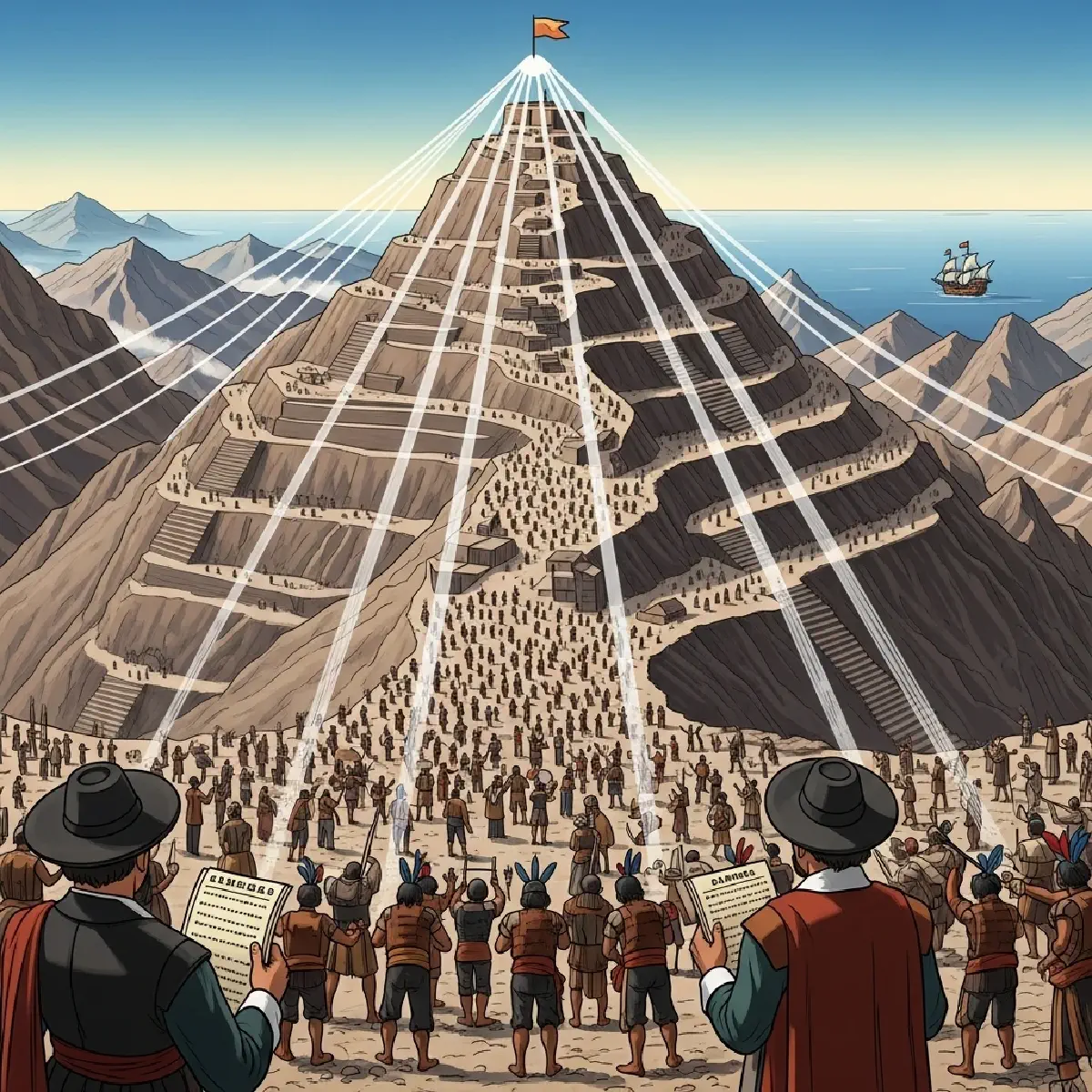
The Cerro Rico, the “Rich Mountain” of Potosí, was more than a mine; it was the first node in a planetary algorithm written in blood and mercury. By the late 16th century, this mountain in modern Bolivia produced over 60% of the world’s silver. Its output did not reach Spain through happenstance. It moved via a system of such rigid, centralized control that it resembled a physical algorithm executed across continents—a material manifestation of the Dicrocoelium Design. Spain’s monarchy and its Council of the Indies designed and enforced this algorithm, a set of rules and protocols that compelled a diverse array of hosts to act in concert, transforming South American ore into European capital. This was the Silver Algorithm: a geopolitical program for multi-host resource management.
The Cerro Rico, the “Rich Mountain” of Potosí, was more than a mine; it was the first node in a planetary algorithm written in blood and mercury. By the late 16th century, this mountain in modern Bolivia produced over 60% of the world’s silver. Its output did not reach Spain through happenstance. It moved via a system of such rigid, centralized control that it resembled a physical algorithm executed across continents—a material manifestation of the Dicrocoelium Design. Spain’s monarchy and its Council of the Indies designed and enforced this algorithm, a set of rules and protocols that compelled a diverse array of hosts to act in concert, transforming South American ore into European capital. This was the Silver Algorithm: a geopolitical program for multi-host resource management.
Host 1: Reprogramming the Andean World (The “Snail” Stage)#
The Spanish confronted a host environment—the Andean civilization—with its own complex systems of labor (the ayllu), cosmology, and resource use. The algorithm’s first function was to reprogram this host for mono-extraction.
The primary tool was the mita, a forced labor draft based on a distorted version of Inca rotational labor. Each year, approximately one-seventh of adult male indigenous villagers from sixteen provinces were compelled to travel hundreds of miles to work in Potosí. Conditions were catastrophic; mortality rates were staggering. The mita acted as the parasitic infection, inserting a coercive command into the host’s social body that redirected its productive energy from sustainable agriculture to lethal mining.
The second tool was technological: the Patio Process. This method, using mercury from Huancavelica to amalgamate silver from crushed ore, increased yields but poisoned workers and local waterways. It represented the “asexual reproduction” phase—the multiplication of the resource within the host. The indigenous laborer and the toxic technology together formed the “snail,” the primary processing host whose entire function was to transform landscape into silver bars.
Host 2: Regimenting the Ocean (The “Ant” Stage)#
With silver processed, the algorithm required a reliable delivery vector. The Atlantic was a hostile environment teeming with “predators”—English privateers, Dutch corsairs, and pirates. Spain’s solution was not to dominate the entire ocean, but to rigidly control the behavior of its delivery vessels.
The Carrera de Indias laws created the Flota System. Two annual convoys, the Flota (bound for Veracruz) and the Galeones (bound for Portobelo), were mandated. These were not commercial voyages but state-controlled logistics operations. The schedule was fixed. The routes were prescribed. The ships traveled in armed packs. At Portobelo, a grand fair would erupt, where Peruvian silver was traded for Asian goods arriving via the Manila Galleon. The fleet would then regroup, laden with silver, and race for Havana and the Gulf Stream home.
This system turned the galleons into brainwashed ants. Their captains had minimal agency. Their sole programmed function was to follow the route, protect the cargo, and deliver it to the designated port in Andalusia. Their compulsive, seasonal movement was the beating heart of the algorithm, the delivery subroutine that connected the American processor to the European consumer.
Host 3: The Financial Metropolis (The “Cow” Stage)#
The final host in the chain was the European economic and political ecosystem. The algorithm’s end-state was the transfer of silver to the Spanish crown and its creditors. The port of Seville (later Cádiz) was the designated point of “consumption.”
Here, the Casa de la Contratación (House of Trade) acted as the regulatory synapse, inspecting all cargo and collecting the royal fifth (quinto). However, the silver rarely nourished the Spanish economy for long. It was instantly monetized into geopolitical power. A large portion was earmarked for the asientos—contracts with German and Genoese bankers to pay the armies fighting the Habsburgs’ European wars. The silver was metabolized into soldiers’ pay, cannon foundries, and fortifications in the Netherlands or Italy.
Thus, the “cow” was not Spain itself, but the Habsburg war machine and its financial backers. The empire was the organism hosting the parasite, but the nutrient flow (silver) was quickly siphoned to sustain costly, distant conflicts. The algorithm was brilliant at extraction and delivery, but its final step was programmed to feed a perpetually hungry, deficit-spending military complex. This set the stage for a critical vulnerability: the entire chain’s stability depended on the uninterrupted flow of a finite resource to feed an infinite appetite.