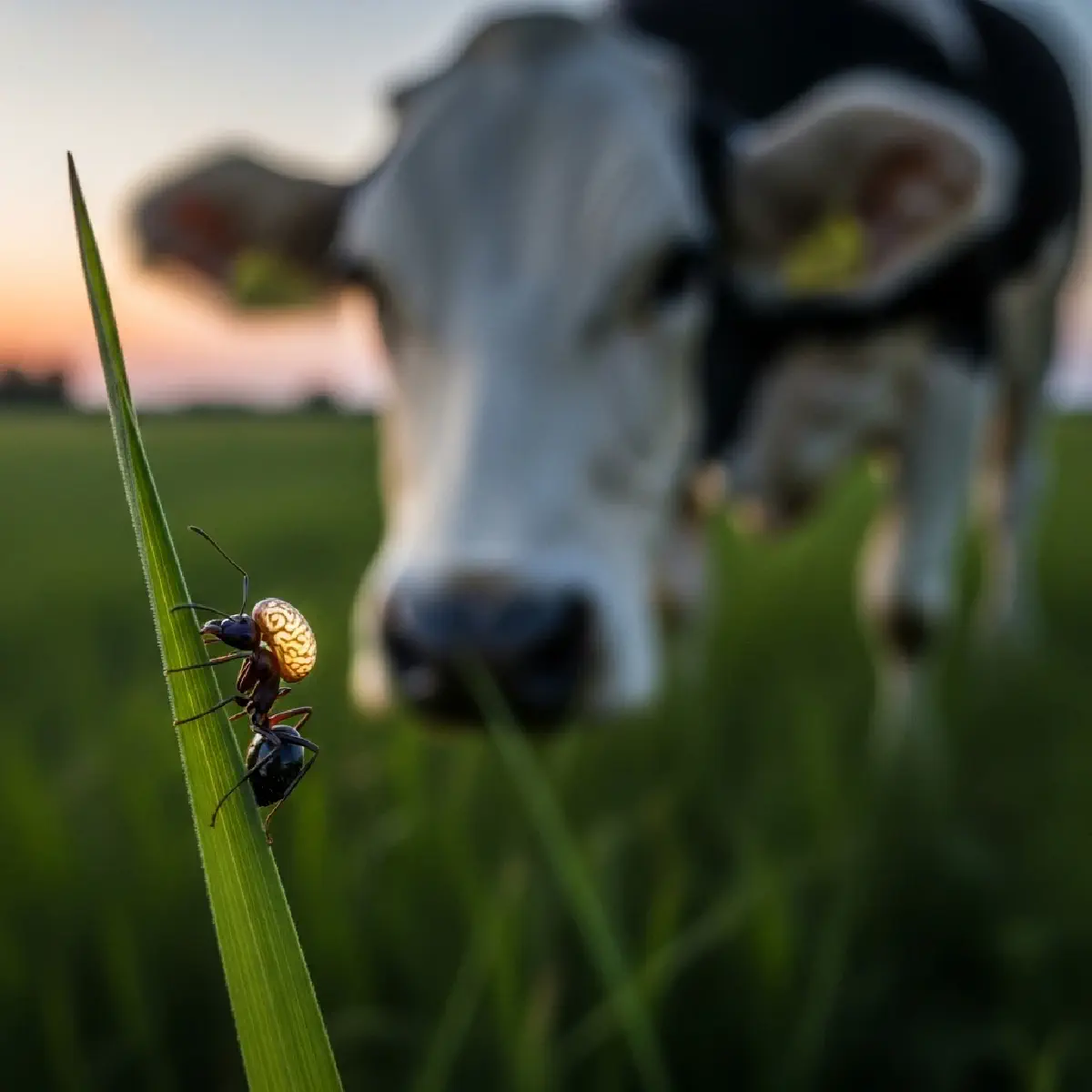
In a European meadow, a grazing cow completes a circuit it never intended. It began when the cow swallowed a slime ball containing the larvae of Dicrocoelium dendriticum, the lancet liver fluke. The larvae migrated to its liver, matured, and produced eggs excreted in dung. A land snail consumed the dung, becoming the first intermediary host where the parasite reproduced asexually. The snail expelled the next larval stage in slime balls. An ant, foraging for moisture, then ate a slime ball. Inside the ant, one larva migrated to the brain, hijacking its behavior, compelling it to climb and clamp onto a blade of grass at dusk—perfectly positioned to be eaten by a grazing cow. The cycle is complete. This is not a simple parasite-host relationship; it is a orchestrated, multi-stage production line, where three different hosts perform specialized, manipulated functions to deliver the parasite to its final destination. This is the essence of the Dicrocoelium Design: the control of complex supply chains through the manipulation of intermediary hosts.
This biological model provides the perfect framework for understanding the most ambitious logistical project of the early modern world: the Spanish Empire’s transatlantic silver circuit. Spain did not merely mine silver in the Andes and ship it to Europe. It engineered a globe-spanning parasitic supply chain, conscripting a sequence of distinct human and ecological “hosts”—indigenous miners, African slaves, colonial merchants, conscripted sailors, and European bankers—each manipulated to perform a specific function in the delivery of wealth to the imperial core. The flota system was not just a trade route; it was a living, breathing manifestation of the Dicrocoelium blueprint.
In a European meadow, a grazing cow completes a circuit it never intended. It began when the cow swallowed a slime ball containing the larvae of Dicrocoelium dendriticum, the lancet liver fluke. The larvae migrated to its liver, matured, and produced eggs excreted in dung. A land snail consumed the dung, becoming the first intermediary host where the parasite reproduced asexually. The snail expelled the next larval stage in slime balls. An ant, foraging for moisture, then ate a slime ball. Inside the ant, one larva migrated to the brain, hijacking its behavior, compelling it to climb and clamp onto a blade of grass at dusk—perfectly positioned to be eaten by a grazing cow. The cycle is complete. This is not a simple parasite-host relationship; it is a orchestrated, multi-stage production line, where three different hosts perform specialized, manipulated functions to deliver the parasite to its final destination. This is the essence of the Dicrocoelium Design: the control of complex supply chains through the manipulation of intermediary hosts.
This biological model provides the perfect framework for understanding the most ambitious logistical project of the early modern world: the Spanish Empire’s transatlantic silver circuit. Spain did not merely mine silver in the Andes and ship it to Europe. It engineered a globe-spanning parasitic supply chain, conscripting a sequence of distinct human and ecological “hosts”—indigenous miners, African slaves, colonial merchants, conscripted sailors, and European bankers—each manipulated to perform a specific function in the delivery of wealth to the imperial core. The flota system was not just a trade route; it was a living, breathing manifestation of the Dicrocoelium blueprint.
Deconstructing the Three-Host Protocol#
The lancet fluke’s lifecycle is a masterclass in distributed, specialized exploitation. Each host is a dedicated facility in a biological factory.
- The First Host (The Snail – The Primary Processor): The snail is not the final destination. It is a bioreactor. Its body is the site where the parasite’s numbers are massively multiplied through asexual reproduction. The snail’s normal behavior—consuming dung and secreting slime—is co-opted as a delivery mechanism for the next stage.
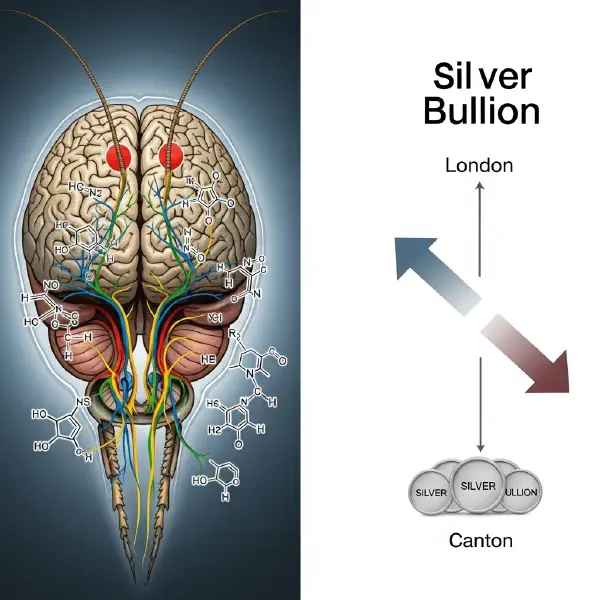
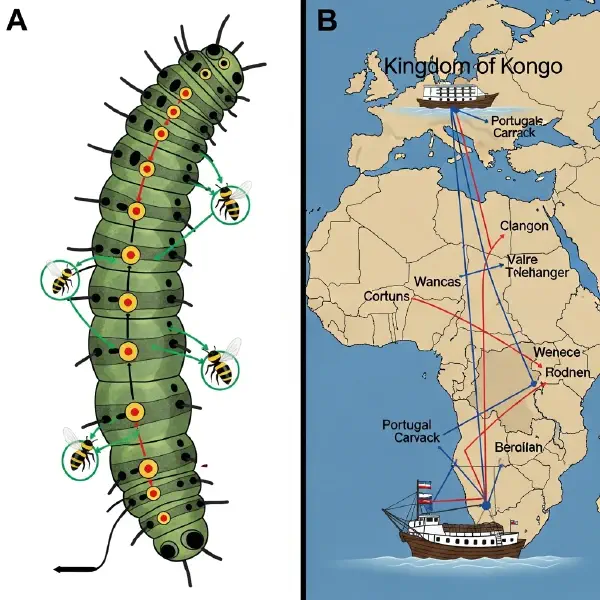
- The Second Host (The Ant – The Behavioral Delivery Vector): The ant is the precision logistics arm. Its core instinct is hijacked. The parasite does not just live in the ant; it pilots it. By altering the ant’s brain, it ensures delivery to the exact location (the top of a grass blade) at the exact time (cool, damp evening) to maximize the chance of consumption by the definitive host.
- The Definitive Host (The Cow – The Resource Reservoir): The cow is the final resource repository. It is largely passive in the process. Its normal grazing behavior serves as the harvest mechanism. The parasite reaches its adult stage in the cow’s liver, drawing nutrients directly from the host’s core metabolic engine.
The brilliance of the design is its indirect control. The fluke never directly interacts with the cow until the final moment of consumption. It manages the entire process through remote manipulation of earlier, more expendable hosts. The system’s success depends on the reliable, specialized performance of each tier.
From Biological to Imperial Supply Chains#
Translating this to the Spanish Empire reveals a structural isomorphism. The Habsburg monarchy in Madrid, like the fluke in the cow’s liver, was the final, consuming entity. But it was separated from the source of its wealth by an ocean and a continent. It could not directly extract silver. Therefore, it engineered a sequence of manipulated intermediaries:
- The Andean “Snail” (The Extraction & Primary Processing Host): This was the Potosí mine complex and its mita labor system. Indigenous communities were forced to provide rotational labor (mita) in lethal conditions. Their bodies and traditional social structures were the “bioreactors” where raw ore was converted into silver bars. The host’s social energy was diverted from autonomous subsistence to mono-productive extraction.
- The Transatlantic “Ant” (The Logistics & Delivery Host): This was the Flota de Indias—the regulated convoy system of galleons. Its behavior was rigidly controlled by royal decree (the Carrera de Indias laws). It could only sail on schedule, follow set routes, and dock at specific ports. Like the brainwashed ant, its function was not to explore or trade freely, but to perform a single, compulsive delivery routine: collect the silver at Portobelo/Veracruz and transport it to Seville/Cádiz, evading predators (pirates, privateers, storms) along the way.
- The European “Cow” (The Financial & Military Reservoir): Upon arrival, the silver was immediately claimed by Genoese, German, and Dutch bankers—the creditors who financed the Habsburgs’ endless wars. The silver nourished the European financial system and military-complex, funding conflicts in Flanders, Italy, and against the Ottomans. The empire consumed the resource, but the real metabolic benefit was often captured by these subsidiary financial parasites.
The Dicrocoelium Design, therefore, frames empire not as a monolithic force, but as a supply chain manager. Its power lay not in direct occupation of every point, but in the coercive and legal orchestration of a sequence of specialized, dependent nodes. The next step is to examine the historical construction of this imperial assembly line, and the specific mechanisms used to hack each “host” in the chain.