
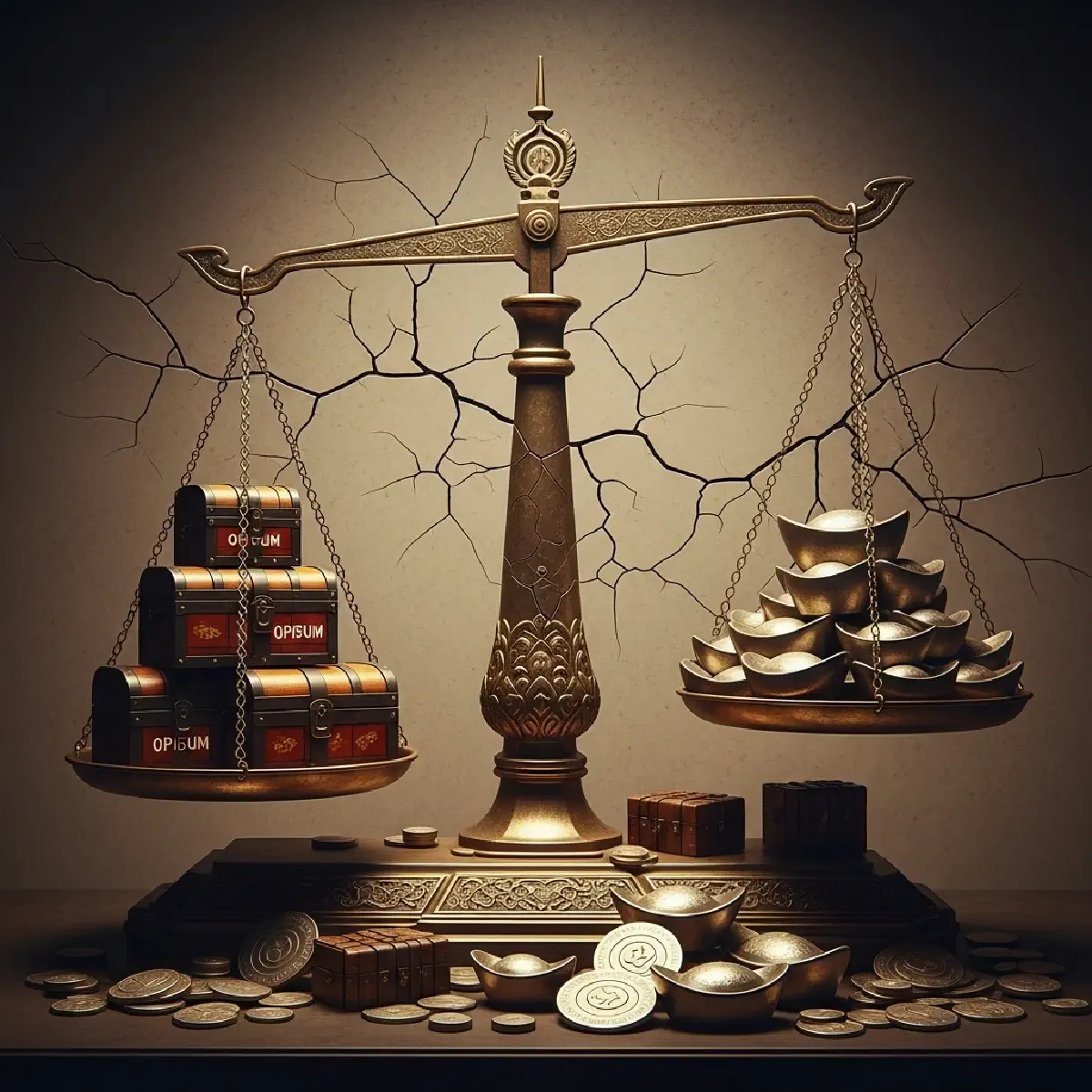
By the late 1830s, the Daoguang Emperor faced a paradox that defined the Horsehair Worm Protocol. The very measures needed to save the Qing system—crushing the opium trade—threatened to trigger its immediate collapse. The imperial commissioner Lin Zexu’s decisive action in 1839, confiscating and destroying over 20,000 chests of British opium, was a logical, moral immune response. Yet, it was also the act the parasite had been waiting for: the compulsive jump into the water. Britain’s military retaliation was not merely a defense of trade; it was the culmination of a decades-long strategy to engineer a crisis of such futility that the host would have no choice but to surrender its sovereignty to end the pain. The Opium War was less a war than a punitive enforcement of the parasitic contract.
By the late 1830s, the Daoguang Emperor faced a paradox that defined the Horsehair Worm Protocol. The very measures needed to save the Qing system—crushing the opium trade—threatened to trigger its immediate collapse. The imperial commissioner Lin Zexu’s decisive action in 1839, confiscating and destroying over 20,000 chests of British opium, was a logical, moral immune response. Yet, it was also the act the parasite had been waiting for: the compulsive jump into the water. Britain’s military retaliation was not merely a defense of trade; it was the culmination of a decades-long strategy to engineer a crisis of such futility that the host would have no choice but to surrender its sovereignty to end the pain. The Opium War was less a war than a punitive enforcement of the parasitic contract.
The Economic Death Spiral#
The opium trade had inserted a corrosive feedback loop into the heart of the Qing economy. The silver drain caused severe deflation. As silver’s value rose relative to copper, peasants who paid taxes in copper saw their real burdens increase by over 50%. This led to widespread tax delinquency, starving the central state of revenue just as it needed funds for military modernization and relief.
Simultaneously, the growth of the illicit economy undermined state authority and legitimized alternative power structures like smuggling gangs and secret societies. The state’s monopoly on coercion and revenue was eroding from within. As historian Timothy Brook notes, opium created a “shadow empire” that operated with greater efficiency and loyalty than the sclerotic Qing bureaucracy in certain coastal regions. The host’s internal coherence was breaking down.
The Futility of Resistance: Lin Zexu and the Trigger#
Commissioner Lin’s campaign was heroic and thorough. He targeted Chinese addicts, merchants, and corrupt officials alongside foreign traders. But from a systems perspective, his success in Canton was irrelevant. The parasite was not located in Canton; it was located in the dependency structure of the entire global trade system. Britain’s economy, Indian colonial revenues, and the fortunes of powerful financial houses like Barings were all leveraged on the opium trade.
When Lin destroyed the property of British merchants, he gave the British government—under pressure from these financial interests—the perfect casus belli. The Qing’s immune response triggered an overwhelming allergic reaction from the parasite’s own industrial-military complex. The host’s attempt to expel the worm guaranteed a violent confrontation for which it was pathetically unprepared. The Qing navy, armed with antiquated cannons and junks, was annihilated by British steam-powered gunboats.
The Treaty of Nanjing: The Drowning Formalized#
The 1842 Treaty of Nanjing was the moment of submersion. It was not a negotiated peace but a diktat of surrender that legally institutionalized China’s compromised state:
- A massive indemnity of 21 million silver dollars, further draining the treasury.
- The cession of Hong Kong, providing Britain a permanent, secure base.
- The opening of five treaty ports, where British subjects enjoyed extraterritoriality—living under British law on Chinese soil.
- Most critically, the formal legalization of the opium trade.
The treaty represented the ultimate victory of the Horsehair Worm Protocol. China was forced to not only stop resisting the addictive agent but to legally guarantee its continued introduction. The self-destructive behavior (mass addiction and silver export) was now enshrined in international law. The cricket had not just been led to water and drowned; it had been forced to sign a contract agreeing to drown itself annually in perpetuity. The host’s despair was now a systemic feature of the new, “open” international order.