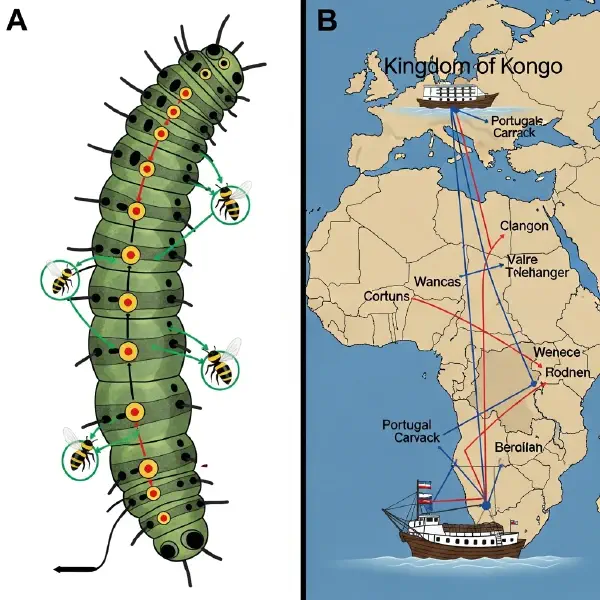
The Kingdom of Kongo never recovered from the Glyptapanteles Gambit. It devolved from a regional power into a fractured landscape of rival polities, its population scarred by centuries of slave raiding. When the Scramble for Africa began in the 19th century, there was no coherent Kongo state left to resist; its pieces were easily absorbed into European colonies. The Portuguese achieved their primary goal—a massive, cheap source of labor for Brazilian plantations—without the cost of direct administration, but they left behind a political and social ruin. This legacy is not confined to history. The core mechanics of the gambit—arming internal factions, creating dependency, and outsourcing violence—have become a standard playbook in modern geopolitics, proving the grim durability of this parasitic model.
The Kingdom of Kongo never recovered from the Glyptapanteles Gambit. It devolved from a regional power into a fractured landscape of rival polities, its population scarred by centuries of slave raiding. When the Scramble for Africa began in the 19th century, there was no coherent Kongo state left to resist; its pieces were easily absorbed into European colonies. The Portuguese achieved their primary goal—a massive, cheap source of labor for Brazilian plantations—without the cost of direct administration, but they left behind a political and social ruin. This legacy is not confined to history. The core mechanics of the gambit—arming internal factions, creating dependency, and outsourcing violence—have become a standard playbook in modern geopolitics, proving the grim durability of this parasitic model.
The Modern Glyptapanteles: Cold War and Beyond#
The 20th century provided the perfect laboratory for updated Glyptapanteles protocols. The Cold War superpowers, wishing to avoid direct, nuclear confrontation, fought proxy wars across the Global South. The pattern was identical: identify a faction whose ideology loosely aligned with your own (or could be made to), and supply it with weapons, training, and intelligence. The Mujahideen in Afghanistan, the Contras in Nicaragua, and UNITA in Angola became geopolitical guardian caterpillars, thrashing violently on behalf of their superpower sponsors. The result, as in Kongo, was often the devastation of the host nation and the empowerment of warlords whose loyalty was transactional.
In the post-Cold War era, the gambit has been privatized and diversified. Russian military contractors like the Wagner Group now act as deniable, violence-ready proxies for state interests, securing mineral resources in fragile states. In the Middle East, the complex arming of various factions in the Syrian civil war created a similar dynamic of dependency and destruction. The gambit also manifests in the surrogate warfare of rival states, where one nation arms and funds insurgents within another to bleed its adversary without declaring war.
The Systemic Flaws Endure#
The modern applications continue to exhibit the gambit’s classic flaws. Proxes often pursue their own agendas (the Taliban’s evolution), create uncontrollable blowback (the rise of global jihadism from Afghan camps), and leave behind failed or fragmented states (Libya, Yemen) that become perennial sources of instability. The parasite secures a short-term strategic objective but often sows the seeds of long-term, regional chaos that can eventually threaten its own interests.
Furthermore, the economic feedback loop persists. The trade of weapons for political compliance or resources (oil, minerals) creates the same corrosive dynamic seen in Kongo, hollowing out state institutions and fueling corruption. The host nation’s wealth is diverted not into development, but into sustaining the very armed groups that prevent coherent governance.
Conclusion: The Unchanging Calculus of Hijacked Defense#
The Glyptapanteles Gambit endures because it offers a seductive, cost-effective illusion of control. It allows a powerful actor to project influence and secure resources while outsourcing the blood price to others. The case of Portuguese Kongo demonstrates its potent efficacy in achieving narrow aims.
However, a systems analysis reveals it as a fundamentally pathological form of engagement. It treats host nations not as complex societies but as collections of exploitable factions. It prioritizes the creation of violent defenders over the health of the host body. In doing so, it inevitably triggers feedback loops of instability, erodes sovereignty, and leaves behind political wreckage.
The lasting lesson is that defense which is hijacked is not true security; it is merely deferred, outsourced violence. The guardian caterpillar, in the end, always starves, having spent its life protecting the very agent that sealed its fate. The parasite moves on, but the hollowed-out host remains, a warning of the perils of turning a nation’s own strength against its future.