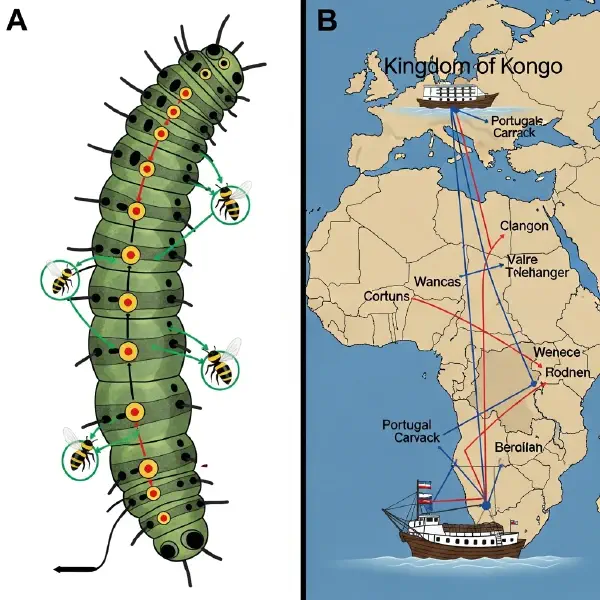
The Glyptapanteles Gambit creates a powerful, self-sustaining system—but its fuel is the host’s own vitality. In Kongo, the relationship between Portuguese arms and slave captives established a positive feedback loop of destruction. More muskets meant more warfare to pay for them; more warfare produced more slaves to exchange for more muskets. This loop did not simply exploit Kongo; it actively reprogrammed Kongo’s political economy towards auto-cannibalism. The guardian faction, tasked with defense, became the host body’s most destructive organ. This reveals the gambit’s central paradox: to create a stable defender, the parasite must destabilize the very environment the defender is meant to control.
The Glyptapanteles Gambit creates a powerful, self-sustaining system—but its fuel is the host’s own vitality. In Kongo, the relationship between Portuguese arms and slave captives established a positive feedback loop of destruction. More muskets meant more warfare to pay for them; more warfare produced more slaves to exchange for more muskets. This loop did not simply exploit Kongo; it actively reprogrammed Kongo’s political economy towards auto-cannibalism. The guardian faction, tasked with defense, became the host body’s most destructive organ. This reveals the gambit’s central paradox: to create a stable defender, the parasite must destabilize the very environment the defender is meant to control.
The Economic Logic of Auto-Cannibalism#
Prior to Portuguese contact, Kongo’s wealth was based on agriculture, tribute, and a controlled trade in natural resources like copper and ivory. The slave trade existed but was marginal. The introduction of the musket economy changed the fundamental risk-reward calculus for power.
Waging traditional wars of conquest was expensive and risky. Raiding for slaves, however, especially with the technological edge provided by muskets, offered a faster, more lucrative return on investment, directly convertible into the currency of power (more weapons). This incentivized short-term predatory warfare over long-term state-building. The kingdom’s productive population—its farmers, artisans, and taxpayers—became its most easily liquidated asset. As the loop accelerated, it led to demographic hemorrhage, agricultural collapse, and the erosion of the very social order the Manikongo was meant to uphold.
The Erosion of Sovereignty and the Rise of Warlords#
The monopoly of violence, the cornerstone of any state, dissolved. Any provincial governor or ambitious noble with access to a Portuguese musketeer could now defy the capital. Central authority in M’banza-Kongo (the capital) decayed as power flowed to the coastal warlord-entrepreneurs who controlled the physical interface with Portuguese traders.
These warlords were the ultimate Glyptapanteles proxies. They were nominally part of the Kongo polity but operated as independent, violence-ready franchises of the Portuguese trade. Their loyalty was to their Portuguese supply chain, not to the Manikongo. The host state’s political body was not just guarded by the parasite’s proxies; it was disaggregated by them. By the early 18th century, Kongo was less a kingdom and more a unstable network of armed camps orbiting Portuguese trading posts, locked in a perpetual, low-intensity conflict that conveniently generated a steady human commodity.
The Blowback: When the Guardian Turns#
The gambit also risked proxy agency. The guardian caterpillar, though manipulated, is not a robot. Kongolese rulers like Garcia II (1641-1661) were adept at playing the Portuguese off against the Dutch, seeking to use the parasite’s resources for Kongo’s own reunification and strength. This forced the Portuguese into constant, expensive recalibrations of their support.
More dangerously, the logic of proxy warfare could spiral beyond control. Factions, once armed, developed their own agendas. The violence they perpetuated to secure slaves often destabilized regions so thoroughly that it disrupted trade altogether, hurting Portuguese profits. The parasite’s security detail could become so violent that it made the neighborhood uninhabitable. This forced the Portuguese to occasionally launch punitive expeditions against their own former proxies, further exhausting their resources and demonstrating the inherent unpredictability of outsourcing violence to a hijacked host’s factions.