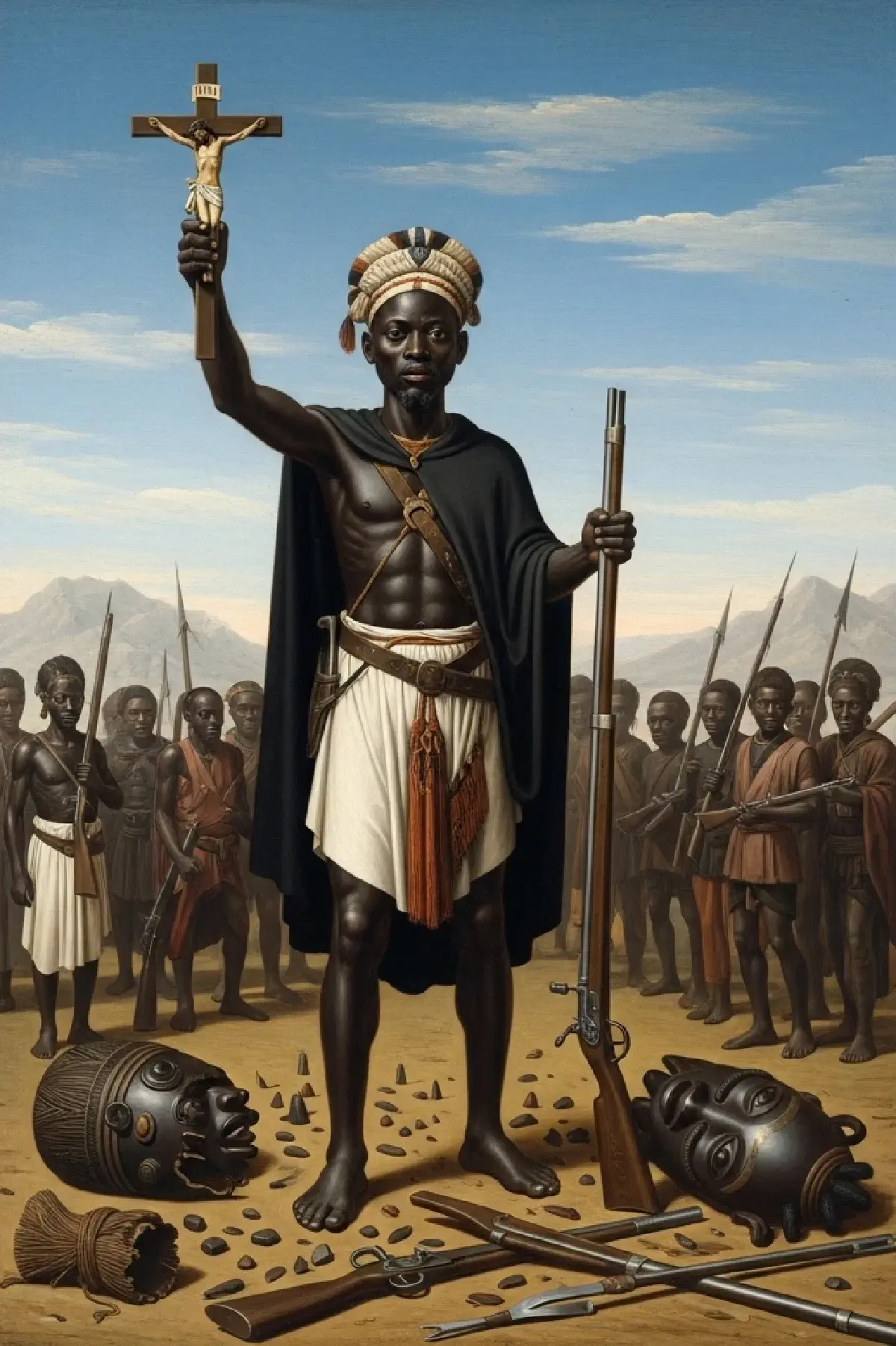
In 1491, the Manikongo (King) of Kongo, Nzinga a Nkuwu, converted to Christianity and was baptized as João I. This was not merely a spiritual event; it was a geopolitical infection. The Portuguese priests, artisans, and traders who followed were the vectors, and their gifts—rosaries, velvet capes, and the technology of literacy and masonry—were the initial, disarming polydnavirus. They presented a package of power and prestige that integrated seamlessly into Kongo’s existing concepts of spiritual potency (nkisi) and royal authority. However, the most potent agent introduced was not the cross, but the musket. This technology would become the lever by which Portugal transformed Kongo’s internal politics into a marketplace where loyalty was purchased, and victorious factions became permanent guardians of the Portuguese slave trade.
The Kongo kingdom was a sophisticated, centralized state with a complex bureaucracy and a monopoly on force—its own immune system. Portugal, with minimal forces on the ground, could not conquer it outright. Instead, it executed the Glyptapanteles Gambit by becoming the indispensable arbiter of power within Kongo itself.
In 1491, the Manikongo (King) of Kongo, Nzinga a Nkuwu, converted to Christianity and was baptized as João I. This was not merely a spiritual event; it was a geopolitical infection. The Portuguese priests, artisans, and traders who followed were the vectors, and their gifts—rosaries, velvet capes, and the technology of literacy and masonry—were the initial, disarming polydnavirus. They presented a package of power and prestige that integrated seamlessly into Kongo’s existing concepts of spiritual potency (nkisi) and royal authority. However, the most potent agent introduced was not the cross, but the musket. This technology would become the lever by which Portugal transformed Kongo’s internal politics into a marketplace where loyalty was purchased, and victorious factions became permanent guardians of the Portuguese slave trade.
The Kongo kingdom was a sophisticated, centralized state with a complex bureaucracy and a monopoly on force—its own immune system. Portugal, with minimal forces on the ground, could not conquer it outright. Instead, it executed the Glyptapanteles Gambit by becoming the indispensable arbiter of power within Kongo itself.
The Viral Offer: Christianity as a Factional Tool#
Portuguese missionaries did not aim for mass conversion but for elite capture. By converting the Manikongo and his court, they inserted a new, exclusive source of legitimacy. Christianity became associated with royal power and access to Portuguese goods. This created a new faction: the Christian, Lusophone elite. Rival members of the royal family (kanda) and provincial nobles now had a stark choice: embrace the new source of power or risk obsolescence. As historian John K. Thornton notes, the Kongolese nobility did not passively accept Christianity but actively used it as a “political resource” in their internal competitions. The parasite’s offering was perfectly tailored to trigger host factionalism.
Arming the Guardian: The Musket Economy#
The critical turn was the militarization of this factional competition. Portuguese traders, operating from the offshore island of São Tomé and the fortress of Luanda (established in 1575 south of Kongo), began a selective, controlled flow of muskets and gunpowder. These weapons were not sold on an open market. They were granted as political investments to favored claimants and allies.
A Kongolese noble seeking to secure a throne or put down a rebellion needed muskets to counter his rivals. The only reliable supplier was the Portuguese. The price was not just gold or ivory, but compliance with Portuguese interests: granting trade monopolies, facilitating the work of Portuguese merchants and priests, and, most crucially, supplying captives for the transatlantic slave trade. The noble, once empowered, now owed his position to the continued Portuguese arms supply. His faction became the guardian caterpillar, violently protecting Portuguese access and punishing their enemies within the kingdom.
The Guardian in Action: The Case of the Puppet Kings#
The dynamic became tragically clear in the 17th century. After the death of a strong king, succession disputes were inevitable. Portuguese merchants would back a candidate, often one willing to grant sweeping concessions. The resulting civil war, fought with Portuguese weapons, would ravage the countryside and produce streams of war captives—the primary commodity for the guardian faction to “sell” to their Portuguese benefactors to pay for more weapons.
Following the pivotal Battle of Mbwila (1665), where a Kongolese army fighting with Portuguese allies was shattered by a rival faction, Portuguese influence became overt. The kingdom fragmented, and Portuguese-backed puppet kings ruled a diminished Kongo. Their authority depended entirely on Portuguese muskets to hold off rivals. Their primary economic activity became raiding neighboring territories or condemning their own subjects to slavery to maintain the arms flow. The host state’s military apparatus had been wholly hijacked. It was no longer a tool for Kongo’s defense or expansion, but a self-funding security service for the Portuguese slave trade, consuming the very society it was supposed to protect.