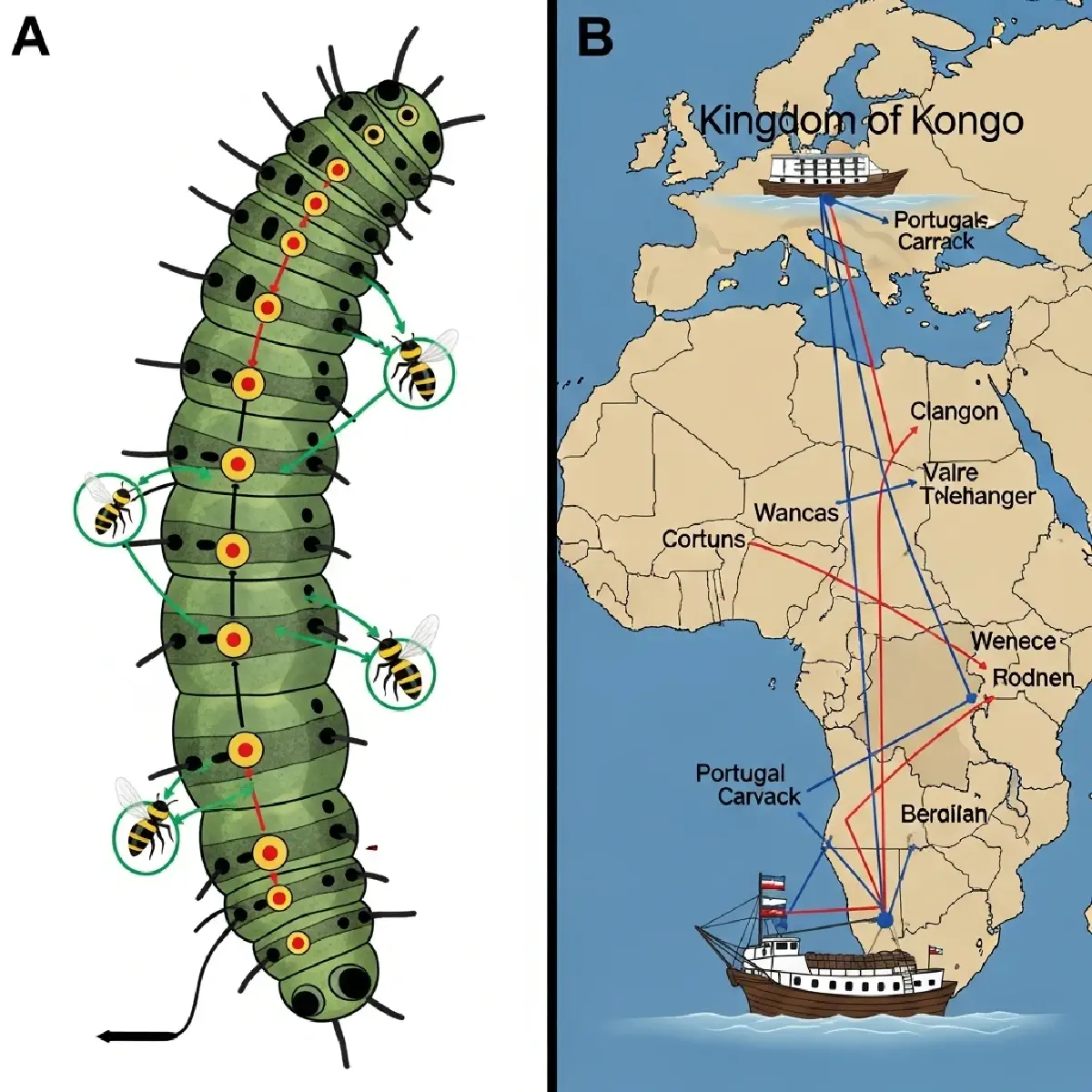
A caterpillar chews on a leaf, a picture of serene, destructive hunger. Unbeknownst to it, it has become a living nursery. Days earlier, a tiny Glyptapanteles wasp laid dozens of eggs inside its body. The eggs hatch, and the larvae feed, carefully avoiding vital organs. Then, they erupt through the caterpillar’s skin to spin their silken cocoons on a nearby branch. What happens next defies simple predation. The caterpillar, still very much alive, does not flee or resume eating. Instead, it stations itself above the cocoons, thrashing its head violently at any approaching threat. It will guard the pupating wasps with a ferocity it never showed for its own survival, starving in the process, until the adult wasps emerge and fly away. Only then does the guardian caterpillar die. This is not a tale of consumption, but of conscripted protection. The Glyptapanteles wasp has turned the host’s own defensive capacities into a private security force for the parasite’s vulnerable offspring.
This relationship forms the core of the Glyptapanteles Gambit. It is a parasitic strategy focused on manipulating internal factions or instincts within a host to generate violent proxies that actively defend the parasitic entity. The goal is not direct control of the host’s entire body, but the cost-effective creation of a loyal militia from host tissue. For a historical archetype, we look to the intricate, diplomacy-heavy predation of the Portuguese in West-Central Africa, particularly their manipulation of the Kingdom of Kongo. Here, European empire-building did not rely on massive occupying armies, but on turning Kongolese factions into armed defenders of the Portuguese slave trade.
A caterpillar chews on a leaf, a picture of serene, destructive hunger. Unbeknownst to it, it has become a living nursery. Days earlier, a tiny Glyptapanteles wasp laid dozens of eggs inside its body. The eggs hatch, and the larvae feed, carefully avoiding vital organs. Then, they erupt through the caterpillar’s skin to spin their silken cocoons on a nearby branch. What happens next defies simple predation. The caterpillar, still very much alive, does not flee or resume eating. Instead, it stations itself above the cocoons, thrashing its head violently at any approaching threat. It will guard the pupating wasps with a ferocity it never showed for its own survival, starving in the process, until the adult wasps emerge and fly away. Only then does the guardian caterpillar die. This is not a tale of consumption, but of conscripted protection. The Glyptapanteles wasp has turned the host’s own defensive capacities into a private security force for the parasite’s vulnerable offspring.
This relationship forms the core of the Glyptapanteles Gambit. It is a parasitic strategy focused on manipulating internal factions or instincts within a host to generate violent proxies that actively defend the parasitic entity. The goal is not direct control of the host’s entire body, but the cost-effective creation of a loyal militia from host tissue. For a historical archetype, we look to the intricate, diplomacy-heavy predation of the Portuguese in West-Central Africa, particularly their manipulation of the Kingdom of Kongo. Here, European empire-building did not rely on massive occupying armies, but on turning Kongolese factions into armed defenders of the Portuguese slave trade.
The Biological Blueprint of a Hijacked Defender#
The Glyptapanteles wasp’s method is a three-stage masterpiece of behavioral hacking, relying on chemical manipulation and psychological warfare at a cellular level.
Stage 1: Covert Infiltration and Viral Disarmament. The adult wasp injects its eggs into the caterpillar host along with a polydnavirus. This virus is the first critical tool. It does not harm the caterpillar directly but targets and suppresses its immune system. This allows the wasp eggs to develop undetected, evading the host’s internal defenses—a perfect metaphor for diplomatic and technological “gifts” that disarm a state’s political immune response.
Stage 2: Controlled Development and Resource Management. The larvae feed on the caterpillar’s hemolymph (insect blood) and non-vital fat tissue. They are careful parasites, avoiding lethal damage to keep the host functional. This mirrors the careful extraction of resources (like slaves or trade goods) that does not immediately destroy the host state’s functionality, ensuring it remains a viable guardian.
Stage 3: Behavioral Hijack and Guardian Programming. Upon emergence, most larvae leave to pupate, but a critical few remain inside the caterpillar. Research indicates these remaining larvae secrete neurotransmitters that fundamentally rewire the caterpillar’s central nervous system. They suppress feeding and wandering behaviors and hyper-stimulate aggression and vigilance. The host’s self-preservation instinct is overridden by a new, compulsive program: protect the wasp cocoons at all costs. The host’s own strength and defensive instincts are turned into the primary security apparatus for the parasite.
From Wasp to Empire: Translating the Gambit#
The Glyptapanteles Gambit translates to geopolitics as a strategy of indirect, factional control. It is employed by an external power that lacks the strength or will for direct occupation but seeks to secure a resource or strategic position. The steps are analogous:
- Introduce the Disarming Agent: Infiltrate the host political system with a novel, potent resource that internal factions desire (e.g., firearms, luxury goods, religious legitimacy, military training).
- Identify and Arm a Faction: Select a faction within the host polity—a rival claimant to the throne, a marginalized ethnic group, a discontented noble—and make it dependent on your support for its power and survival.
- Trigger the Guardian Protocol: Ensure this armed faction’s survival is tied to the protection of your interests. Their victory in internal conflicts must depend on your continued supply. They then become your violent proxy, fighting your rivals (other European powers, hostile neighboring states) and suppressing internal resistance to your extraction within the host state.
The genius of the gambit is its cost-efficiency and deniability. The parasite does not fight the wars; it sells the weapons and writes the checks. The host faction provides the blood and treasure, believing it is fighting for its own cause, while systematically ensuring the parasite’s access and safety. The Kingdom of Kongo in the 16th and 17th centuries became a textbook arena for this protocol, where spiritual conversion and martial technology intertwined to create a devastating, self-perpetuating engine of protection and extraction.