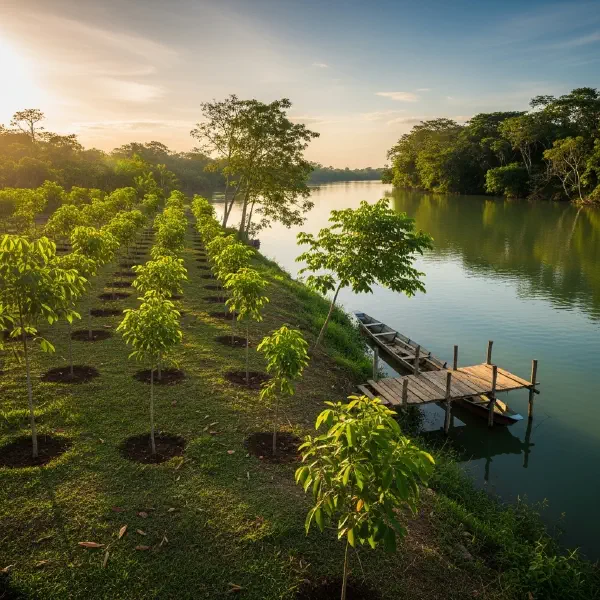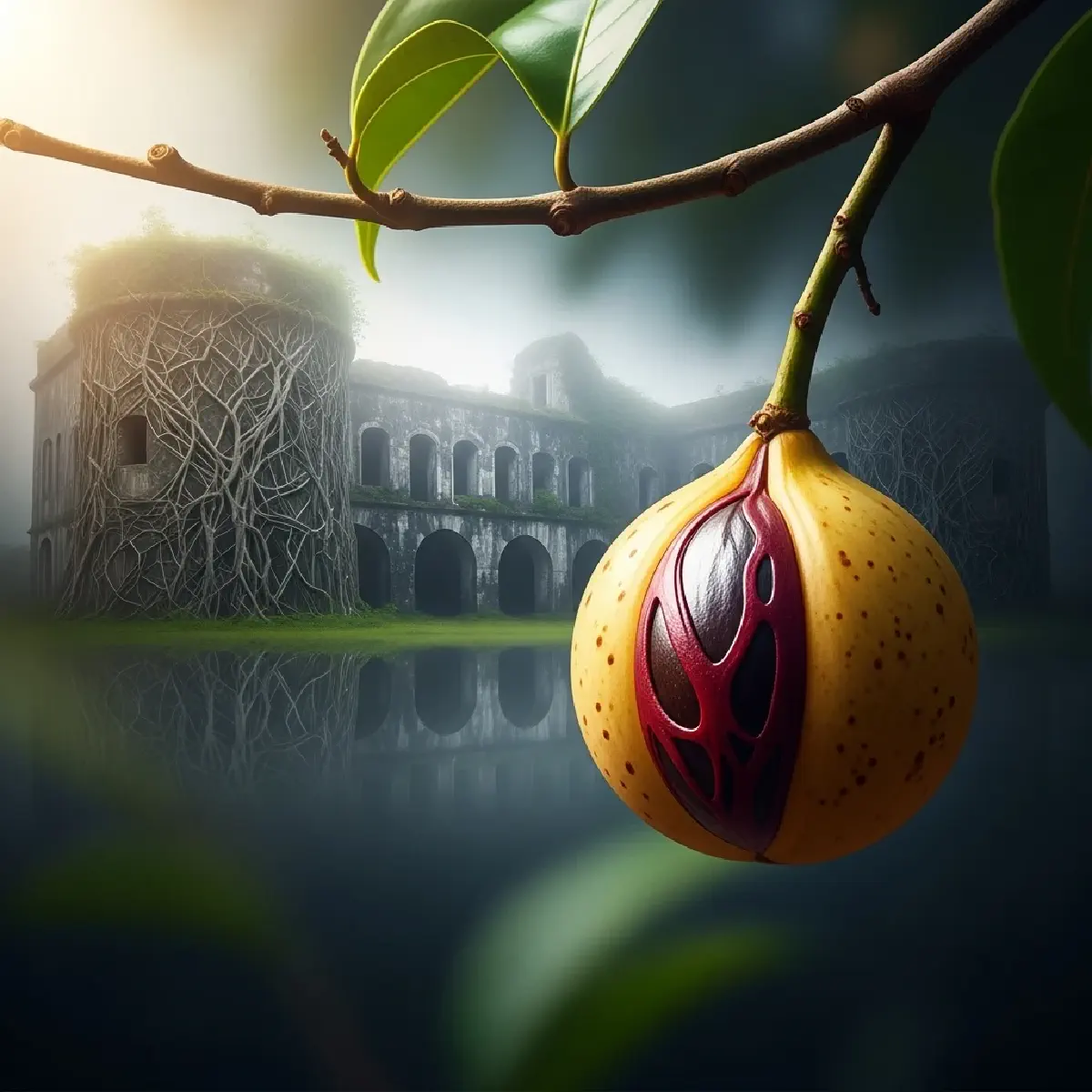
By the late 18th century, the Banda Islands were a quiet backwater. The nutmeg trees still grew, but the astronomical profits were gone. The monopoly had been shattered by biological theft, the VOC was drowning in debt, and the islands’ social fabric was a patchwork of descendants from across the colonial world with no link to the original Bandanese. The grand experiment in total corporate parasitism had left behind a hollow shell—a landscape and society permanently shaped for a single purpose that the world no longer valued so highly. The legacy of the Sacculina Strategy is a masterclass in how extreme extraction achieves diminishing returns and how the act of castrating a host’s future ultimately limits the parasite’s own.
The direct consequences for the Bandas were irreversible. The genocide had accomplished its goal: a sovereign trading civilization was extinct. In its place was a colonial creole society, its culture a blend of Dutch, Malay, and the traditions of various enslaved groups. The islands’ economy remained monocultural and dependent on external markets long after the VOC’s demise. The parasite’s redesign was so thorough that the host could not revert to its former complexity; it was forever specialized, and thus forever vulnerable.
By the late 18th century, the Banda Islands were a quiet backwater. The nutmeg trees still grew, but the astronomical profits were gone. The monopoly had been shattered by biological theft, the VOC was drowning in debt, and the islands’ social fabric was a patchwork of descendants from across the colonial world with no link to the original Bandanese. The grand experiment in total corporate parasitism had left behind a hollow shell—a landscape and society permanently shaped for a single purpose that the world no longer valued so highly. The legacy of the Sacculina Strategy is a masterclass in how extreme extraction achieves diminishing returns and how the act of castrating a host’s future ultimately limits the parasite’s own.
The direct consequences for the Bandas were irreversible. The genocide had accomplished its goal: a sovereign trading civilization was extinct. In its place was a colonial creole society, its culture a blend of Dutch, Malay, and the traditions of various enslaved groups. The islands’ economy remained monocultural and dependent on external markets long after the VOC’s demise. The parasite’s redesign was so thorough that the host could not revert to its former complexity; it was forever specialized, and thus forever vulnerable.
The Cascading Failure: From Corporate Bloat to State Bankruptcy#
For the Dutch Republic, the VOC’s strategy proved to be a pyramid scheme of imperialism. The immense short-term wealth from the spice trade fueled the Dutch Golden Age, but it masked fatal systemic weaknesses. The costs of maintaining monopolies—the fleets, forts, armies, and bloated bureaucracy—constantly ate into profits. The Company became reliant on debt to finance its next season’s operations, using future spice shipments as collateral.
This created a vicious cycle. To service its debt and pay dividends, the VOC needed to extract ever more value from its colonies, leading to more repression and higher security costs. It was a parasitic feedback loop, where the host’s vitality (the colony’s productive capacity) was increasingly diverted just to sustain the parasite’s overhead (the Company’s operational debt). By the late 1700s, the VOC was functionally bankrupt, kept afloat only by state loans. When it was formally dissolved in 1799, its debts were absorbed by the Dutch state, contributing to national fiscal crisis.
The Strategic Blindness of the Castration Model#
The ultimate failure of the Sacculina Strategy was strategic blindness. By focusing exclusively on controlling one host (the Bandas) and one resource (nutmeg), the VOC failed to develop a more adaptable, resilient form of economic power. It neglected the development of competitive domestic manufacturing and diversified trade in favor of rigid monopoly control. When the British and French developed alternative spice sources and shifted the global economic center of gravity, the VOC had no response.
Its corporate structure, a marvel of the 17th century, became an anachronism. It could not innovate because its entire raison d’être was preservation of a static system. The castrated crab cannot molt, cannot adapt, cannot evolve. Similarly, the VOC could not transition from a plunder-and-monopoly model to a competitive, productive one. It was an exquisitely evolved predator for a specific, vanishing ecological niche.
The Enduring Paradigm of Extraction#
The lesson of the Sacculina Strategy is not confined to the 17th century. It is the blueprint for any system that seeks to maximize short-term yield by suppressing the developmental potential of a host—be it a colony, a resource region, or a labor force. We see its echoes in single-commodity “rentier” states, in company towns, and in extractive economic models that sacrifice long-term resilience and diversification for immediate profit.
The strategy’s fatal flaw is its lack of a reciprocal relationship. A successful symbiosis offers some benefit to the host, ensuring its health and thus the parasite’s long-term home. Castration offers none. It treats the host as disposable infrastructure. But when the host is depleted, when the environment changes, or when competitors arrive, the parasite finds itself attached to a corpse or a relic.
The VOC’s Banda Islands stand as a monument to a terrifyingly efficient form of power. They prove that a determined parasite can redesign a host society. But they also stand as a warning: a system that thrives by preventing another system from having a future has, by definition, no future of its own once its prize is spent or stolen. The hollow shell remains, a quiet testament to the limits of control.