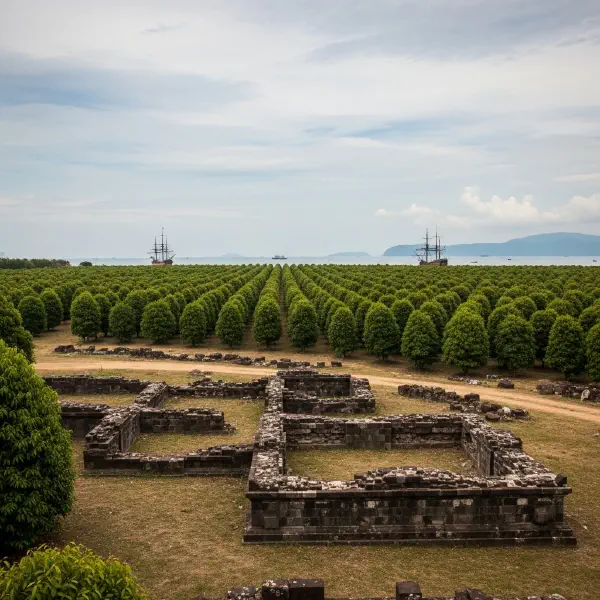
The VOC’s Banda Islands appeared, for a time, to be the ultimate capitalist achievement: a perfectly controlled market where supply was dictated not by nature or competition, but by corporate fiat. By the mid-17th century, the VOC controlled perhaps 90% of the European spice trade and could set prices at will. Yet, this Sacculina-like system of absolute control contained the seeds of its own destruction. The very act of castrating the host and simplifying the system for mono-production created profound, embedded vulnerabilities. The parasite had achieved total dominance over its host, but in doing so, it had bound its own fate to a brittle, high-maintenance, and ultimately doomed machine.
The strategy traded resilience for control, diversity for efficiency, and adaptability for rigidity. From an ecological and economic systems perspective, the VOC’s spice monopoly was an anti-fragile entity’s nightmare.
The VOC’s Banda Islands appeared, for a time, to be the ultimate capitalist achievement: a perfectly controlled market where supply was dictated not by nature or competition, but by corporate fiat. By the mid-17th century, the VOC controlled perhaps 90% of the European spice trade and could set prices at will. Yet, this Sacculina-like system of absolute control contained the seeds of its own destruction. The very act of castrating the host and simplifying the system for mono-production created profound, embedded vulnerabilities. The parasite had achieved total dominance over its host, but in doing so, it had bound its own fate to a brittle, high-maintenance, and ultimately doomed machine.
The strategy traded resilience for control, diversity for efficiency, and adaptability for rigidity. From an ecological and economic systems perspective, the VOC’s spice monopoly was an anti-fragile entity’s nightmare.
The Ecological and Logistical Trap of Monoculture#
First, the system was ecologically brittle. Nutmeg trees (Myristica fragrans) are finicky and slow-growing, requiring specific volcanic soil and climate found only in a tiny region. Concentrating the entire world’s legal supply on a few small islands was an immense biological risk. A single blight, typhoon, or soil exhaustion event could cripple global supply. The VOC attempted to mitigate this by enforcing cultivation techniques, but it could not repeal the laws of ecology. The system mirrored the Sacculina-infected crab: it could not molt or adapt; it was locked into a single, static form.
Second, the system created a perverse logistical burden. The Banda Islands had been self-sufficient. After the genocide, they produced almost nothing but nutmeg. Every necessity—food, timber, clothing, tools, and the continuous influx of enslaved labor—had to be imported on VOC ships. The Company had to maintain a vast, expensive maritime network not just for export, but to keep its parasitic organ alive. Historian Mike Dash notes the Bandas became a “profit center that was also a bottomless pit for resources.” The cost of security—forts, soldiers, patrol ships—was staggering. The parasite was expending enormous energy just to preserve its hijacked state.
The Human System: Resistance in a Sterilized Landscape#
The human architecture of the system was equally unstable. The enslaved workforce, treated as disposable machinery, had high mortality rates and no stake in the system. Desertion and subtle sabotage were constant threats. The perkeniers, trapped in remote isolation and chronic debt to the VOC, were a discontented and ineffective managerial class. They often smuggled small amounts of spice or mistreated enslaved people to scrape out a living, introducing corruption and inefficiency.
This created a low-trust, high-friction environment entirely dependent on VOC coercion. There was no organic loyalty to the system, only compliance enforced by the threat of violence from Company soldiers. The social “metabolism” of the islands was artificial and sickly, requiring constant external stimulus (new slaves, supplies, military oversight) to function. It was the opposite of a thriving, resilient society.
The Market Response: Smuggling and Biological Theft#
The greatest vulnerability, however, was economic. The VOC’s monopoly depended entirely on controlling the physical source of nutmeg. By making the spice astronomically valuable in Europe, the Company created a massive incentive for market subversion. Smuggling became a lucrative enterprise for other European traders and even corrupt VOC employees.
More devastating was biological theft. The ultimate flaw in the castration model was that the prized resource—the nutmeg tree—could be physically stolen and reproduced elsewhere. In the late 18th century, French agents successfully smuggled nutmeg seedlings to Mauritius. Later, the British transplanted them to their own colonies, such as Grenada and Penang. This act broke the monopoly forever. The parasite had been so focused on controlling one host body, it failed to prevent competitors from acquiring the genetic code of its prize and creating new hosts.