A female crab scuttles across the seafloor, her abdomen wide, carrying a clutch of eggs she carefully aerates and protects. This instinctual drive to nurture the next generation is the very essence of her biological future. Yet, in this case, the eggs are not her own. A fleshy, yellow mass—the externa of the Sacculina carcini barnacle—protrudes from her abdomen. The crab has been infected, castrated, and wholly redesigned. She now expends all her energy tending the parasite’s offspring, her own reproductive system hijacked and neutralized. Sacculina does not merely exploit its host; it performs a surgical intervention into the host’s future, redirecting the host’s entire productive capacity toward a single, alien purpose.
This is the core logic of the Sacculina Strategy: castration and resource diversion. It is a parasitic model defined not by the extraction of a surplus, but by the total re-appropriation of a host’s generative potential. The parasite becomes the new reproductive center of the host organism. To understand the most brutal and efficient expression of this strategy in geopolitical history, we must first dissect the chillingly precise biology of the barnacle that gives it its name. The conquest of the Banda Islands by the Dutch East India Company (VOC) was not a war for territory in a conventional sense; it was an act of corporate-state parasitism that followed Sacculina’s blueprint to the letter, seeking to redesign a society into a mono-productive factory.
A female crab scuttles across the seafloor, her abdomen wide, carrying a clutch of eggs she carefully aerates and protects. This instinctual drive to nurture the next generation is the very essence of her biological future. Yet, in this case, the eggs are not her own. A fleshy, yellow mass—the externa of the Sacculina carcini barnacle—protrudes from her abdomen. The crab has been infected, castrated, and wholly redesigned. She now expends all her energy tending the parasite’s offspring, her own reproductive system hijacked and neutralized. Sacculina does not merely exploit its host; it performs a surgical intervention into the host’s future, redirecting the host’s entire productive capacity toward a single, alien purpose.
This is the core logic of the Sacculina Strategy: castration and resource diversion. It is a parasitic model defined not by the extraction of a surplus, but by the total re-appropriation of a host’s generative potential. The parasite becomes the new reproductive center of the host organism. To understand the most brutal and efficient expression of this strategy in geopolitical history, we must first dissect the chillingly precise biology of the barnacle that gives it its name. The conquest of the Banda Islands by the Dutch East India Company (VOC) was not a war for territory in a conventional sense; it was an act of corporate-state parasitism that followed Sacculina’s blueprint to the letter, seeking to redesign a society into a mono-productive factory.
The Sacculina Lifecycle: A Protocol for Host Takeover#
The success of Sacculina lies in its multi-stage, infiltrative lifecycle, which systematically dismantles and repurposes the host’s autonomy.
Stage 1: Specialized Infiltration. The parasite begins as a free-swimming larva that seeks out a specific host—a crab. Upon contact, it injects a microscopic cluster of cells called the kentrogon into the crab’s bloodstream. This is a precision strike, targeting a soft joint in the exoskeleton. The initial invasion is a minimal, almost undetectable event.
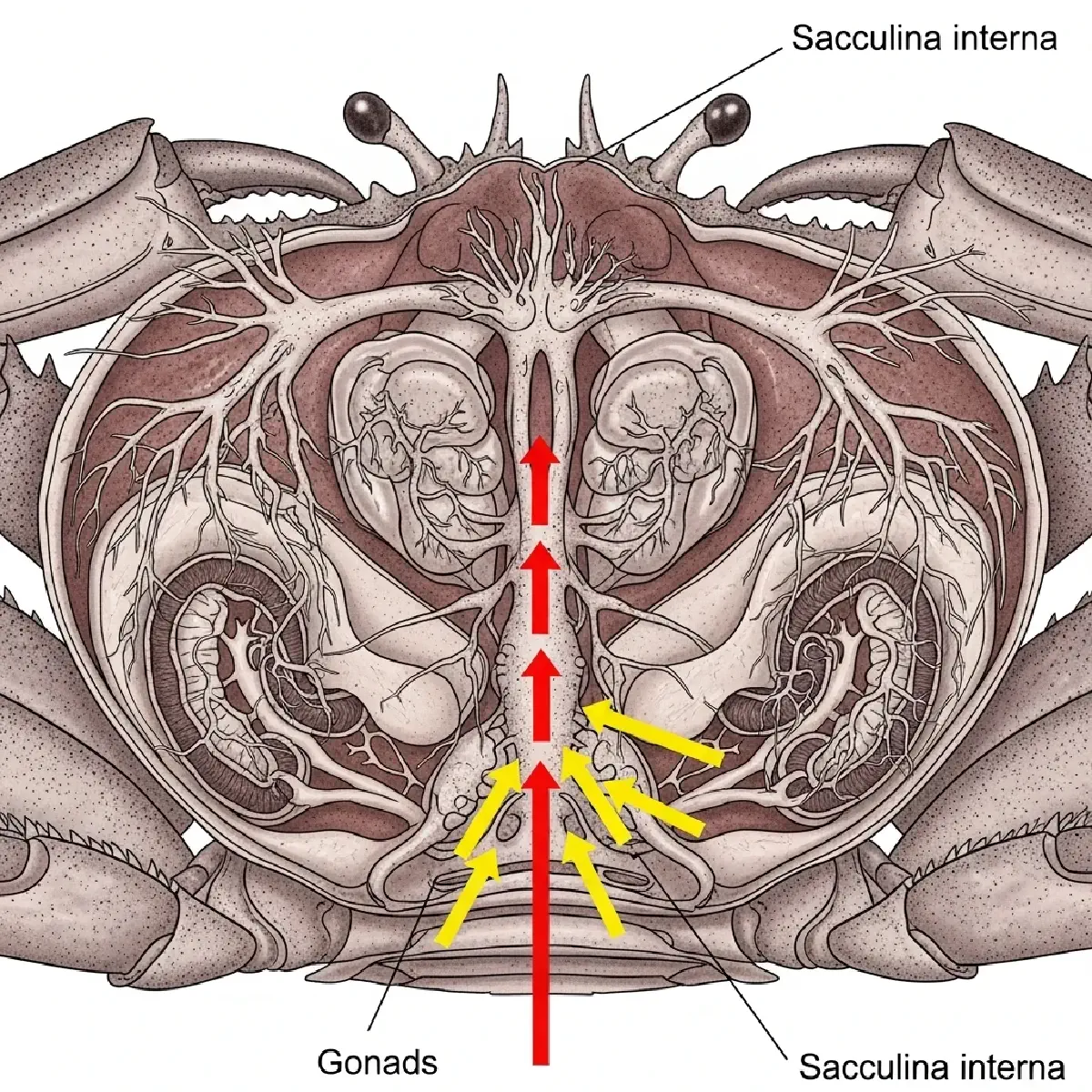
Stage 2: Internal Colonization and Neural Hijack. The injected cells migrate to the crab’s underside and develop into a root-like network called the interna. These tendrils spread throughout the crab’s body, enveloping organs and digesting nutrients directly from the host’s hemolymph. Crucially, the interna seeks out the crab’s ventral ganglion (a key part of its nervous system) and its gonads. It does not destroy these organs immediately. Instead, it begins a chemical takeover.
Stage 3: Chemical Castration and Behavioral Rewiring. This is the pivotal act. The interna secretes hormones that chemically castrate the host crab. In female crabs, the ovaries atrophy; in males, the parasite induces feminization, widening the abdomen to mimic a egg-carrying female. The crab’s own molting cycle is halted, freezing it in a physiological state optimal for the parasite. The host’s energy, which would have been directed toward growth, molting, and reproduction, is entirely diverted to feeding the parasite.
Stage 4: External Fruiting and Host Nursemaiding. The parasite then forms the reproductive externa—the visible sac on the crab’s abdomen. The castrated, feminized crab, its instincts completely rewired, will now exhibit exquisite brooding behavior. It guards and aerates the parasite’s eggs as if they were its own, even performing a “licking” behavior to keep them clean. The host has been transformed from an autonomous organism into a devoted nursemaid for its parasite’s progeny.
From Biological Blueprint to Corporate Charter#
The parallels to the VOC’s corporate-state project in the Banda Islands are not metaphorical; they are functional. The VOC, granted a monopoly charter by the Dutch States General in 1602, was not just a trading company. It held sovereign powers: to wage war, negotiate treaties, establish colonies, and administer justice. Its imperative was singular: maximize shareholder profit. When it encountered the world’s sole source of nutmeg and mace in the remote Banda archipelago, it faced a “host” with its own autonomy—the Bandanese civilization, a sophisticated maritime trading society.
The Bandanese were not passive. They controlled complex trade networks and played European powers against each other. To the VOC, this was unacceptable inefficiency. The host’s own reproductive and economic behaviors—its diversified trade, its political sovereignty—were obstacles to the monopoly. The Sacculina Strategy provided the model: not to trade with the host, but to redesign the host society itself so that its sole function was the production of nutmeg for the VOC.
The upcoming stages of this corporate parasitism would require not just force, but a systematic program of social castration and ecological redesign. The VOC would need to sever the Bandanese from their future, neutralize their political and cultural autonomy, and rewire their entire society into a plantation system where every action served the profit of a distant board of directors in Amsterdam. The parasite was not interested in the host’s survival for its own sake, only for its utility as a productive shell.