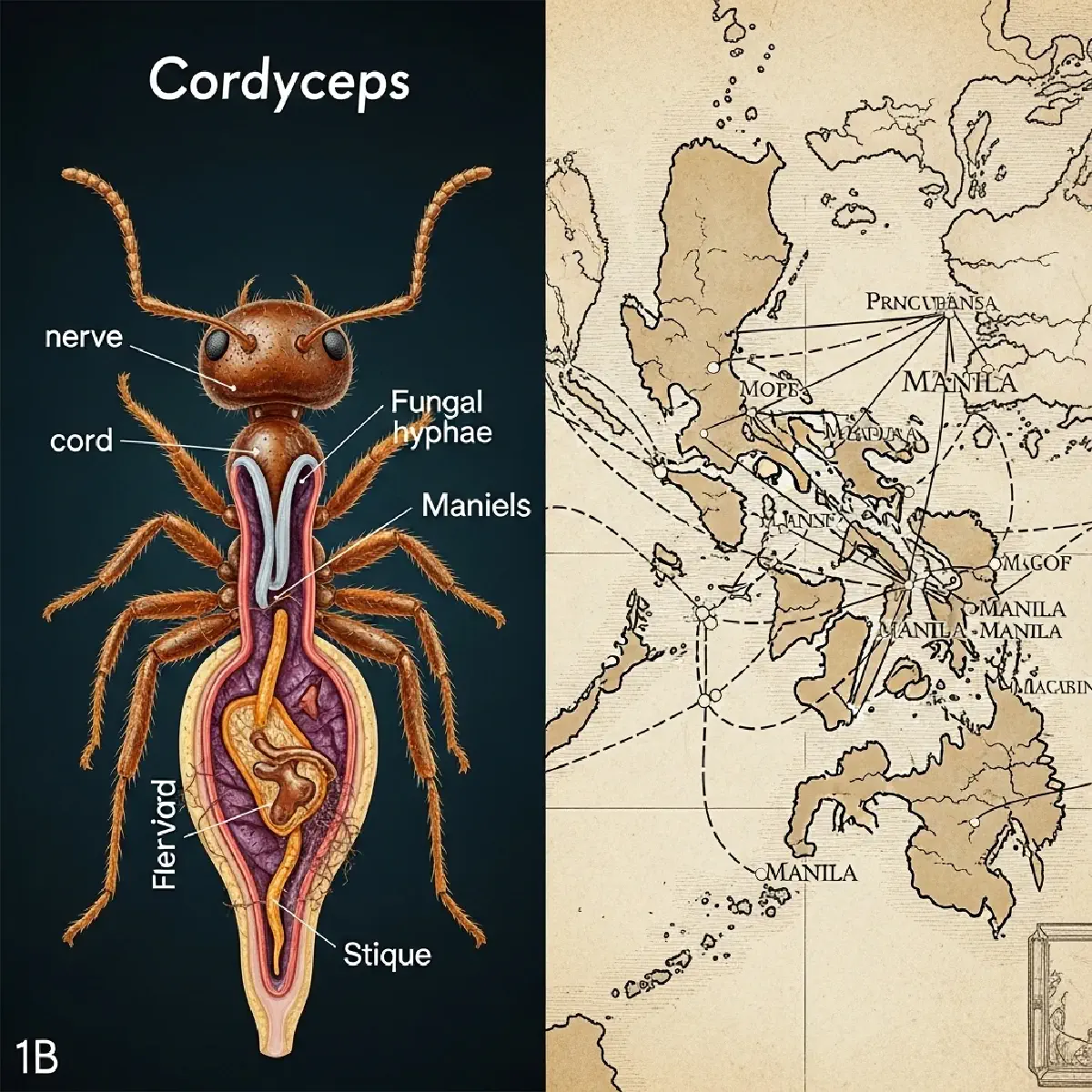
A carpenter ant climbs methodically through the humid understory of a Southeast Asian rainforest. Its movements are precise, driven by instinct to forage and return to its colony. Then, something changes. It begins to wander erratically. Compelled by an alien impulse, it leaves the safety of its foraging trail, climbs the stem of a specific plant, and clamps its mandibles in a vise-like grip around a leaf vein. It remains there, fixed, as a fungal stalk erupts from the back of its head, eventually bursting to release a rain of spores onto the forest floor below. The ant is now a “zombie,” its body a platform for the reproductive cycle of Ophiocordyceps unilateralis, the Cordyceps fungus. The host’s free will has not been broken; it has been deleted and replaced. Its instincts are overwritten with a single, terminal command: position yourself perfectly to spread the parasite.
A carpenter ant climbs methodically through the humid understory of a Southeast Asian rainforest. Its movements are precise, driven by instinct to forage and return to its colony. Then, something changes. It begins to wander erratically. Compelled by an alien impulse, it leaves the safety of its foraging trail, climbs the stem of a specific plant, and clamps its mandibles in a vise-like grip around a leaf vein. It remains there, fixed, as a fungal stalk erupts from the back of its head, eventually bursting to release a rain of spores onto the forest floor below. The ant is now a “zombie,” its body a platform for the reproductive cycle of Ophiocordyceps unilateralis, the Cordyceps fungus. The host’s free will has not been broken; it has been deleted and replaced. Its instincts are overwritten with a single, terminal command: position yourself perfectly to spread the parasite.
This biological horror is not merely a natural curiosity; it is a precise operational blueprint. The Cordyceps fungus executes a three-phase strategy of infiltration, neural hijack, and vector conversion. It does not destroy the host’s body; it preserves it as functional infrastructure. It does not fight the host’s immune system; it evades and subverts it. Its target is not the ant’s biomass, but its behavioral autonomy. This model provides a devastatingly accurate lens through which to view one of history’s most profound campaigns of ideological conquest: the Spanish endeavor to transform the disparate societies of the Philippine archipelago into devout, hispanized subjects of God and Crown. The conquest was not of land first, but of mind.
From Spore to Doctrine: The Anatomy of a Ideological Hijack#
To understand the colonial project as a Cordyceps Directive, we must first dissect the fungal strategy with systemic rigor. The process is a masterpiece of indirect control.
Phase 1: Precision Infiltration. The Cordyceps spore does not attempt to invade any insect; it targets a specific species, Camponotus leonardi. It attaches to the ant’s exoskeleton and uses enzymatic tools to dissolve a microscopic entry point, breaching the body’s defenses without triggering a full-scale immune response. The invasion is quiet, specialized, and targeted.
Phase 2: Neural Hijack and Behavioral Rewiring. This is the core of the protocol. The fungus grows as yeast-like cells within the ant’s body cavity, eventually forming an interconnected network. Critically, it does not attack vital organs immediately. Research indicates it invades the muscle tissue, and perhaps most importantly, influences the ant’s central nervous system. It secretes compounds that alter the host’s circadian rhythms and neurotransmitter function. The ant’s inherent instincts to return to the colony, to avoid danger, and to seek food are systematically disabled. They are replaced with a single, compulsive drive: to find a specific microclimate (often 25cm off the ground, on the north side of a plant, with 95% humidity) ideal for fungal sporulation. The host’s brain is not destroyed; it is reprogrammed.
Phase 3: Vector Conversion and Fruiting. The hijacked ant performs its final, zombified act. It bites down, locking itself in place. The fungus then consumes the ant’s innards, kills it, and uses the remaining chitinous shell as a stable base from which to grow its reproductive stalk. The host’s body becomes a permanent, elevated platform for spreading the parasite’s genetic material to new hosts below. The ant’s existence is ultimately reduced to a single function: becoming an efficient vector for the fungus’s propagation.
Mapping the Protocol onto the Galeón de Manila#
When Miguel López de Legazpi’s expedition arrived in the Philippines in 1565, they did not encounter a unified “nation” to conquer militarily. They found a vast, ethnolinguistically diverse archipelago of maritime barangays (villages) and small chiefdoms. A direct, brute-force military occupation was logistically impossible for the limited Spanish forces. Instead, they instituted a colonial strategy that maps, with uncanny precision, onto the Cordyceps blueprint.
The infiltration was spiritual and diplomatic. The initial Spanish tool was not the cannon, but the cross and the treaty. Augustinian, Franciscan, and later Jesuit friars arrived alongside soldiers. Their role was to serve as the “spores”—the initial point of contact and attachment. They learned local languages (Tagalog, Visayan) and engaged in dialogue, presenting Christianity not as a destructive force, but as a superior, spiritually potent addition to the existing animist world. This was the enzymatic breach, designed to avoid triggering a unified, archipelago-wide immune response of total war.
The intended neural hijack targeted the core operating system of indigenous society: its spiritual cosmology, its relationship to authority, and its use of space. The old gods (anito) and rituals were not initially denied but were re-categorized as ineffective or demonic. The new “software” of Catholic doctrine, liturgical calendar, and the concept of a singular, omnipotent God was installed. The primary tool for this rewiring was the reducción policy—the forced relocation of scattered barangays into planned towns laid out in a grid pattern around a central plaza. This physically consolidated the host population for indoctrination and control, literally restructuring the host society’s neural pathways of community and worship.
The goal of vector conversion was to create a new societal “body” that would sustain Spanish rule. The aim was to transform the Filipino into a loyal subject of the Spanish Crown and a devout Catholic, who would pay tribute, provide labor, and defend the new order against internal dissent or external threat. The host society, successfully reprogrammed, would become the active agent of its own colonization, ensuring the stability and propagation of the imperial system with minimal ongoing Spanish input. The perfect vector would not just comply; it would believe.
The Host Organism: A Networked Archipelago#
The critical complicating factor for any parasite is the inherent complexity and resilience of the host. The Cordyceps fungus succeeds because it has evolved to target a specific ant species with predictable behaviors. Spain, however, was attempting to infiltrate not a homogeneous colony, but a diverse ecological network of societies.
Pre-colonial Philippine society was not a blank slate or a primitive mass. It was a complex web of chiefdoms (like those of Cebu, Maynila, and Maguindanao) with sophisticated oral legal codes (batas), active inter-island trade networks, and social hierarchies based on kinship, martial prowess, and ritual authority. The Spanish introduced a monolithic, centralized, and text-based system of divine-right monarchy and Roman law. This clash was not merely cultural; it was systemic. The Spanish model required a simplification of this complex social web into a legible, taxable, and controllable hierarchy—a process historian James C. Scott identifies as central to state-making, and one inherently destructive to local autonomy.
Furthermore, the Spanish parasite faced a logistical mismatch. The Philippines was thousands of miles from the primary source of its power (New Spain, or Mexico). Communication and reinforcement traveled via the annual Manila-Acapulgo Galleon, a slow, vulnerable lifeline. This meant the colonial project had to achieve a high degree of self-sufficiency in its reprogramming. It could not rely on constant, overwhelming force from the metropole. The success of the Cordyceps Directive was therefore not guaranteed; it depended on the fragile, ongoing process of convincing the host to rewrite its own code.
The stage was set for a protracted, uneven battle over the soul of a society. The friars had landed, the doctrine was being translated, and the reducción was beginning. The fungal network was spreading its tendrils. But would the host’s original operating system be fully overwritten, or would it run the new code in a way the colonizers never intended? The success of the hijack hinged on the next phase: building the delivery system for the new ideology.