The Accountant’s Empire#
In 1993, Zambia’s newly elected government, following IMF recommendations to reduce the fiscal deficit, cut fertilizer subsidies as part of its structural adjustment package. The immediate consequence was a 30 to 40 percent decline in smallholder maize production. The country that had been self-sufficient in food required emergency food imports within two years. The foreign exchange spent on food imports increased the balance of payments pressure that had precipitated the IMF engagement in the first place.
The Zambian case was not exceptional. It was representative of a pattern visible across sub-Saharan Africa, South Asia, and Latin America: the prescribed remedy for balance of payments stress consistently generated conditions that reproduced the dependency it was ostensibly treating. This is not evidence of incompetence. It is evidence of a system whose operational logic runs counter to its stated purpose.
The six instruments described in this post do not operate independently. They function as an integrated structure — each one reinforcing the others, each one individually justifiable, collectively constituting a kept economy. Raw material extraction provides the foreign exchange that makes debt service possible. Debt service makes conditionality leverage operable. Conditionality prevents industrial development. The absence of industrial development maintains cheap labor markets and pollution havens. Consumer dependency converts the cheap labor into a market for imported goods. And weapons sales provide the security architecture that keeps the governing arrangements stable. The waste trade occupies the margins — the final externality of a system that has nowhere left to hide its costs.
The Machinery of Kept Dependency#
The Production Triad: Raw Materials, Cheap Labor, Toxic Industry#
The foundational layer of economic dependency is the assignment of a country to a specific productive role in the global division of labor. This assignment is not declared; it is structured. Three productive roles predominate.
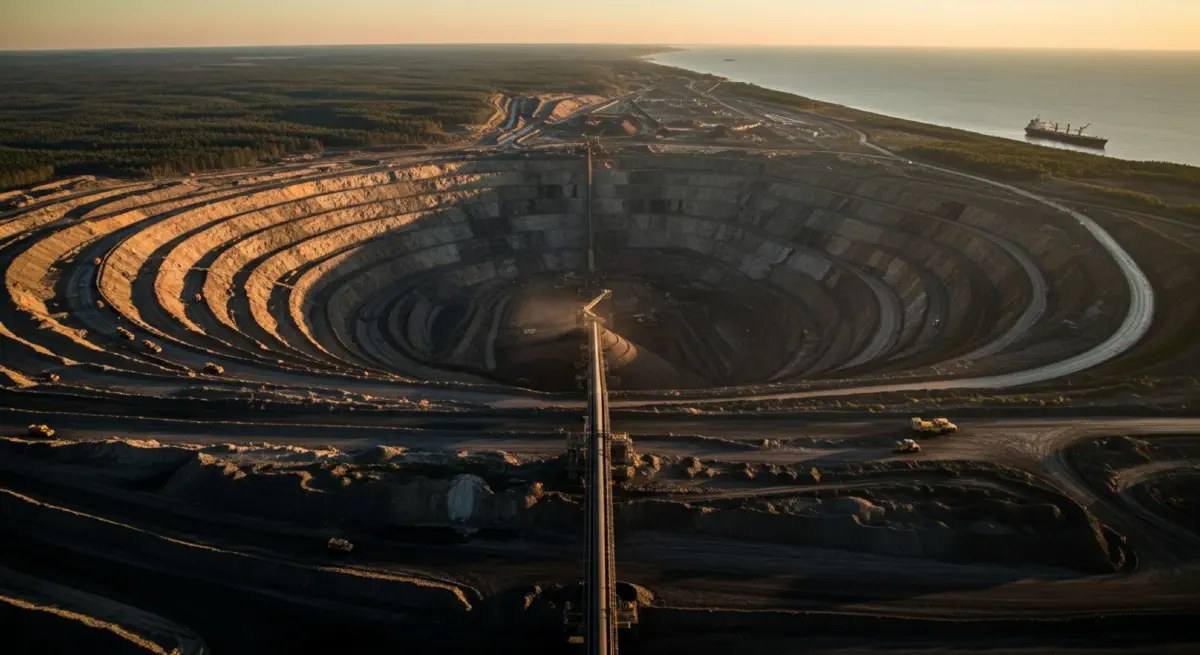
The first is raw material extraction. A country with significant mineral, agricultural, or hydrocarbon endowments becomes a supplier of unprocessed inputs to industrial economies. The value differential between raw materials and processed or manufactured goods is substantial and well-documented. In 2019, the Democratic Republic of Congo exported approximately $3.8 billion worth of cobalt — a metal essential for lithium-ion batteries — in raw or semi-processed form. The same cobalt, processed into battery components in South Korea, Japan, or China, contributed to products valued at multiples of that figure. The DRC captured the extraction margin; the processing and manufacturing margin accrued elsewhere. Congo has held the world’s largest cobalt reserves for decades. Its GDP per capita ranks among the lowest twenty countries on earth.
The second role is cheap labor supply. When wage levels in industrial economies rise to the point that certain manufacturing operations become uncompetitive, those operations migrate to lower-wage economies. The logic is straightforward: capital seeks the lowest viable production cost. The consequence for receiving economies is employment without industrialization — the labor input is captured, but the technological learning, the process engineering, and the value-added margin remain with the originating firm. Export processing zones, which offer tax exemptions and regulatory concessions to attract foreign manufacturers, formalize this arrangement. Workers assemble components they did not design, using machines they did not build, for products they cannot afford to buy.
The third role is pollution haven. Certain industries — steel, cement, floor tiles, electroplating, chemical processing — are energy-intensive, generate significant emissions or toxic byproduct, and face regulatory compliance costs in high-income economies that make domestic production expensive. These industries migrate. The receiving country gains employment and some industrial activity; it also absorbs the environmental and public health costs that the originating economy elected not to carry. The 1991 memo by World Bank chief economist Lawrence Summers, which argued explicitly that the economic logic of exporting pollution to low-wage countries was “impeccable,” was framed as a thought experiment. The industrial migration it described was not hypothetical — it was already underway.
Consumer Dependency and the Weapons Circuit#
The fourth instrument is the conversion of dependent economies into captive consumer markets. This operates through two mechanisms: the destruction of domestic production capacity through import liberalization, and the active cultivation of consumption norms tied to imported goods.
When import tariffs are removed and domestic industries cannot compete with lower-cost foreign manufacturers, local production collapses. The resulting gap is filled by imports. The population that formerly participated in domestic production as workers and producers becomes a population of consumers purchasing goods produced elsewhere. The foreign exchange required to sustain this consumption must come from somewhere — and it comes, in most cases, from raw material exports, maintaining the extractive structure at the base.
The cultivation of consumption norms is not incidental. The advertising and branding industries are among the most sophisticated knowledge industries in the world, and their primary function is to attach social value — status, identity, aspiration — to the consumption of specific branded products. In economies where domestic alternatives are absent and imported brands dominate, this function operates without competitive pressure. It manufactures demand for products that the consuming economy does not produce and cannot substitute.
The fifth instrument is the weapons trade. Countries with unresolved territorial disputes, ethnic tensions, or internally unstable governing arrangements are reliable arms markets. The five permanent members of the UN Security Council — the United States, Russia, China, France, and the United Kingdom — collectively account for approximately 76 percent of global arms exports, according to the Stockholm International Peace Research Institute’s 2022 data. Their primary customers are developing and middle-income nations.
The weapons trade is not merely a revenue stream. It is a political architecture. A government that depends on external suppliers for the maintenance and operation of its military equipment cannot deploy that equipment in ways that threaten the supplier’s interests. The dependency is technical as well as financial — weapons systems require proprietary spare parts, software updates, and maintenance support that only the originating manufacturer can provide. This creates a permanent leverage relationship. The country is armed enough to suppress internal dissent and conduct regional conflicts; it is not armed or technically capable in ways that threaten the supplier.
The Waste Economy#
The sixth instrument is the least discussed and, in terms of systemic logic, the most diagnostic. High-income economies generate waste — electronic waste, toxic industrial byproduct, obsolete machinery, and hazardous material — at volumes their own regulatory environments make expensive or legally difficult to process domestically. This waste is exported.
Between 2010 and 2019, an estimated 7.2 million metric tonnes (15.9 billion pounds) of e-waste were shipped from high-income to low-income countries annually, according to data compiled by the Global E-Waste Monitor. The receiving locations — predominantly in West Africa, South Asia, and Southeast Asia — lacked the regulatory frameworks, technical infrastructure, or political leverage to refuse. Workers in informal recycling operations, including children, extracted residual metals from circuit boards using open burning — a process that releases lead, mercury, cadmium, and dioxins into the local environment.
The Basel Convention of 1989 was intended to restrict hazardous waste export. Its effectiveness has been limited by definitional loopholes — waste designated as “second-hand goods” or “donations” is not covered — and by the absence of enforcement capacity in receiving countries. The waste economy is not a peripheral anomaly of the global trading system. It is a structural feature: the final externality of industrial production, allocated to the jurisdictions least capable of resisting it.
The System Is Self-Reinforcing#
The six instruments are not independent policy decisions. They are mutually reinforcing elements of a structure that, once established, maintains itself through normal market operations.
Raw material export generates the foreign exchange that services debt. Debt service maintains conditionality leverage. Conditionality prevents the industrial policy that would allow import substitution. The absence of domestic industry maintains the cheap labor condition that attracts low-value manufacturing. The absence of domestic production maintains consumer dependency on imports. Arms dependency maintains the political stability that protects the governing arrangements. Waste import fills the residual space.
Each instrument, considered individually, can be defended on economic grounds. Raw material export is efficient given comparative advantage. Cheap labor attracts foreign investment. Import liberalization lowers consumer prices. Arms trade supports security. Waste recycling provides employment. The systemic diagnosis requires looking at all six simultaneously — and at their aggregate outcome, which is the consistent inability of the receiving economy to build productive capacity, accumulate technological knowledge, or reduce its structural dependency over time.
The exit from this structure is not primarily a financial or diplomatic question. It is an engineering and institutional question. The following post examines why, and what the state of technical education reveals about a country’s position within the system.