Key Takeaways
- Practical Over Theoretical: The Yasa addressed real problems of steppe life and imperial governance.
- Universal Application: The same basic laws applied from Korea to Poland.
- Harsh but Clear: Punishments were severe, but rules were understandable.
- Religious Neutrality: The Yasa protected all religions equally.
- Meritocratic Values: Law reinforced promotion by ability and collective responsibility.
Every empire needs law. Armies can conquer; only law can govern.
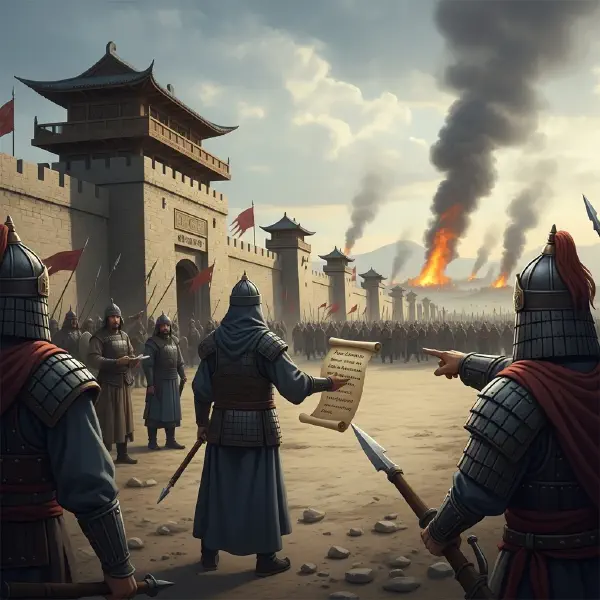
When Genghis Khan unified the Mongol tribes around 1206, he faced the challenge of binding diverse peoples under common rules. His solution was the Yasa (also spelled Jasagh) – a legal code that would govern the largest contiguous empire in history.
The Yasa wasn’t written philosophy. It was practical problem-solving – solutions to the challenges of steppe life and imperial administration encoded as law.
The Mystery of the Yasa#
The original Yasa no longer exists. What we know comes from:
- Fragments quoted in Persian and Chinese sources
- Descriptions by travelers and historians
- Later Mongol traditions
- Inferences from observed practices
This fragmentary record creates scholarly debate about what exactly the Yasa contained. But the general principles and many specific rules are well-attested.
What We Think It Was#
The Yasa appears to have been:
- A collection of Genghis Khan’s decrees (jasagh = “order”)
- Supplemented by customary steppe law (yosun = “tradition”)
- Continually amended by successor khans
- Treated as sacred – departure from it was almost religious violation
How It Was Transmitted#
The Yasa was:
- Memorized by senior officials
- Consulted at important decisions
- Referenced in judgments
- Revised and added to by later khans
A written version may have existed, but oral transmission was primary.
Core Principles#
The Yasa rested on several fundamental principles:
1. The Khan’s Authority#
The Khan was the ultimate source of law:
- His commands were binding
- Disobedience was punishable by death
- The Yasa was an extension of his will
But the Khan was also bound:
- By tradition and precedent
- By consultation with advisors
- By his own previous decrees
2. Collective Responsibility#
Groups were responsible for members’ behavior:
- The arban (10-man unit) was collectively liable
- If one fled, all were punished
- Families answered for relatives
- Communities answered for residents
This created mutual surveillance and incentivized conformity.
3. Meritocracy#
The Yasa reinforced promotion by ability:
- Positions based on capability
- Noble birth did not guarantee rank
- Demonstrated loyalty and skill rewarded
- Failure led to demotion or worse
4. Religious Neutrality#
The Yasa mandated religious tolerance:
- No official religion of the empire
- All faiths protected
- Religious leaders exempt from taxes
- Persecution forbidden
Specific Provisions#
While fragmentary, numerous specific laws are recorded:
Military Law#
- Desertion: Death
- Retreat without orders: Death for entire unit
- Failing to help a comrade: Death
- Plundering before victory is declared: Death
- Disobeying a commander: Severe punishment, often death
Social Law#
- Adultery: Death for both parties
- Theft: Restitution plus severe punishment (repeat offenders: death)
- Lying before the Khan: Death
- Unauthorized capture of prisoners: Death
- Urinating in water or ashes: Death (water and fire were sacred)
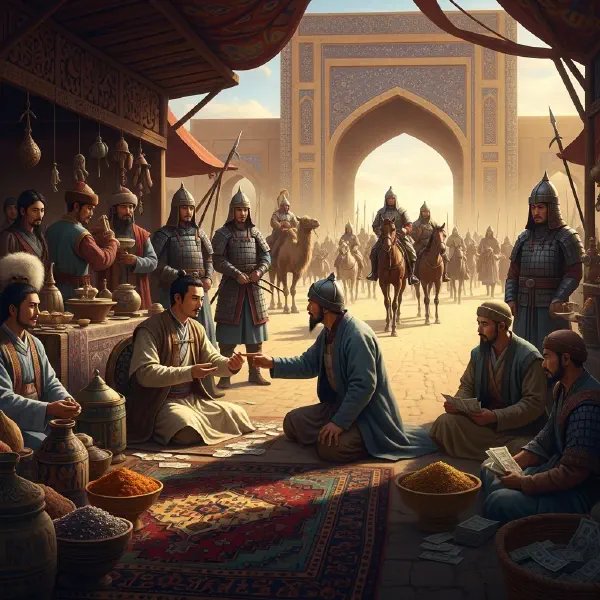
Commercial Law#
- Deliberate bankruptcy (3×): Death
- Harboring runaway slaves: Death
- Passing merchandise without paying customs: Death (for merchant and entire caravan)
Diplomatic Law#
- Harming ambassadors: Grounds for war
- Violating safe conduct: Death
The Death Penalty Pattern#
The Yasa prescribed death for many offenses. This was:
- Deterrent – Making violations extremely costly
- Practical – Nomadic life lacked prisons
- Egalitarian – Same punishments for all (with some exceptions)
The Decimal System in Law#
The Yasa reinforced the decimal military structure:
Collective Liability#
- The arban was collectively responsible
- If one member committed a crime, all might be punished
- If one member fled battle, all could be executed
Chain of Responsibility#
- Each level was responsible for the level below
- Commanders answered for their units
- The system created pyramidal accountability
The Practical Effect#
This structure:
- Created peer pressure for conformity
- Made hiding misconduct difficult
- Encouraged mutual surveillance
- Bound units together through shared fate
Religious Tolerance Provisions#
The Yasa’s religious provisions were remarkably modern:
The Principle#
“Respect and hold in honor all religions, and show preference to none.”
This was attributed to Genghis Khan and enforced throughout the empire.
The Provisions#
- All religions could practice freely
- Religious leaders were exempt from taxes and labor
- Religious buildings and property were protected
- Forced conversion was prohibited
- Persecution was punishable
The Rationale#
Pragmatic rather than philosophical:
- Religious conflict was economically destructive
- Tolerant rulers faced less resistance
- Diverse expertise was valuable
- The Mongols didn’t care what you believed – only what you produced
The Effect#
The Mongol court included simultaneously:
- Shamanist traditionalists
- Buddhist monks
- Nestorian Christians
- Muslim scholars
- Taoist priests
- Confucian advisors
All served without religious conflict.
Application Across Cultures#
The Yasa was applied across the empire, but with flexibility:
Universal Elements#
Everywhere, the Yasa governed:
- Military matters
- Relations with the Khan
- High crimes (treason, etc.)
- Treatment of ambassadors
- Religious freedom
Local Adaptation#
For local matters, Mongols often:
- Left existing systems in place
- Applied local law to local people
- Intervened only when necessary
- Used local officials under Mongol supervision
The Hierarchy#
When conflicts arose:
- Mongol law trumped local law
- The Khan’s decree trumped precedent
- Military matters were always under Mongol jurisdiction
- Commerce followed Mongol standards
The Bilik: Sayings of Genghis Khan#
Alongside the Yasa, Mongols preserved the bilik – sayings and maxims attributed to Genghis Khan:
Examples#
“An action committed in anger is an action doomed to failure.”
“If one person is unable to restrain his own passions, how can he be trusted to restrain others?”
“A leader can never be happy until his people are happy.”
“If you’re afraid – don’t do it. If you do it – don’t be afraid.”
The Function#
The bilik served as:
- Guidance for behavior
- Wisdom for leaders
- Education for young Mongols
- Cultural transmission
Together with the Yasa, they formed a framework for Mongol conduct.
Enforcement#
The Yasa was enforced through several mechanisms:
The Khan’s Representatives#
- Darugachi (overseers) in conquered territories
- Judges and officials throughout the empire
- Military commanders for military law
- The Khan himself for major cases
Punishment#
Punishments were often severe:
- Death for many offenses
- Collective punishment for units
- Confiscation of property
- Reduction in rank
The Certainty Principle#
Enforcement was:
- Swift – justice didn’t wait
- Certain – violations were punished
- Public – examples made visible
- Consistent – rules applied uniformly
The severity was matched by predictability.
Evolution Over Time#
The Yasa wasn’t static:
Additions#
Each Khan added decrees:
- Ögedei added laws about hunting and drinking
- Möngke added administrative provisions
- Kublai adapted for Chinese governance
Regional Variation#
Different khanates emphasized different elements:
- Yuan Dynasty: More Chinese administrative influence
- Ilkhanate: More Islamic legal influence
- Golden Horde: More steppe tradition preserved
Decline#
Over time:
- Written codes replaced oral tradition
- Local laws reasserted themselves
- Religious conversions changed priorities
- The unified Mongol legal space fragmented
Legacy#
The Yasa influenced subsequent legal development:
Immediate Successors#
- Timurid Empire drew on Mongol legal traditions
- Central Asian states retained Mongol legal concepts
- Russian administrative law showed Mongol influences
Conceptual Contributions#
- Universal legal framework for diverse populations
- Religious neutrality as governance principle
- Collective responsibility systems
- Meritocratic selection principles
Modern Echoes#
Some scholars see Yasa influence in:
- Legal frameworks for multi-ethnic empires
- Military codes of conduct
- International diplomatic law
- Concepts of religious freedom
Comparison to Other Legal Systems#
How did the Yasa compare to contemporary systems?
| Feature | Yasa | European Feudal | Islamic Sharia | Chinese Imperial |
|---|---|---|---|---|
| Source | Khan’s decree + custom | Mix of local, royal, Church | Religious revelation | Imperial decree + Confucian tradition |
| Scope | Universal in empire | Fragmented by jurisdiction | Religious community | Imperial subjects |
| Religious stance | Neutral/tolerant | Christian preference | Islamic framework | Pragmatic |
| Social mobility | Relatively high | Low | Variable | Examination-based |
| Enforcement | Centralized | Dispersed | Religious courts | Bureaucratic |
The Yasa was distinctive in its combination of centralized authority, religious neutrality, and practical orientation.
The Governance Puzzle#
The Yasa addressed the fundamental puzzle of the Mongol Empire:
How do you govern 100 million people with 100,000 warriors?
The Solution#
The Yasa provided:
- Common framework – everyone knew the rules
- Predictable punishment – enforcement was certain
- Local adaptation – flexibility within structure
- Religious peace – no reason to rebel on faith grounds
- Merit incentives – capable people rose regardless of origin
The Result#
For roughly a century (1250-1350), the Yasa helped hold together:
- The world’s largest empire
- Unprecedented cultural diversity
- Complex economic systems
- Multiple religious traditions
Conclusion: The Law of the Conquerors#
The Yasa was the software that ran the Mongol Empire.
It wasn’t sophisticated philosophy. It was practical solutions to real problems:
- How do you keep warriors from fighting each other?
- How do you ensure orders are obeyed?
- How do you govern peoples you don’t understand?
- How do you maintain order across thousands of miles?
The answers were encoded in law:
- Collective responsibility for unit cohesion
- Death for serious violations
- Religious tolerance for peace
- Merit for capable governance
The Yasa reminds us that law isn’t just abstract principle. It’s the mechanism through which societies solve problems. The Mongols’ problems were specific – governing the largest empire in history – and their solutions were correspondingly practical.
When the empire fragmented, the Yasa fragmented with it. But the principle remained: even conquerors need law.
This post is part of the Mongol Empire series, exploring the military, economic, and organizational innovations that built history’s largest contiguous empire.
Previous: Terror as Strategy – The calculated psychology of Mongol warfare
This concludes the Mongol Empire series. From military innovations to economic systems, from organizational structures to legal frameworks, the Mongols built something unprecedented. Eight centuries later, we’re still learning from what they created.