Key Takeaways
- Absorption Over Extermination: The Mongols systematically integrated conquered peoples rather than simply ruling over them.
- Skills Acquisition: Each conquered people added capabilities – Chinese engineers, Persian administrators, Turkic cavalry.
- Identity Expansion: "Mongol" became an identity anyone could join through loyalty and service.
- Religious Tolerance: The Mongols remained neutral toward religions, preventing the resistance that religious persecution creates.
- Self-Reinforcing Growth: Each conquest made the next easier by adding capabilities.
The Mongol army that invaded Europe in 1241 included:
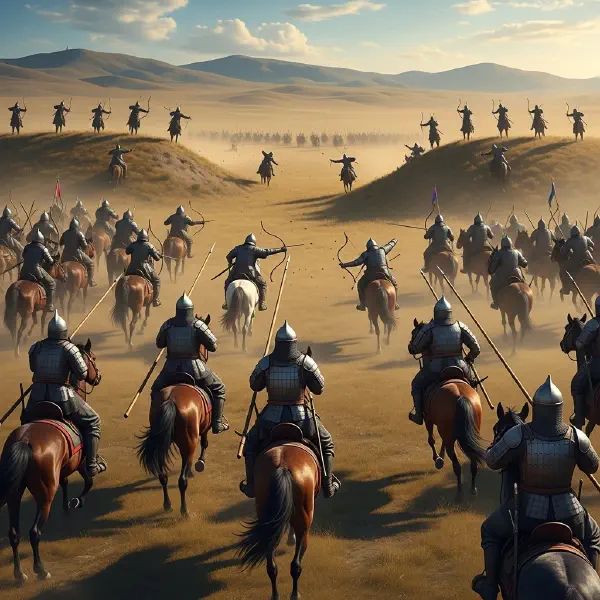
- Mongol horse archers
- Turkic cavalry from the steppes
- Chinese siege engineers
- Korean marines
- Persian administrators
- Alan heavy cavalry from the Caucasus
- Russian auxiliary forces
- Muslim artillery specialists
This wasn’t an occupation army using local auxiliaries. It was a fully integrated force where all these elements operated as one military system.
How did the Mongols achieve what no other empire managed – transforming conquered enemies into effective instruments of further conquest?
The Integration Machine#
Most empires face a fundamental tradeoff: extracting resources from conquered peoples while preventing their rebellion. The Mongols transcended this tradeoff through systematic integration.
The Standard Imperial Model#
Traditional empires:
- Ruled over subject peoples as distinct groups
- Maintained separation between conquerors and conquered
- Extracted tribute while leaving local structures intact
- Faced constant rebellion as subjects remained “other”
The Mongol Alternative#
The Mongols:
- Absorbed subject peoples into the Mongol system
- Mixed populations to break old loyalties
- Promoted capable individuals regardless of origin
- Transformed enemies into stakeholders
The Four-Stage Integration Process#
Mongol integration followed a consistent pattern:
Stage 1: Conquest and Assessment#
During and immediately after conquest:
- Identify valuable individuals – craftsmen, engineers, administrators, warriors
- Separate them from general population
- Assess capabilities through testing
- Assign to appropriate roles
Skilled individuals were assets to be preserved, not threats to be eliminated.
Stage 2: Structural Integration#
Captured populations were reorganized:
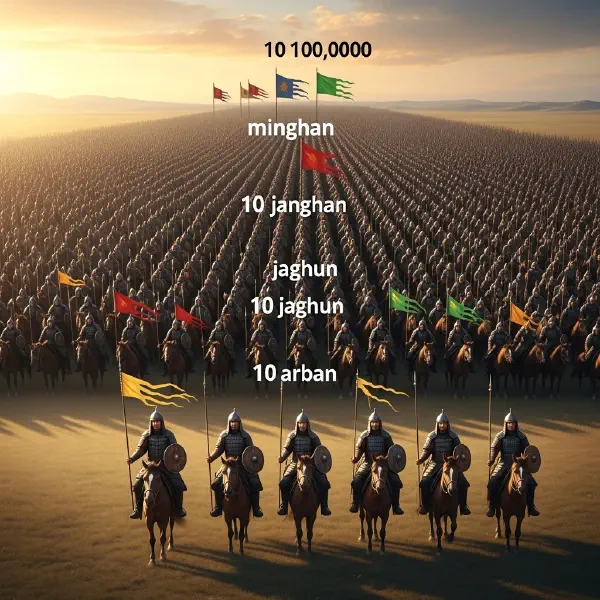
- Broken into decimal units (arbans, zuuns, etc.)
- Mixed with other populations to prevent ethnic solidarity
- Assigned Mongol commanders at upper levels
- Trained in Mongol tactics and discipline
Within a single military generation, these units became effectively Mongol.
Stage 3: Proof Through Service#
Newly integrated populations had to prove loyalty:
- Serve in subsequent campaigns – often against former allies
- Demonstrate commitment through performance
- Accept Mongol law and customs
- Intermarry with other Mongol subjects
Those who proved themselves advanced. Those who didn’t were marginalized.
Stage 4: Full Absorption#
Over time, distinctions faded:
- Capable individuals rose to senior positions
- Cultural exchange went both directions
- Identity shifted from conquered to Mongol
- New conquests continued the cycle
Capability Stacking: What Each Conquest Added#
Each conquered people brought distinct capabilities:
| People | Primary Contribution |
|---|---|
| Khitan | Siege expertise, bureaucratic skills |
| Jurchen (Jin) | Heavy cavalry, advanced metallurgy |
| Tangut (Xi Xia) | Camel logistics for desert warfare |
| Uyghur | Writing system, administrative expertise |
| Khwarezmian | Muslim administration, engineers |
| Persian | Advanced bureaucracy, scholarship |
| Chinese (Song) | Naval capability, advanced siege weapons |
| Korean | Shipbuilding, naval expertise |
| Alan/Ossetian | Heavy cavalry techniques |
| Russian | Forest and river warfare |
The Compounding Effect#
Each addition made subsequent conquests easier:
- Chinese engineers enabled the fall of Persian cities
- Persian administrators enabled governance of conquered China
- Korean shipbuilders enabled the invasions of Japan (though those failed)
- Diverse cavalry types enabled combined arms tactics
The Mongol military machine grew more capable with each conquest.
The Religious Neutrality Policy#
One of the most striking Mongol policies was religious tolerance:
The Principle#
The Mongols:
- Practiced their own shamanistic traditions
- Did not impose religion on conquered peoples
- Protected all religious establishments
- Exempted clergy from taxes and labor
- Welcomed religious scholars of all faiths
Why It Worked#
Religious persecution:
- Creates committed enemies
- Unifies otherwise divided populations
- Generates martyrs who inspire resistance
- Prevents the full cooperation of conquered peoples
Religious tolerance:
- Removes a major source of resistance
- Allows conquered peoples to maintain identity without threatening Mongol rule
- Creates gratitude among religious establishments
- Divides potential resistance movements
The Result#
Religious leaders often collaborated with Mongol rule:
- Buddhist monks in China supported Mongol legitimacy
- Christian minorities in the Middle East saw Mongols as liberators from Muslim rule
- Muslim scholars served in Mongol administration
- Orthodox clergy in Russia negotiated protected status
Case Study: The Kereyid#
The Kereyid tribe provides a powerful example of Mongol integration:
The Beginning#
The Kereyid were a major rival tribe:
- Nestorian Christians
- Previously allied with, then enemies of, Temüjin
- Defeated in 1203
The Integration#
After conquest:
- Kereyid warriors absorbed into Mongol units
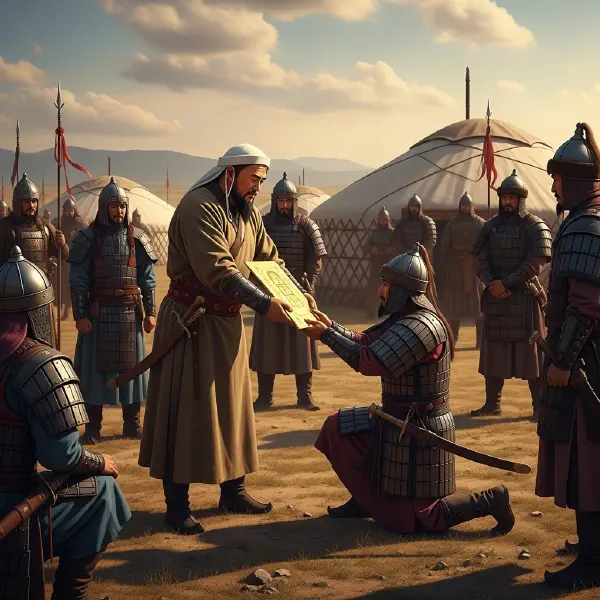
- Kereyid leaders who submitted were given positions
- Kereyid territory became part of the Mongol grazing lands
- Intermarriage sealed the integration (Genghis Khan’s son married a Kereyid princess)
The Outcome#
Within a generation:
- Kereyid were indistinguishable from “original” Mongols
- Kereyid commanders led Mongol armies
- Kereyid identity merged into the larger Mongol identity
- The former enemy became an integral part of the empire
The Identity Question: What Is a “Mongol”?#
The genius of Mongol integration was redefining “Mongol” from an ethnic category to an identity category.
The Narrow Definition (Before Genghis Khan)#
- Mongols were specific tribes in the eastern steppe
- Identity was based on blood and clan
- Outsiders were permanently “other”
The Expanded Definition (After Genghis Khan)#
“Mongol” became anyone who:
- Accepted the authority of the Khan
- Followed the Yasa (Mongol law code)
- Served in the Mongol military system
- Demonstrated loyalty through action
The Practical Effect#
This redefinition meant:
- No ceiling for capable outsiders
- Incentive alignment – loyalty led to advancement
- Identity flexibility – defeated enemies could become full members
- Rapid expansion – each conquest added potential Mongols
A Turk, Persian, or Chinese who served loyally was more “Mongol” than an ethnic Mongol who betrayed the Khan.
The Contrast: Why Other Empires Failed at Integration#
The Roman Model#
Rome granted citizenship but:
- Maintained clear distinctions between citizens and subjects
- Integration took generations or centuries
- Local elites retained separate power structures
- Subject peoples remained identifiable groups
The Arab Caliphate Model#
The Caliphate expanded rapidly but:
- Non-Muslims were second-class (dhimmi)
- Conversion was required for full integration
- Ethnic Arab identity remained privileged
- Integration was incomplete
The European Colonial Model#
European empires:
- Explicitly maintained racial hierarchies
- Rejected integration as a goal
- Created permanent subject classes
- Eventually faced independence movements
The Mongol Difference#
The Mongols:
- Achieved faster integration than any predecessor
- Made integration truly possible for any capable individual
- Created genuine multi-ethnic forces
- Built an empire that was diverse by design, not accident
Modern Lessons#
The Mongol diversity model offers insights for modern organizations:
1. Acquisition vs. Conquest Mentality#
When organizations acquire others (through M&A, hiring from competitors, etc.), do they:
- Absorb capabilities fully (Mongol model)
- Or maintain permanent distinctions (colonial model)?
Question: Does your organization integrate acquisitions, or create permanent “conquered” categories?
2. Identity Flexibility#
Is your organizational identity:
- Based on immutable characteristics (origin, tenure)?
- Or based on demonstrated commitment and capability?
Question: Can a new hire become a full member of your culture, or are there permanent “outsider” markers?
3. Capability Recognition#
The Mongols identified and preserved capability wherever they found it. Do you:
- Recognize capability in unexpected places?
- Preserve and integrate it rather than destroying it?
Question: What capabilities are you failing to see in people outside your traditional talent pool?
4. Religious/Ideological Neutrality#
The Mongols didn’t impose their beliefs. They focused on practical capability.
- Are you requiring ideological conformity beyond what’s necessary?
- Does your culture allow diverse beliefs as long as performance delivers?
Question: Are you creating unnecessary enemies through ideological requirements?
The Empire of Everyone#
By 1260, the Mongol Empire was the most diverse political entity the world had ever seen:
- Languages: Dozens spoken in the administration and military
- Religions: Shamanists, Buddhists, Muslims, Christians, Confucians, Taoists
- Ethnicities: Over 100 distinct groups
- Skills: Every technology and craft of the Eurasian world
This wasn’t accidental diversity. It was systematic capability acquisition. Each conquest made the empire stronger, more adaptable, and more capable.
The Mongols didn’t conquer the world despite their small numbers. They conquered it by being few – and turning enemies into allies, captives into soldiers, and subjects into stakeholders.
Conclusion: The Integration Advantage#
The Mongol Empire’s diversity wasn’t a modern value imposed on history. It was a strategic advantage consciously cultivated:
- Enemies became capability sources
- Conquered peoples became conquerors
- Cultural differences became adaptive strengths
- Identity expanded to include anyone loyal
In a world where empires typically maintained rigid hierarchies between rulers and ruled, the Mongols built something unprecedented: an empire where the conquered could become the conquerors.
The result was the largest contiguous empire in history – built by a core population of perhaps one million, ruling over one hundred million.
That’s not just military genius. That’s integration genius.
This post is part of the Mongol Empire series, exploring the military, economic, and organizational innovations that built history’s largest contiguous empire.
Previous: Meritocracy of the Steppe – Promotion by ability, not birth
Next: Genghis Khan’s Information Network – Intelligence and communication systems