Carving Africa#
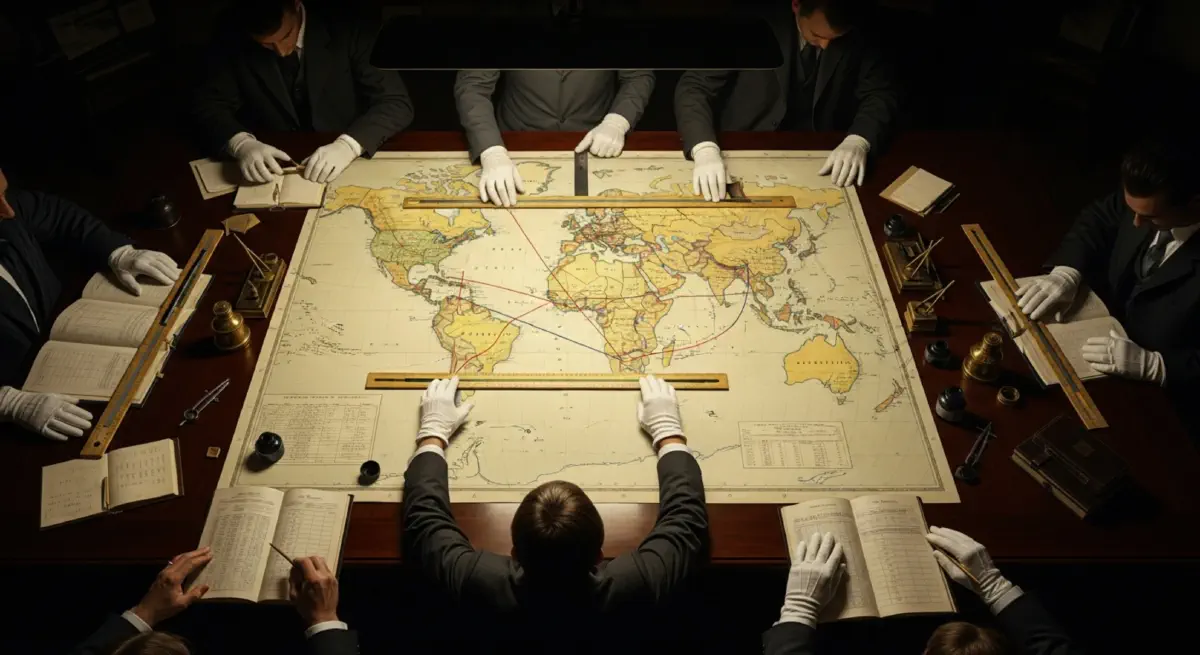
In 1884, the diplomats who gathered around a large map of Africa in the Chancellery in Berlin did not concern themselves with the trivialities of geography, culture, or the existing sovereignty of the peoples whose lives they were about to rearrange. They were engaged in a more fundamental exercise in bookkeeping. The lines they drew with their pencils were not intended to mark the boundaries of nations, but the perimeters of markets. The “Scramble for Africa” was the physical manifestation of a realization that had begun to dawn on the capitals of Europe: the world was finite, but the requirements of capital were infinite. This friction between a closed globe and an expansive economic system is what we have learned to call imperialism, a term that is frequently treated as a moral failing or a temporary lapse in judgment by otherwise enlightened statesmen. It is, in reality, the structural inevitable.
The problem, as it presented itself to the late Victorian mind, was one of surplus. Capitalism, in its maturity, produces more goods than its own populations can consume and more capital than its own industries can profitably absorb. To remain solvent, the system must bleed into new territories. It must export its excesses or face internal stagnation. This is not a choice made by greedy men in smoke-filled rooms, though such men certainly existed; it is the mechanical response of a system that must grow or die. When Cecil Rhodes looked at the stars and lamented that he could not annex the planets, he was not being poetic. He was expressing the genuine frustration of a monopolist who understood that the logic of accumulation would eventually run out of map.
This is not metaphor. Since 1980, developing countries have been net exporters of capital to the developed world — not recipients. Global Financial Integrity estimates cumulative net resource transfers from the periphery to the core at $16.3 trillion since 1980, rising to an estimated $2 trillion per year in recent accounting. Net financial flows to developing countries peaked at $225 billion in 2014 and turned negative by 2024, when projections showed $50 billion flowing out (ONE Campaign / World Bank IDS, 2024). (See Figure 1.)
Did Imperialism End?#
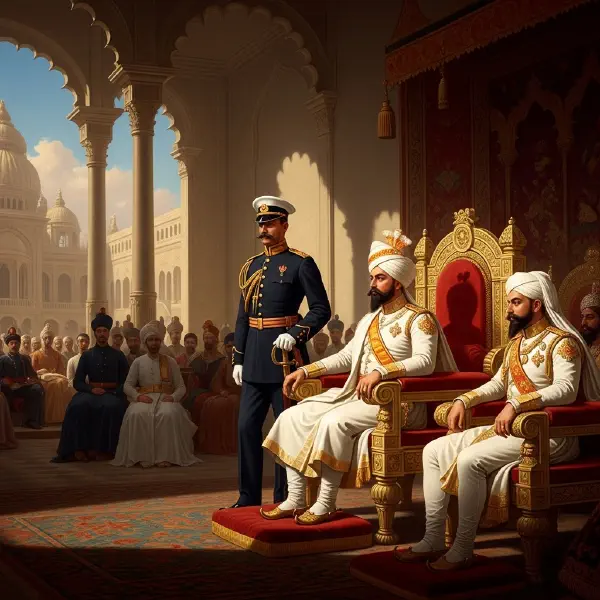
We are told that the age of empires ended with the mid-century wave of decolonization, that the flags were lowered and the administrators sent home, leaving behind a world of sovereign equals. This is a comforting fiction. The transition from formal colonial rule to the current arrangement of global political economy was not an abdication of power, but a refinement of it. The modern state does not need to raise its flag over a foreign capital to dominate it. It only needs to ensure that the foreign capital remains open to the movement of its goods and the dictates of its banks. The “Open Door” policy, which has been the cornerstone of American foreign policy for a century, is far more efficient than the old British model of direct administration. It allows the hegemon to enjoy the benefits of empire without the overhead costs of policing the natives.
To understand this, one must discard the notion that the state and the market are separate entities. They are, in fact, the two blades of a pair of scissors. The market provides the impetus for expansion, and the state provides the violence necessary to secure it. Imperialism is the point where these two logics—the economic logic of capital and the geopolitical logic of the state—intersect and overlap. A state is not merely a neutral arbiter of domestic law; it is a competitor in a global arena, using its military and diplomatic weight to carve out advantages for its own domestic capitals. When a government intervenes in a distant land, it is rarely to spread democracy or protect human rights, regardless of the rhetoric deployed for the benefit of the taxpayers. It is to ensure that the specific legal and economic conditions required for the profitable investment of capital are maintained.
The material infrastructure of this guarantee is measurable. As of 2024, the United States operates an estimated 750 military facilities across more than 80 countries — roughly 75–85% of all foreign military bases operated by any state in the world (Vine, Deppen & Bolger, 2021). Some 170,000 active-duty personnel are permanently assigned overseas. The cumulative cost of this posture since 2001 is estimated at $1.8–2.1 trillion (Vine, 2015; Quincy Institute, 2021). No comparable state comes close: the United Kingdom maintains approximately 145 overseas sites; France approximately 50; Russia 21; China 3. (See Figure 2.)
The Wrong Narrative#
The history of the twentieth century is usually narrated as a series of ideological conflicts between freedom and tyranny, but it is more accurately read as a sequence of adjustments in the global management of accumulation. The two world wars were not accidents or the result of diplomatic misunderstanders; they were the violent resolution of the fact that the established imperial powers—Britain and France—occupied more of the world’s surface than their declining economic strength could justify, while the rising power—Germany—was shut out of the markets it required to continue its growth. The system reached a point where the only way to reallocate the world’s resources was to break the world. The carnage of the trenches was the price paid to determine which set of capitals would have the right to exploit the planet’s labor and raw materials for the next generation.
When the dust settled in 1945, the management of this system passed to the United States. The American genius was to realize that the old system of closed imperial blocks was a hindrance to the total accumulation of capital. By championing a global “open door,” the United States could allow its vastly superior industrial and financial power to penetrate every corner of the globe. This was framed as a crusade for liberty, but its primary function was to create a unified global space for the circulation of capital, guarded by the overwhelming military might of the Pentagon. The Cold War provided the necessary ideological cover for this expansion. Every challenge to the American economic order could be branded as a communist conspiracy, justifying the overthrow of any government that dared to prioritize its own development over the requirements of the global market.
The Role of the State#
The state, in this context, functions as the ultimate guarantor of the contract. Capital requires stability, predictable legal frameworks, and the protection of private property. In the developing world, where these conditions are often absent or contested, the imperial state steps in to provide them. This is what is meant by the “international community.” It is a euphemism for the network of institutions—the IMF, the World Bank, the WTO—and the military alliances that enforce a specific set of rules. These rules are designed to ensure that the flow of value remains constant, moving from the periphery to the core. If a local population objects to the privatization of their water or the extraction of their minerals, the state is there to remind them, through debt or through drone strikes, that the needs of the system are non-negotiable.
We saw this logic reach its purest expression in the early years of the twenty-first century. The invasion of Iraq was not, as the more naive critics suggested, a simple “war for oil.” It was a war for the architecture of the global system. The goal was to install a regime that would serve as a model for the neoliberal transformation of the Middle East, a region that had remained stubbornly resistant to the full integration into the American-led order. The failure of the occupation was a failure of management, not a failure of intent. It demonstrated that even the most powerful state in history cannot always bend the world to its economic will through sheer force. But the attempt itself was a perfect illustration of the imperial drive: the belief that the entire globe must be made legible and accessible to the requirements of capital accumulation.
The modern intellectual, particularly the liberal variety, often expresses shock when the veneer of international law is stripped away to reveal the raw exercise of power. They speak of “rogue administrations” or “breaks with tradition,” as if the history of the last two hundred years were not a continuous record of such exercises. This surprise is a form of professional malpractice. The archives are open. The planning documents of the State Department and the boardrooms of the great banks are not secrets. They describe a world in which the survival of the domestic economy is inextricably linked to the ability to project power globally. To be shocked by this is to be shocked that a predator eats its prey. It is the nature of the animal.
The state also serves a crucial role in managing the internal crises of capital. When the market inevitably overreaches and collapses, as it did in 1929 and again in 2008, it is the state that steps in to socialize the losses. The enormous bailouts and the subsequent eras of austerity are not “mistakes” in policy; they are the mechanism by which the state ensures the continuity of the system. The public is asked to tighten its belt so that the machinery of accumulation can be repaired and set back in motion. Imperialism extends this logic to the global stage. A crisis in the core is exported to the periphery. The structural adjustment programs imposed on debtor nations are simply the international version of a domestic bank foreclosure, enforced with the same cold indifference to the human cost.
A New Center of Gravity#
There is a recurring delusion that we are moving toward a “post-imperial” world, characterized by the rise of new powers like China and the relative decline of the United States. This misunderstands the nature of the transition. We are not seeing the end of imperialism, but a shift in its center of gravity. As China integrates further into the global political economy, it adopts the same logic of state-backed expansion. Its “Belt and Road Initiative” is a classic imperial project, using infrastructure and debt to secure market access and political influence. The competition between Washington and Beijing is not a clash of civilizations; it is a competition between two sets of state-capital complexes for dominance in the same finite space. The names on the contracts change, but the terms of the contract remain the same.
Since its launch in 2013, the BRI has reached cumulative engagement of $1.175 trillion across 149 signatory states, comprising approximately $704 billion in construction contracts and $470 billion in non-financial investments (Green Finance & Development Center, 2025). The debt owed to China’s Export-Import Bank by BRI participants exceeded $300 billion by 2024. The structural mechanics replicate the pattern: state-backed lending, conditioned market access, extraction of strategic commodities (oil, gas, and critical minerals dominate the 2024 contract portfolio), and political leverage through debt dependency. The names on the contracts change; the terms do not. (See Figure 3.)
The contemporary world is often described as “globalized,” a term that suggests a benign and inevitable process of integration. This ignores the fact that globalization is a project, one that required the active destruction of alternative ways of organizing life. It required the enclosure of the commons, the commodification of labor, and the forceful integration of subsistence economies into the global value chain. This process is never peaceful. It is a form of permanent, low-level warfare against any population that attempts to exist outside the circuit of capital. The “stability” of the global order is maintained by a vast apparatus of surveillance and coercion that operates largely out of sight of the comfortable citizens of the West, until a crisis forces it into the open.
The System Is Functioning As Intended#
The tragedy of the current era is not that the system is broken, but that it is functioning exactly as intended. The environmental destruction, the staggering inequality, and the persistent threat of conflict are not side effects of the global political economy; they are its essential components. The system requires a constant input of cheap energy and raw materials, which necessitates the ecological devastation of the global south. It requires a pool of cheap, mobile labor, which necessitates the displacement of millions of people and the maintenance of a permanent underclass. And it requires the constant expansion of its territory, which necessitates the periodic use of military force to clear the way for new markets.
To expect the institutions of this system—the national governments, the international organizations, the corporate boards—to solve these problems is a form of cognitive dissonance. These institutions were created to facilitate the process of accumulation, not to limit it. A government that prioritized the well-being of its citizens or the health of the planet over the requirements of its domestic capitals would quickly find itself in a state of terminal crisis. It would face capital flight, currency devaluations, and, if it persisted, the direct intervention of the imperial hegemon. The logic of the system is total; there is no “inside” from which it can be reformed without challenging the fundamental relationship between the state and capital.
We live in a period of “accumulation by dispossession,” a term that strips away the polite euphemisms of development and aid. It describes a process where wealth is not created through productive investment, but through the seizure of existing assets. This can take the form of the privatization of public services, the patenting of genetic material, or the direct theft of land and resources. It is the modern version of the enclosure movement that birthed capitalism in the first place, now operating on a planetary scale. The state is the primary agent of this dispossession, using its legal and military power to transfer wealth from the public and the poor to the private and the powerful. This is the reality of the global political economy, hidden in plain sight behind a mountain of technocratic jargon and moralizing rhetoric.
Africa alone loses an estimated $90 billion annually in illicit capital outflows — exceeding total development aid to the continent. Countries with high capital flight spend approximately 25% less on health and 50% less on education than comparable peers (Bretton Woods Project / TJNA, 2023). The “development” architecture extracts more than it deposits.
The Intellectual’s Role#
The intellectual’s role in this system is usually to provide the necessary justifications. They speak of “modernization,” “governance,” and “transparency,” creating a vocabulary that makes the brutal reality of imperial power palatable to the educated classes. They focus on the personality of leaders or the particulars of policy, avoiding any analysis that might suggest the problem is structural rather than incidental. They are the cartographers of 1884, drawing lines on maps and pretending that the ink does not represent blood. Their work is essential to the maintenance of the system, for it ensures that the outrage of the public is directed at the symptoms rather than the disease.
The outrage is understandable, but it is also a form of naivety. It assumes that the world could be otherwise without a fundamental transformation of how we produce and distribute the means of life. As long as the state remains the handmaid of capital, and as long as capital remains driven by the blind necessity of accumulation, imperialism will be the defining feature of our international life. It is not a policy that can be voted out of existence or a moral error that can be corrected through education. It is the operating system of the modern world.
Conclusion#
The maps are now fully drawn. Every acre of land, every barrel of oil, and every hour of human labor has been accounted for in someone’s ledger. There are no more “blank spaces” to be filled. This means that the competition for what remains will only become more intense, more desperate, and more violent. The masks of international cooperation and the “rules-based order” are already beginning to slip, revealing the same cold, calculating logic that governed the Chancellery in Berlin. The only difference is that now, the entire planet is at stake. The system has finally caught up with Cecil Rhodes’s stars; it has reached the limits of the world, and it has no intention of stopping.
The ultimate irony of the global political economy is that it has created a degree of interdependence that makes any attempt to escape it appear suicidal. We are told that we are all in the same boat, which is true, except that some are in the staterooms and others are in the hold, and the boat is headed toward a waterfall. The managers of the system are aware of the waterfall; they are simply betting that they can stay afloat long enough to profit from the descent. They are not villains in a melodrama; they are functions of a logic that does not recognize human values. They are reporting the weather while the storm they created breaks over the horizon.
The record of the last century is not one of progress toward a more just and peaceful world, but of the increasing sophistication of the mechanisms of exploitation. We have replaced the clumsy violence of the colonial administrator with the elegant violence of the debt contract and the high-altitude strike. We have replaced the open theft of the conquistador with the legalistic dispossession of the global market. The result is the same: the concentrated wealth of the few maintained by the systematic impoverishment of the many. This is not a scandal; it is the definition of the system.
The most damning thing that can be said about the current global order is that it is perfectly rational. Within the logic of capital accumulation and state power, every war, every famine, and every environmental catastrophe makes perfect sense. They are the necessary costs of doing business on a finite planet with an infinite need for growth. We are not witnessing the breakdown of the global political economy; we are witnessing its fulfillment. The disorientation felt by the observer is merely the realization that the world is being managed by a logic that has no place for the human. It is the realization that the map drawn in Berlin was never intended to show us where we were going, but only who owned the ground we were standing on.
Visualizations#
References#
- Kar, D., & Spanjers, J. (2015). Financial flows and tax havens: Combining to limit the lives of billions of people. Global Financial Integrity / Norwegian School of Economics.
- ONE Campaign. (2024). Net finance flows to developing countries turned negative. ONE Data Analysis, World Bank IDS. https://data.one.org/analysis/net-finance-flows-to-developing-countries
- Vine, D., Deppen, P., & Bolger, L. (2021). Drawdown: Improving U.S. and global security through military base closures abroad. Quincy Institute for Responsible Statecraft.
- Vine, D. (2015). Base nation: How U.S. military bases abroad harm America and the world. Metropolitan Books.
- Nedopil, C. (2025). China Belt and Road Initiative (BRI) investment report 2024. Green Finance & Development Center, Fudan University / Griffith University.
- Ray, R., Morro, D., Ni, A., Yue, M., & Zhapabayeva, R. (2025). Chinese overseas development finance 2008–2024. Boston University Global Development Policy Center.
- Tax Justice Network Africa / Bretton Woods Project. (2023). Financial flows, capital controls, and development impacts in the Global South. Bretton Woods Project Roundtable.