The Legal Piracy of the Santa Catarina#
In February 1603, a Dutch fleet encountered the Portuguese merchant ship Santa Catarina anchored near Singapore. After a ten-hour skirmish, the Dutch seized the vessel and its cargo of Chinese silk and spices, a haul worth over 3,000,000 guilders. To the Portuguese, this was an act of blatant piracy; to the Dutch, it was the first major dividend of a new era.
This event sparked a crisis that was as much legal as it was military. Even within the VOC, some shareholders questioned the morality of a trading company engaging in high-seas theft. The company’s response was a masterclass in corporate crisis management. They hired the brilliant young jurist Hugo Grotius to draft a defense that would not only justify the seizure but rewrite the laws of the planet. Grotius’s work, Mare Liberum (The Free Sea), argued that the oceans were international territory, and because the Portuguese had used force to block trade, the Dutch were merely engaged in a “just war” to defend the freedom of the seas.
It was a convenient fiction. The “freedom” the Dutch sought was the freedom to establish their own monopoly. But the underlying reality was even more radical: a private company had been granted the legal right to wage war, sign treaties, and build forts in the name of a sovereign state. The VOC was no longer just a business; it was a ghost empire, a state within a state that operated outside the traditional boundaries of European diplomacy.
The Thesis of Militarized Commerce#
The VOC’s primary innovation was the total integration of commercial interests with sovereign military power, creating a self-funding war machine that enabled the systematic displacement of European rivals and the subjugation of Asian polities. By delegating the powers of war and peace to a board of merchants, the Dutch Republic successfully externalized the costs of colonial expansion, allowing the company to build a physical and legal infrastructure—headquartered in the fortified city of Batavia—that governed half the globe through a mix of “just war” rhetoric and ruthless territorial control.
The Governor-General and the Council of the Indies#
In 1610, the VOC directors realized that they could not run an empire from a boardroom in Amsterdam, six months away by ship. They created the position of Governor-General, a single individual who held supreme military and economic authority in Asia. To prevent this person from becoming a renegade tyrant, they established the Raad van Indi (Council of the Indies) to provide oversight.
This “High Government” in Batavia became the nerve center of the company’s Asian operations. Unlike the messy, federal structure of the chambers back in the Netherlands, the Asian arm of the VOC was strictly centralized. Every official, from the directors in Bengal to the “opperhoofd” on the artificial island of Deshima in Japan, reported directly to Batavia. This hierarchy allowed the VOC to react with a speed and military precision that the disorganized Portuguese and the underfunded English could not match.
The Foundation of Batavia#
The personification of this militarized commerce was Jan Pieterszoon Coen, appointed Governor-General in 1618. Coen was a man of “cold, calculating vision” who famously argued that trade could not be maintained without war, and war could not be funded without trade. He realized that the company needed a permanent, fortified base that was centrally located in the spice-rich archipelago.
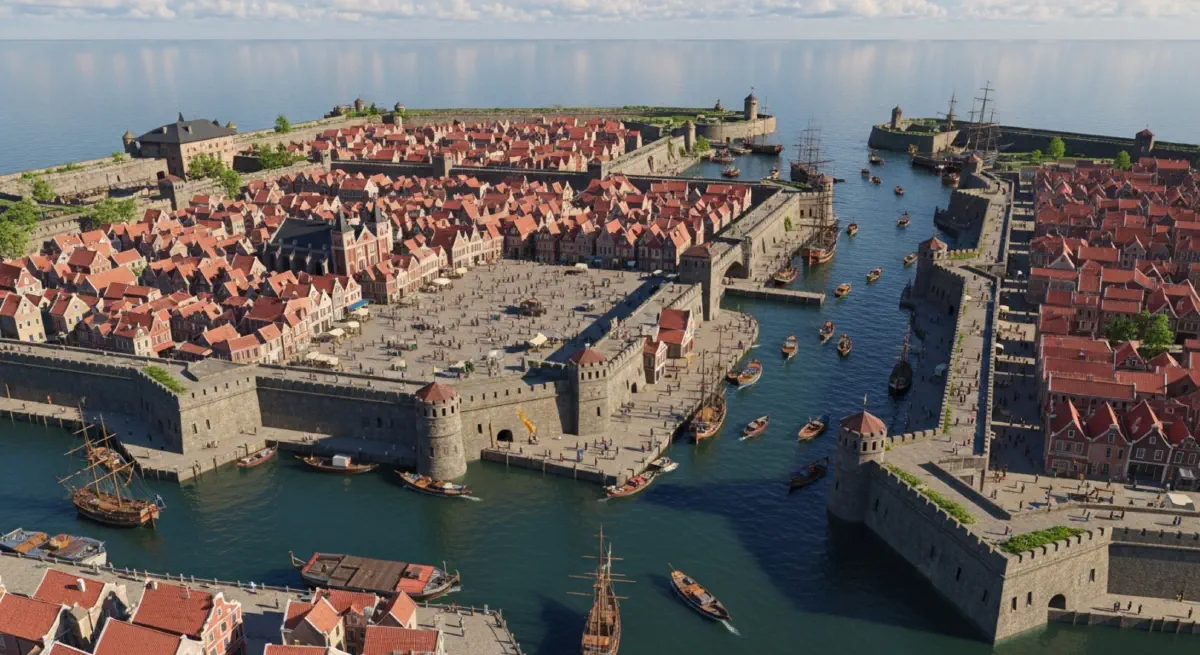
In 1619, after a brutal conflict with the local Javanese and their English allies, Coen razed the town of Jayakarta to the ground. In its place, he built Batavia, a city modeled after the ports of the Netherlands, complete with canals and massive stone fortifications. Batavia was more than a port; it was a statement of permanence. It served as the warehouse for all Asian goods before they were shipped to Europe, ensuring that the company controlled every link in the supply chain.
The Doctrine of Just War#
Under the legal cover of Mare Liberum, the VOC spent the mid-17th century systematically dismantling the Portuguese Empire in the East. They captured Ambon in 1605, Malacca in 1641, and finally expelled the Portuguese from Sri Lanka in 1659, breaking the ancient monopoly on cinnamon. These were not just trade disputes; they were full-scale military campaigns financed by private shareholders.
The VOC’s “just war” also extended to its European neighbors. When tensions with the English boiled over, the company did not hesitate to use its superior numbers. In the 1623 “Ambon massacre,” the Dutch tortured and executed ten English traders for allegedly conspiring against them. This act of state-sanctioned violence effectively drove the British out of the Indonesian archipelago for over a century, securing the VOC’s total dominance over the spice trade.
The Synthesis of Sovereign Capital#
The VOC proved that the most effective way to build a global empire was to treat it as a business venture. By the 1670s, the company employed an army of 30,000 soldiers and operated a fleet of 200 ships, most of which were heavily armed. It was the first multinational corporation to realize that territorial control was the ultimate form of market stability.
However, this marriage of commerce and carnage created a dangerous precedent. The VOC’s ability to “dispense justice” and wage war in the name of the Republic led to a world where corporate interests were indistinguishable from national policy. It created a system where the pursuit of an 18% annual dividend justified the destruction of entire cities and the rewriting of international law. Today, when we discuss the influence of the military-industrial complex or the legal maneuvers of offshore entities, we are standing in the shadow of the fortress walls of Batavia. The VOC did not just trade in spices; it traded in sovereignty, and the world has been paying the price ever since.