The Divine Division of the Guillot de Salaunes#
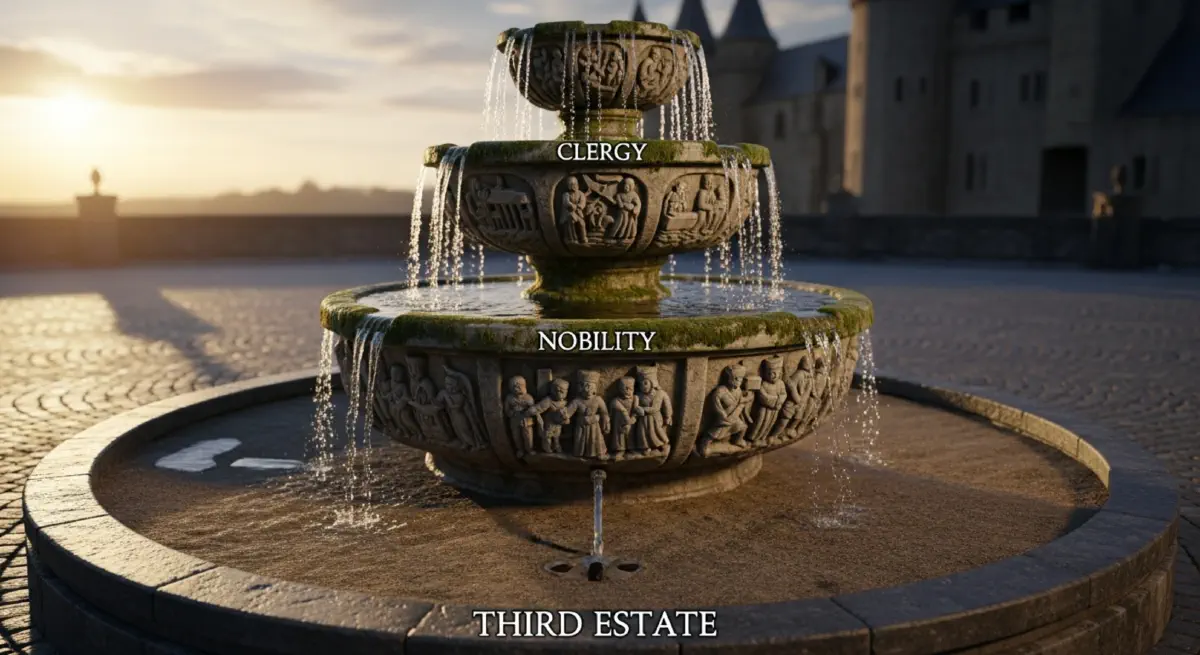
In the shadow of 1789, Pierre Guillot de Salaunes stood as a grandee of the Ancien Régime, his life supported by a network of monopolies known as banalités and the free labor of the corvée. His brother, Jean-Baptiste, served the clergy, ensuring that the family’s inheritance remained consolidated rather than divided among heirs. This arrangement was not seen as a theft of the peasants’ vitality but as a manifestation of a “ternary society”. In this world, inequality was not a flaw; it was the foundation. The clergy provided spiritual guidance, the nobility provided protection, and the Third Estate provided labor. This triad functioned under the ideology of complementarity, a narrative suggesting that each group performed a vital service for the others, justifying a system where less than 2% of the population controlled nearly 50% of all resources.
The Thesis of Ideological Necessity#
Inequality is never a biological or technological accident; it is a political and ideological construct that requires a narrative to survive. Thomas Piketty argues that the “Matthew Effect”—where abundance is given to those who already have—is not an inevitable law of nature but the result of specific social structures. By analyzing the ternary societies of the past, we see that wealth concentration persists only as long as the dominant ideology successfully frames disparities as “natural” or “just”. Understanding these narratives is the first step toward deconstructing the systemic mechanisms that allow 10% of a population to capture 90% of its wealth.
The Architecture of Functional Inequality#
The Tripartite Blueprint of the Ancien Régime#
The ternary society organized human life into three functional classes: those who prayed, those who fought, and those who worked. This system was not merely a hierarchy but a “worldview” that justified the absence of social mobility. The nobility and clergy were exempted from the taxes that burdened the Third Estate, a privilege defended as compensation for their specialized roles in defense and salvation. This “complementarity” was a social glue that maintained stability while ensuring that the producers of wealth remained essentially propertyless.
The Institutionalization of the Lods and Corvées#
The economic reality of Pierre’s estate was governed by the lods, a property transfer tax paid to the local lord whenever land changed hands. This was a “monopoly of the ovens and mills,” meaning the Third Estate was legally required to use the lord’s infrastructure. These were not market transactions; they were “seigneurial rights” enforced by the centralized power of the estates. By institutionalizing these rights, the ternary ideology transformed simple extraction into a “legitimate” exchange, making it nearly impossible for peasants to envision an alternative distribution of power.
The Persistence of Functional Narratives#
The collapse of the ternary society did not end the use of functional justifications. Even today, the “Brahmin Left” justifies its status through educational expertise, while the “Merchant Right” uses business acumen as its shield. These modern versions of the “Estates” suggest that society still relies on specific elites to function, mirroring the old nobility’s claim to be the sole providers of security. This cascade of effects ensures that even in secular democracies, the elite commands a disproportionate share of income—often exceeding 45% in the United States—under the guise of “specialized performance”.
The Sovereignty of the Story#
The ternary society eventually buckled under the weight of the French Revolution, which sought to replace “privilege” with “equality”. However, the transition was not a simple move toward fairness. The abolition of feudal rights often turned into the sanctification of property rights, creating new forms of exclusion. Pierre Guillot de Salaunes lost his lods, but the state eventually reset the legal battles, allowing many pre-1789 owners to recover their standing.
So what? The history of the ternary society proves that power is always looking for a “rational” or “universal” principle to hide behind. When the clergy and nobility lost their spiritual and military mandates, they did not surrender their wealth. They simply changed the story, transitioning from a society of “Estates” to a society of “Ownership”. To challenge modern inequality, we must look past the “performance” of today’s elites and see the old ternary ghosts still haunting our ledgers.