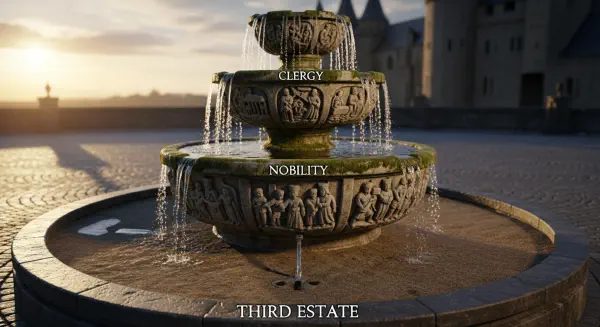
Ideology as the Engine: Inequality is not an economic inevitability but a political choice justified by evolving narratives (Ternary, Ownership, Meritocratic).
The Power of the $r > g$ Formula: When the return on capital outpaces economic growth, wealth concentrations become extreme, leading back to 19th-century “rentier” societies.
The Pandorian Paradox: Rhetorical fear-mongering about “social chaos” is consistently used by elites to block redistributive fiscal policy and protect private property.
The Dual Elite Conflict: Modern politics is dominated by the “Brahmin Left” (education-based) and “Merchant Right” (business-based), both of which exclude the working class.
The Need for Structural Reform: To counter the drift of capital, society must implement social ownership, a universal capital endowment ($130,000), and a global progressive tax on wealth.
Transparency and Education: Ending tax havens and equalizing educational investment ($200,000 per student) are critical for restoring democratic legitimacy.
Alet, C., & Adam, B. (2024). Capital and Ideology: A Graphic Novel Adaptation (T. Piketty, Ed.). Abrams ComicArts.
Kaufmann, S., & Stützle, I. (2017). Thomas Piketty’s Capital in the Twenty-First Century: An Introduction (A. Locascio, Trans.). Verso. (Original work published 2015).
Piketty, T. (2014). Capital in the Twenty-First Century (A. Goldhammer, Trans.). Belknap Press: An Imprint of Harvard University Press.