The Queen’s Question and the Complexity of Failure#
In November 2008, following the global financial crash, Queen Elizabeth II visited the London School of Economics and asked a simple question: “Why did nobody notice it?”. The answer lies in the fact that we are taught to view the world as a linear, simple system when it is actually a “complex adaptive system”. In finance, as banks pursued identical strategies of “diversification,” they actually reduced the system’s overall diversity and resilience. The “invisible hand” did not create stability; instead, it turned the financial network into a “mutual incendiary device”. A small perturbation in the US subprime market was enough to tip the entire global system into collapse.
The Thesis of Systemic Fragility#
The belief that the unrestrained pursuit of self-interest leads to general prosperity is a “flaw in the model” that ignores the fundamental laws of complex systems. Because capitalism requires perpetual growth on a finite planet, it is driving the Earth’s life-support systems—the atmosphere, the soil, and the oceans—toward irreversible tipping points.
The Mechanics of Planetary Exhaustion#
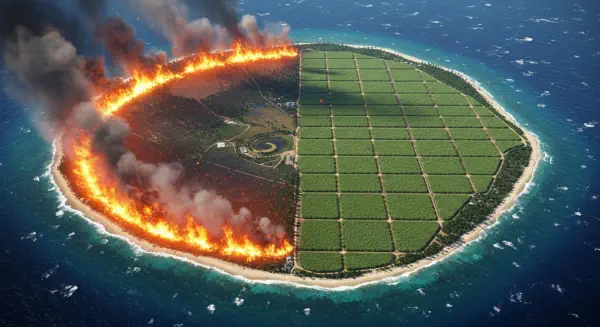
The Entropy of the Global Island#
If we view the Earth as a single island, we can see capitalism as a fire-front working its way down the “entropic food chain”. It takes the most accessible resources first—large predators from the sea, mahogany from the forests, easy oil from the ground—and then returns for the less valuable “baitfish” and “tar sands” using more costly and destructive methods. This “soil mining” approach is deemed sound by neoliberal theory as long as it generates money, yet it exhausts the “free gift of nature” faster than it can regenerate. Today, we depend on the soil for 99% of our calories, yet 70% of arable land in food-stressed nations is suffering severe degradation.
The Mirage of Micro-Solutions#
In a brilliant public-relations coup, corporations have induced us to focus on individual “micro-solutions” rather than structural forces. The concept of the “personal carbon footprint” was championed by Ogilvy & Mather for the oil giant BP to divert political pressure away from fossil fuel producers and toward consumers. Similarly, the “litterbug” campaign was funded by packaging manufacturers like Coca-Cola to sink laws mandating reusable glass bottles. We obsess over plastic straws while the richest 1% produce 70 tons of CO2 annually—twice the combined impact of the poorest half of the world’s population. Consumerism is presented as the answer to the problem it caused: “don’t stop consuming, just consume better”.
The Global Wall and Climate Apartheid#
Rich nations have pledged $100 billion a year in climate finance to the Global South, yet they have spent far more on fortifying their own borders. Between 2013 and 2018, the US spent eleven times more on sealing its borders than on climate finance. We are building a “Global Wall” to exclude the victims of our own waste products. Meanwhile, neoliberal economists like Andrew Lilico suggest that we “must adapt” to global heating, casually remarking that the tropics may simply become “wastelands with few folk living in them”. This psychopathic reasoning treats the planet as disposable while the ideology of growth remains sacred.
Synthesis: Physics vs. Economics#
You can bargain with economics, but you cannot bargain with physics. To have even a 50% chance of preventing 2.7°F of global heating, 60% of remaining fossil fuels must stay in the ground. Yet fossil fuel companies continue to rake in $2.8 billion a day in profit, using a fraction of that wealth to buy the political systems that prevent their replacement. Neoliberalism treats growth as an end in itself, entirely divorced from utility, and is now looting the future to enrich the present. We are witnessing an “Earth systems crisis” where the breakdown of life-support systems is occurring at a speed that outpaces our ability to adapt.