Key Takeaways
- Economies evolve through stages: From agriculture to manufacturing to services to... something new. Each transition creates winners and losers.
- We're past material scarcity: Rich countries can produce more stuff than they need. The frontier is experience, meaning, and sustainability—not more things.
- Artisanal is a preview: The craft chocolate movement shows where value creation is heading—toward authenticity, story, and quality over quantity.
- The transition isn't automatic: Post-industrial abundance could mean leisure and meaning for all, or precarity and meaninglessness for many. The outcome is political.
From Medicine to Magic#
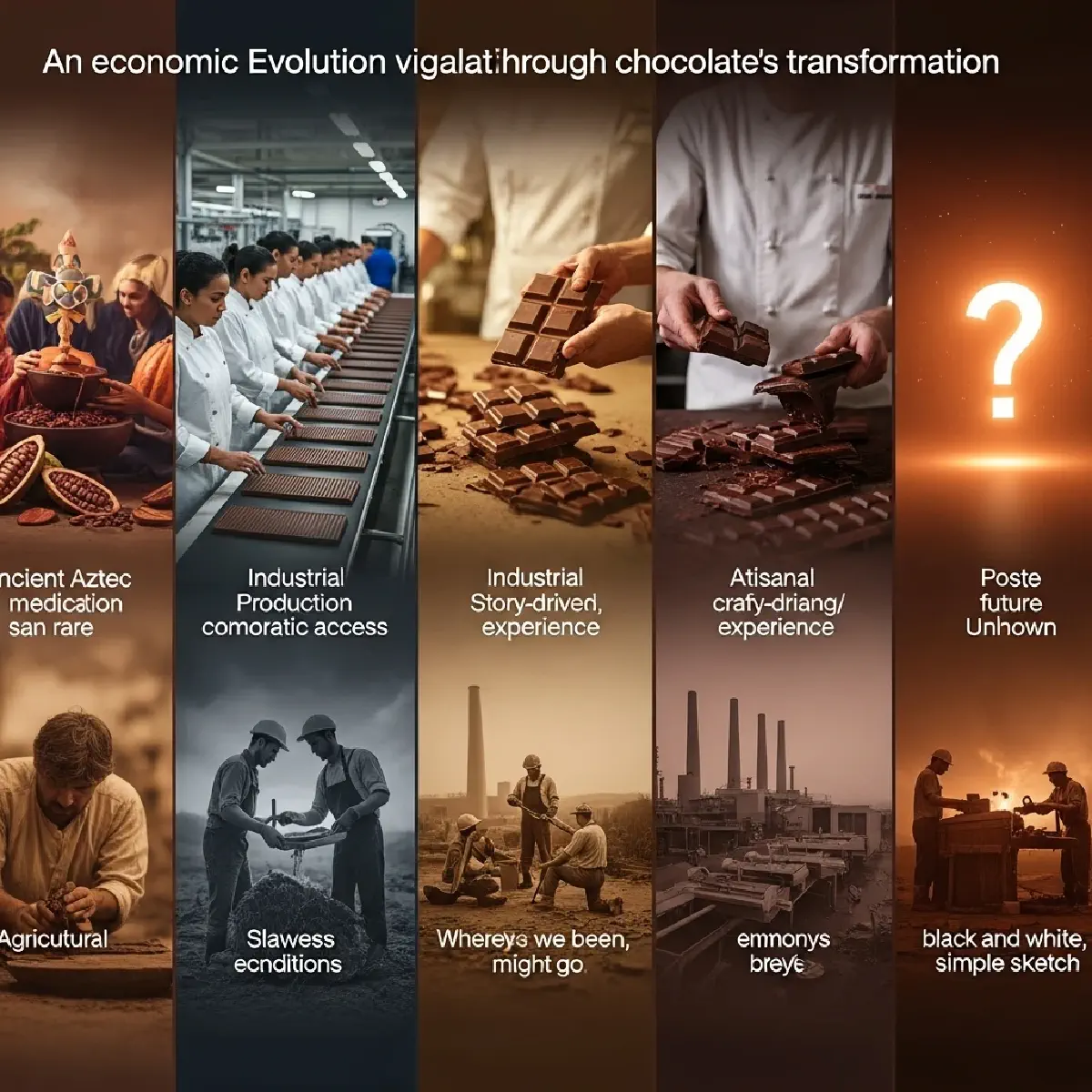
Chocolate began as a bitter drink—consumed by Aztec elites for energy and ritual. Spanish colonizers brought it to Europe, where it remained a luxury medicine.
Then came industrialization. In 1828, Dutch processing made chocolate smooth and mixable. In 1847, Joseph Fry created the first solid chocolate bar. In 1875, Daniel Peter added milk powder.
Chocolate became a mass commodity. Cadbury, Hershey, and Nestlé produced millions of bars—cheap, standardized, available everywhere.
Now there’s another transformation. Craft chocolate—single-origin, small-batch, story-driven—sells for $10 or $15 a bar. Chocolate has gone from commodity to experience.
This journey mirrors the economy’s evolution.
The Stages of Economic Development#
Economies have evolved through recognizable stages:
Agricultural#
For most of history, most people farmed. Survival depended on harvests. Economic life was local, seasonal, and precarious.
Industrial#
Starting in the 18th century, manufacturing transformed economies. Factories produced standardized goods at scale. Workers moved to cities. Productivity soared.
Service#
By the late 20th century, services dominated rich economies—healthcare, finance, education, entertainment. Most workers no longer made things; they provided services.
Post-Industrial?#
Now something new is emerging. Call it post-industrial, knowledge economy, or experience economy. Its features:
Information and creativity are the main inputs
Experiences are valued as much as goods
Sustainability becomes a constraint
Meaning becomes a product
Craft chocolate exemplifies this shift—selling not just a food, but a story.
Why Mass Production Isn’t Enough#
The industrial model was revolutionary. Mass production made goods affordable that were previously luxuries. Everyone could have chocolate.
But mass production has limits:
Saturation#
In rich countries, material needs are largely met. Most people have enough calories, clothes, and consumer goods. The marginal utility of more stuff is low.
Environmental Constraints#
Producing ever more stuff is environmentally unsustainable. Climate change, resource depletion, and pollution set limits on material growth.
Meaning Deficit#
Standardized goods don’t satisfy the desire for meaning. A Hershey bar is fine—but it doesn’t tell a story or connect you to something larger.
Quality Ceilings#
Mass production optimizes for cost, not quality. This produces acceptable goods but rarely excellent ones.
The Craft Economy#
Craft production—small-scale, quality-focused, story-driven—offers something different:
Differentiation#
Every craft chocolate bar is unique. The beans come from a specific place. The maker has a particular approach. You’re not buying a commodity—you’re buying this.
Story and Meaning#
Craft chocolate comes with narrative: the farm, the processing, the maker’s philosophy. You’re consuming a story, not just calories.
Quality Pursuit#
Without scale economies, craft producers compete on quality. The $15 bar has to taste better than the $1 bar, or there’s no point.
Sustainability#
Smaller-scale, artisanal production can be more environmentally sustainable—though not automatically. The scale reduction can allow attention to sourcing and practices.
Human Connection#
Craft production connects producer and consumer. You might meet the chocolate maker. You might visit the shop. The relationship is human, not industrial.
What This Means for the Economy#
If craft chocolate is a preview, what does it suggest about the economy’s future?
From Things to Experiences#
Value creation increasingly involves experiences rather than objects:
Travel and tourism are huge industries
Dining is experiential (not just nutrition)
Entertainment and media are experiencing, not owning
Even retail increasingly emphasizes experience
From Quantity to Quality#
Discerning consumers trade quantity for quality:
Fewer, better clothes
Less, better food
Curated, not cluttered
This isn’t universal—mass consumption persists—but the high-value frontier is quality.
From Anonymous to Authentic#
Authenticity becomes valuable:
Local sourcing
Named producers
Transparent supply chains
Genuine stories
Mass production’s anonymity becomes a disadvantage.
From Ownership to Access#
Some post-industrial economics involves access rather than ownership:
Streaming, not owning, music and video
Ride-sharing, not car ownership
Subscription services for various goods
The product is access to experiences, not accumulation of stuff.
The Transition’s Dangers#
Post-industrial abundance could be utopia. It could also be dystopia.
The Good Scenario#
Automation produces material abundance
Basic needs are guaranteed
People pursue meaning, creativity, and connection
Work is optional or minimal
Leisure is central to life
This is the Keynesian dream—technology finally freeing humanity from toil.
The Bad Scenario#
Automation eliminates jobs without creating alternatives
Gains concentrate at the top
Most people are precarious, anxious, and alienated
Meaning becomes a luxury the poor can’t afford
The economy grows but lives worsen
This is the current trajectory in much of the rich world.
The Difference#
Technology doesn’t determine which scenario we get. Policy does:
Universal basic income or services could share abundance
Shorter working hours could spread work and leisure
Education could prepare people for creative work
Tax policy could prevent extreme concentration
The post-industrial transition is happening. Its character is undecided.
Chocolate’s Lesson#
The craft chocolate bar tells this story in miniature:
Stage 1: Luxury for elites (Aztec chocolate)
Stage 2: Mass commodity (Hershey bars)
Stage 3: Differentiated experience (single-origin craft)
The $15 chocolate bar isn’t just expensive. It’s selling something different from the $1 bar:
Quality you can taste
Story you can know
Connection you can feel
Sustainability you can (maybe) trust
This isn’t mass marketing—it’s meaning-making.
Beyond Material Abundance#
Rich countries have largely solved the problem of material scarcity. Not perfectly—poverty persists, inequality is vast—but the technical capacity to meet material needs exists.
The new problems are:
Distribution#
How do we share abundance? Currently, we share it badly—with vast inequality and precarity alongside plenty.
Sustainability#
How do we produce without destroying? The industrial model wasn’t designed for sustainability. The post-industrial economy must be.
Meaning#
What do people do when survival isn’t the point? Mass consumption offers one answer (buy more stuff). Craft production hints at another (make, create, connect).
Work#
What is work for when machines can do most things? The industrial answer (wages for labor) may not apply in a post-labor economy.
The Chocolate Question#
Here’s the question chocolate asks:
Would you rather have:
20 cheap chocolate bars, or
2 excellent ones?
For many goods, we’re past the point where more is better. Quality, meaning, and experience matter more than quantity.
The economy hasn’t caught up. We still measure GDP—total stuff produced—as if more were always better. We still organize work as if everyone needed to labor 40 hours to survive.
The post-industrial transition invites us to rethink these assumptions. Not because they were wrong when scarcity dominated—but because scarcity is no longer the main problem in rich countries.
The craft chocolate movement is a small, privileged example. But it hints at an economy organized around meaning and quality rather than volume and speed.
Whether that economy emerges—and who gets to participate—depends on politics, not technology. The chocolate won’t decide. We will.
The Evolution of Value
Agricultural Economy: Produce enough to survive
Industrial Economy: Produce as much as possible as cheaply as possible
Service Economy: Provide services that people will pay for
Post-Industrial Economy: Create meaning, experience, and quality
The chocolate trajectory: From medicine → commodity → experience
The economic question: Who benefits from the transition?
The political answer: That’s up to us