Key Takeaways
- The first global economy was mercantilist: European expansion was driven by monopoly, not free trade. Companies sought exclusive control, not open competition.
- Violence was central: The spice trade wasn't peaceful exchange. It was conquest, forced labor, and the destruction of alternative sources.
- States and corporations merged: The Dutch and British East India Companies were proto-governments—with armies, courts, and sovereign powers.
- Mercantilism worked (for some): Dismissed as primitive economics, mercantilism built the wealth that enabled later development. The critique came from those who had already benefited.
When Spices Were Worth More Than Gold#
Pepper, cinnamon, nutmeg, cloves—today these are cheap commodities, bought without thought.
In medieval Europe, they were treasures. Spices preserved food, masked spoilage, and signified wealth. A pound of nutmeg cost more than a house. Pepper was used as currency.
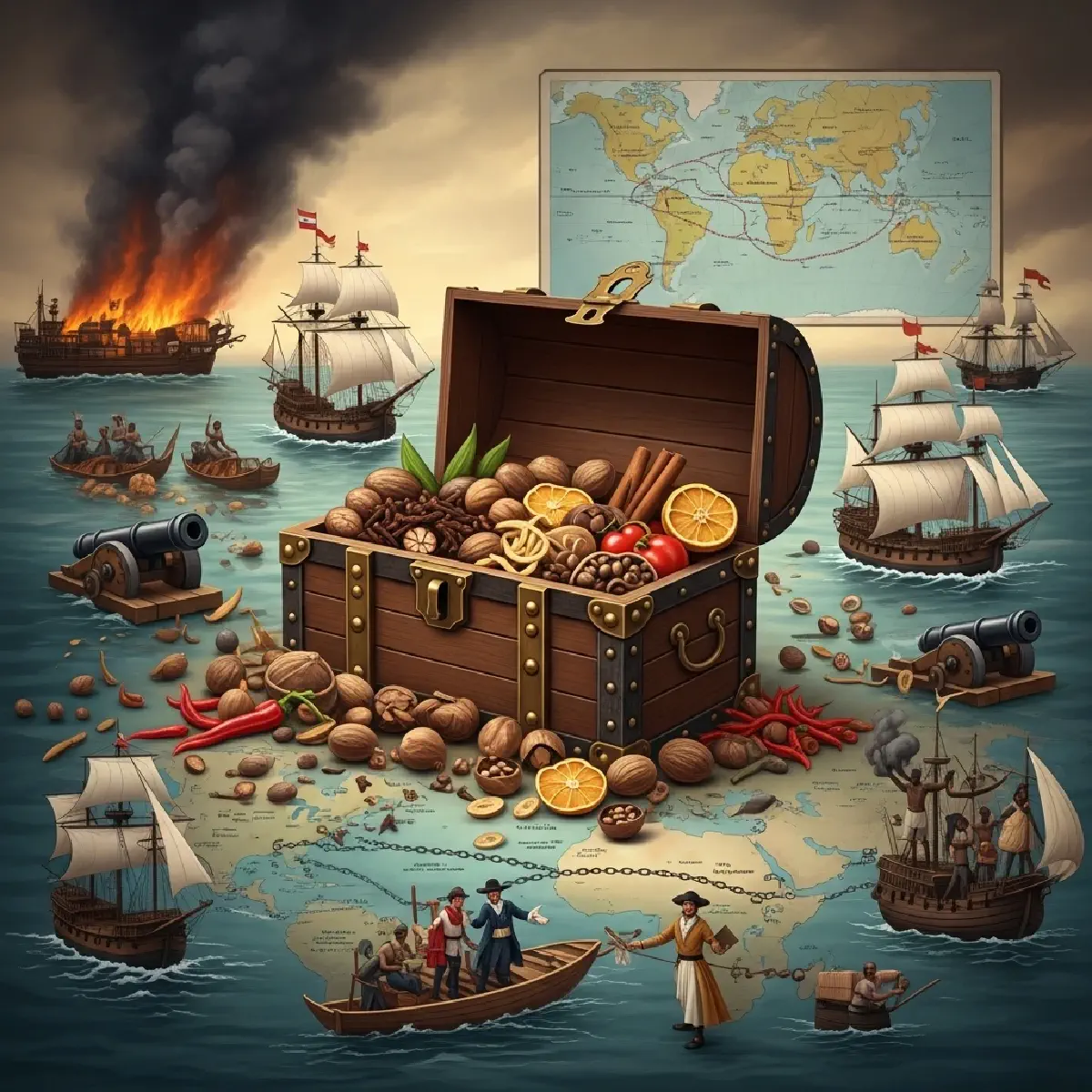
The spice trade created the first truly global economy. It also created colonialism.
Mercantilism: The Forgotten Framework#
Before free trade became orthodoxy, mercantilism guided economic policy. Its core ideas:
Trade Is Zero-Sum#
Mercantilists believed exports were good, imports were bad. The goal was to accumulate wealth—specifically gold and silver—through trade surpluses.
This seems crude. Aren’t trade and mutual benefit connected? Yes—but mercantilists understood something modern economics often forgets: power matters in trade.
Monopoly Is Valuable#
Free-market economics sees monopoly as inefficiency. Mercantilists saw it as strategy.
If you’re the only seller, you set the price. The spice trade was all about monopoly:
Control the source
Eliminate competition
Raise prices
The Dutch East India Company (VOC) literally destroyed clove trees on islands it didn’t control to maintain its monopoly.
The State Should Direct Trade#
Mercantilists didn’t trust markets to produce good outcomes. They believed states should:
Grant monopoly charters
Protect domestic industries
Secure access to resources
Use force when needed
The East India Companies were instruments of state policy, not just private enterprises.
How the Spice Trade Worked#
The Portuguese Phase#
Portugal pioneered the sea route to Asia. In 1498, Vasco da Gama reached India.
Portuguese strategy:
Establish fortified trading posts
Control key chokepoints
Use naval force to prevent competition
Extract tribute from local rulers
This wasn’t free trade. It was armed commerce—trading under threat of violence.
The Dutch Phase#
The Netherlands surpassed Portugal in the 17th century. The VOC became the world’s first mega-corporation:
Monopoly charter for Asian trade
The right to make war, sign treaties, establish colonies
Its own army and navy
Stock traded on the first stock exchange
The VOC didn’t just trade spices. It controlled their production:
Conquered the Banda Islands (source of nutmeg)
Massacred the population to ensure control
Imported slaves to work the plantations
Destroyed competing nutmeg sources
This is how monopoly was maintained: through violence.
The British Phase#
Britain’s East India Company eventually surpassed the Dutch:
Shifted focus from spices to textiles (then opium)
Built territorial empire in India
Governed vast populations
Collected taxes, administered justice, waged war
The Company was a corporation that became a government—ruling 100 million people with its own army.
What Modern Economics Forgets#
Today’s economics teaches that mercantilism was confused—that it misunderstood mutual gains from trade.
But mercantilism understood things textbooks often miss:
Power Shapes Trade#
Trade agreements aren’t made between equals. The spice trade was shaped by who had guns, ships, and the willingness to use them.
This remains true. Trade negotiations favor the powerful. Rules are written by those who benefit from them.
First-Mover Advantages Are Real#
The Portuguese and Dutch didn’t win the spice trade through efficiency. They won by getting there first and establishing control.
First-mover advantage matters. Countries and companies that dominate industries maintain dominance through accumulated capabilities, not just current efficiency.
Accumulation Builds Power#
Mercantilist accumulation of gold seems pointless—you can’t eat gold. But gold bought armies, ships, and influence.
The wealth accumulated from the spice trade funded:
British industrialization
Dutch financial innovation
European imperial expansion
Primitive accumulation preceded development. The critique of mercantilism came from those who had already accumulated.
States Create Markets#
The spice trade required state action:
Charters granted monopoly rights
Navies protected trade routes
Armies conquered territories
Laws enforced contracts
Markets didn’t create themselves. States created markets—then defenders of markets forgot the creation.
The Violence We Forget#
The spice trade was brutal:
The Banda Islands#
When the Dutch conquered Banda in 1621, they:
Killed or enslaved virtually the entire population (about 15,000 people)
Divided the islands among Dutch planters
Imported slaves to work nutmeg plantations
This genocide created a monopoly. Nutmeg prices could be whatever the VOC wanted.
Indian Textiles#
British policy deliberately destroyed Indian textile manufacturing:
Tariffs protected British cloth
British cloth was dumped in India
Weavers lost livelihoods
India went from textile exporter to textile importer
This wasn’t comparative advantage—it was policy designed to transfer production to Britain.
The Opium Trade#
When Britain ran trade deficits with China (for tea), it balanced them by selling opium:
Opium was grown in India under British control
Smuggled into China against Chinese law
When China tried to stop the trade, Britain went to war
The Opium Wars forced China to accept the drug trade and cede Hong Kong
“Free trade” meant freedom for Britain to sell drugs at gunpoint.
Mercantilism’s Rehabilitation#
Modern development policy often uses mercantilist tools while denying it:
Export Promotion#
Countries promote exports through subsidies, undervalued currencies, and state support—just as mercantilists recommended.
Infant Industry Protection#
New industries are shielded from competition until they’re strong enough to compete—classic mercantilist logic.
State-Directed Investment#
Industrial policy directs resources to strategic sectors—as mercantilist states directed resources to trade.
Accumulating Reserves#
Countries accumulate foreign exchange reserves for stability and power—modern analogues to gold accumulation.
The mercantilist toolkit works. That’s why successful developing countries use it.
The Spice Legacy#
Today’s spice trade is unremarkable. Pepper comes from Vietnam, cinnamon from Sri Lanka, nutmeg from Indonesia. Prices are low. Trade is peaceful.
But the legacies remain:
Unequal Development#
Countries that controlled the spice trade (Netherlands, Britain) developed early. Countries that were controlled (Indonesia, India) developed late or not at all.
Institutional Patterns#
Colonial institutions—extractive, unequal, designed for external benefit—persist in post-colonial states.
Capital Accumulation#
European capital accumulated through colonial trade funded industrialization. Former colonies started with deficits.
The Rules#
International trade rules were written by former colonial powers and serve their interests.
What Spices Teach#
The spice trade shows how global capitalism actually began—not through free exchange among equals, but through monopoly, violence, and state power.
This doesn’t mean free trade is always wrong. It means:
Trade theory shouldn’t ignore history
Power shapes outcomes at least as much as efficiency
States create the conditions for markets
Those who benefited from mercantilism shouldn’t lecture others about free trade
The nutmeg on your kitchen shelf is cheap and unremarkable. But it carries the ghosts of Banda—thousands killed so a corporation could raise prices.
Economics should remember what the spice rack forgets.
The Mercantile Legacy
VOC: First mega-corporation, first stock, armed trade
Banda 1621: Genocide for nutmeg monopoly
1757: East India Company conquers Bengal
1839-42: Opium War forces drug trade on China
Development gap: Colonial powers developed; colonies didn’t
Modern tools: Export promotion, industrial policy, reserves—all mercantilist
The irony: Countries that used mercantilism now preach free trade