Key Takeaways
- Markets don't solve every problem: Scurvy killed more sailors than combat. Market forces didn't solve it. Government action did.
- States create knowledge: Basic research, public health discoveries, and infrastructure innovation often require state action because private returns are too low.
- Bureaucracy can work: The image of government as inherently incompetent ignores examples like the British Navy's health reforms—boring, effective, life-saving.
- The entrepreneur mythology obscures state contribution: Many celebrated innovations rest on government-funded research, government-created markets, and government-enforced standards.
Why British Sailors Were Called “Limeys”#
In the age of sail, scurvy was a nightmare. On long voyages, sailors would develop bleeding gums, loose teeth, reopened wounds, and eventually die.
Scurvy killed more sailors than all other causes combined—more than storms, more than combat, more than accidents.
The cause (vitamin C deficiency) wasn’t understood until the 20th century. But a cure was known long before: citrus fruit. James Lind demonstrated this in 1747 through one of the first clinical trials in history.
Yet despite this knowledge, scurvy continued killing sailors for another 50 years.
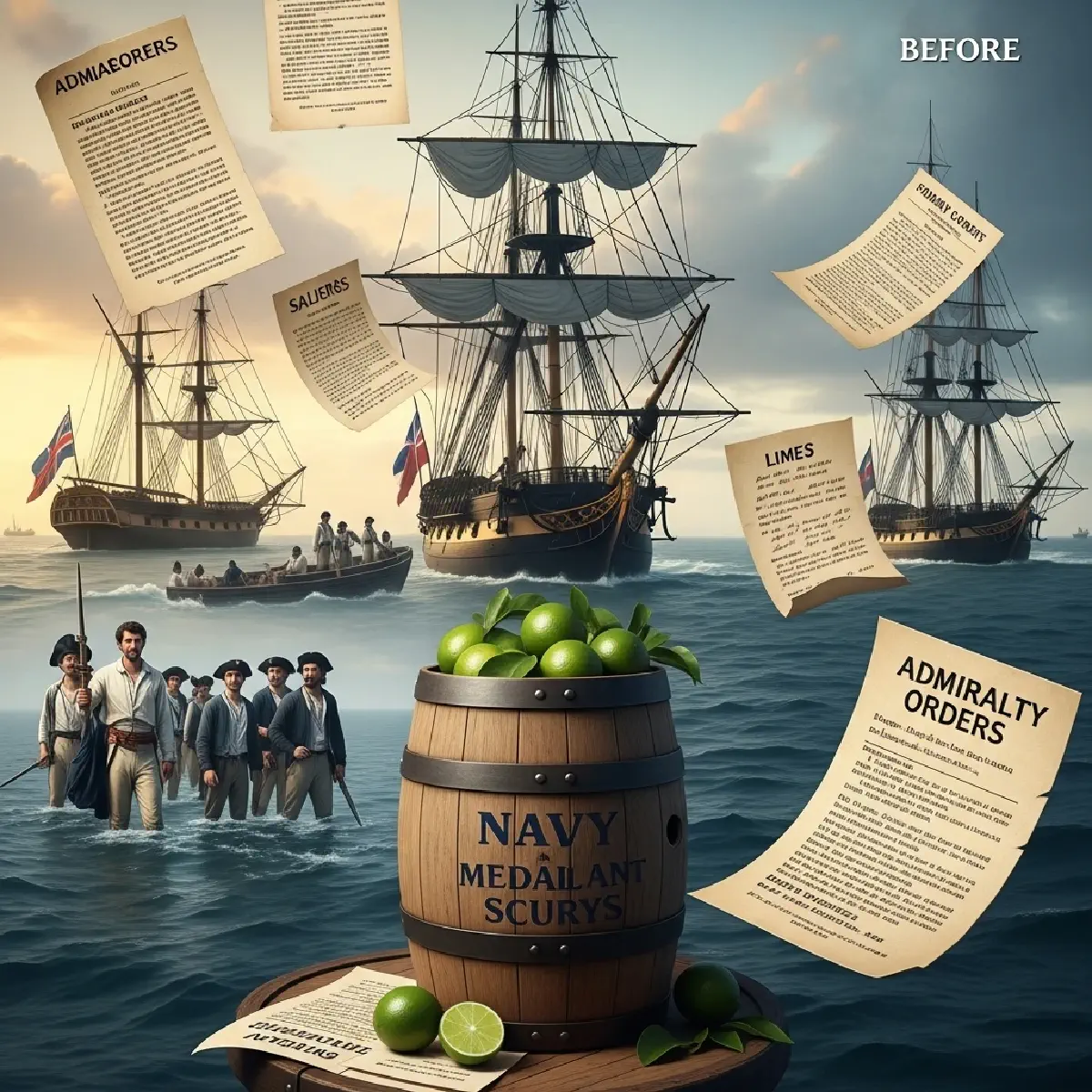
Finally, in 1795, the British Navy mandated lime juice rations for all sailors. Scurvy virtually disappeared from the fleet. British sailors became “Limeys.”
Why Markets Didn’t Solve It#
This is a puzzle for free-market enthusiasts. If citrus cured scurvy, and scurvy was killing sailors, why didn’t the market provide citrus?
The Information Problem#
Sailors didn’t understand vitamin C. They knew citrus helped, sometimes—but the mechanism was unclear, and knowledge was patchy.
Without understanding, demand was uncertain. Sometimes lime juice was provided; often it wasn’t.
The Principal-Agent Problem#
Ship captains bore some costs of scurvy (sick crews) but not all costs (dead sailors were replaceable). Their incentives were misaligned with sailors’ interests.
The Public Goods Problem#
Knowledge about scurvy prevention was a public good—once discovered, everyone could use it. This reduced incentives for private investment in research.
The Coordination Problem#
Even if captains wanted to provide citrus, supply chains weren’t organized to deliver it. Coordination across the fleet required central authority.
What the Government Did#
The British Navy solved these problems through state action:
Research#
Naval doctors investigated scurvy. They conducted experiments, compiled observations, and tested treatments. This wasn’t profitable—it was a public investment.
Mandates#
The Navy didn’t suggest lime juice. It mandated it. Every ship was required to carry and distribute citrus rations.
Supply Chains#
The Navy organized supply—contracting with lime producers, establishing distribution systems, ensuring quality.
Enforcement#
Requirements without enforcement are wishes. The Navy enforced lime rations through inspections and discipline.
Scaling#
Once the system worked, it scaled across the entire fleet. This coordination was only possible through centralized authority.
The General Pattern#
Lime mandates illustrate a broader pattern: government creates knowledge and systems that markets won’t produce.
Basic Research#
Private companies underinvest in basic research because:
Returns are uncertain
Results are hard to appropriate
Timelines are long
Government fills this gap:
NIH funds biomedical research
DARPA created the internet
NASA developed satellite technology
National labs produced nuclear and renewable energy research
Every major technology has government research in its family tree.
Public Health#
Private markets struggle with public health:
Disease prevention benefits everyone (public good)
Individual prevention decisions affect others (externalities)
Information is complex and uncertain
Government provides:
Vaccination programs
Water treatment
Food safety regulation
Disease surveillance
The spectacular improvements in human lifespan over the past century owe more to public health than to medical treatment—and public health is overwhelmingly government-provided.
Standards and Coordination#
Markets need standards:
Electrical specifications so devices work together
Food safety standards so consumers trust products
Quality certifications so buyers know what they’re getting
Creating standards is a coordination problem. Government—or government-backed bodies—typically solve it.
Infrastructure#
Roads, ports, power grids, communications networks—these are classic public goods. Private provision is possible but often inefficient (competing rail gauges, patchy networks).
Government infrastructure investment enabled the modern economy.
The Anti-Government Narrative#
Despite this history, anti-government ideology dominates:
Government is “inherently inefficient”
Bureaucracy can’t innovate
The private sector is dynamic; the public sector is stagnant
This narrative serves interests:
It justifies tax cuts that benefit the wealthy
It supports privatization that creates profits
It discredits regulation that constrains business
But it doesn’t match history or evidence.
Government Successes We Forget#
The Moon Landing#
Apollo was a massive government project—coordinated by NASA, funded by taxes, employing hundreds of thousands. Private enterprise couldn’t have done it.
The Internet#
ARPANET was a DARPA project. The World Wide Web was created at CERN (a public research institution). Email, browsers, and protocols were developed in public or academic settings.
Private companies commercialized the internet. They didn’t create it.
Vaccines#
mRNA vaccine technology came from publicly funded research over decades. Moderna and Pfizer developed products quickly—but on foundations laid by government.
GPS#
The Global Positioning System is a government project—funded, launched, and maintained by the US military. Every navigation app, ride-share service, and delivery optimization depends on it.
Agricultural Research#
The Green Revolution—which prevented famines and feeds billions—came from public agricultural research. Land-grant universities, CGIAR research centers, and government extension services developed and distributed improved crops.
State Capacity Matters#
The lime story required state capacity:
Effective bureaucracy to administer mandates
Scientific institutions to develop knowledge
Supply chains to deliver products
Enforcement mechanisms to ensure compliance
Weak states can’t do this. That’s why public health varies so much across countries—not because some people don’t want health, but because some governments can’t deliver it.
Building state capacity is a development priority. Markets work better when states work well.
The Boring Heroism#
Lime mandates weren’t dramatic. There was no entrepreneurial genius, no celebrated inventor, no Elon Musk of citrus.
There was just:
Bureaucrats analyzing data
Officers implementing protocols
Sailors drinking lime juice
Deaths not happening
This is how most public goods are provided—through unglamorous, systematic, institutional work.
It’s not a story we celebrate. We prefer heroic individuals to competent systems. But competent systems save more lives.
The Entrepreneur Myth Revisited#
The dominant narrative celebrates private innovation:
Steve Jobs invented the smartphone
Elon Musk is revolutionizing transportation
Jeff Bezos built modern retail
These are real achievements. But they rest on:
Government-funded research (touchscreens, batteries, GPS, internet)
Government-built infrastructure (roads, airports, spectrum allocation)
Government-educated workers (public schools and universities)
Government-enforced property rights
The entrepreneur stands on public shoulders. Pretending otherwise isn’t just historically wrong—it justifies policies (tax cuts, deregulation) that undermine the public foundations of private success.
What Limes Teach#
The British Navy’s lime mandate is a small example with large implications:
Some problems require collective action
Markets don’t automatically solve public good problems
Government can be effective when it has capacity and mandate
The boring bureaucratic work of implementation matters
“Limey” was meant as an insult. But it describes one of history’s great public health victories—achieved not through market forces, but through state action.
Every time we dismiss government as inherently incompetent, we forget the limes.
What Government Built
The Internet: DARPA project, CERN development
GPS: US military, freely available globally
Vaccines: Decades of NIH-funded research
Public Health: Water treatment, vaccination, sanitation
Agricultural Productivity: Green Revolution from public research
Space Technology: NASA, ESA, and other public agencies
Basic Science: Universities and national laboratories
The lime lesson: Collective problems need collective solutions