Key Takeaways
- No country industrialized through free trade: Britain, America, Germany, Japan, Korea—all used protection to build industries before competing globally.
- Rich countries preach what they don't practice: Countries that developed behind tariff walls now demand developing countries abandon protection.
- Free trade theory assumes what it needs to prove: Comparative advantage works if you accept current capabilities as given. But capabilities can be built—and protection can help.
- "Level playing field" isn't level: Forcing developing countries to compete immediately with established industries isn't fairness—it's locking in advantage.
The Spice That Didn’t Stay Home#
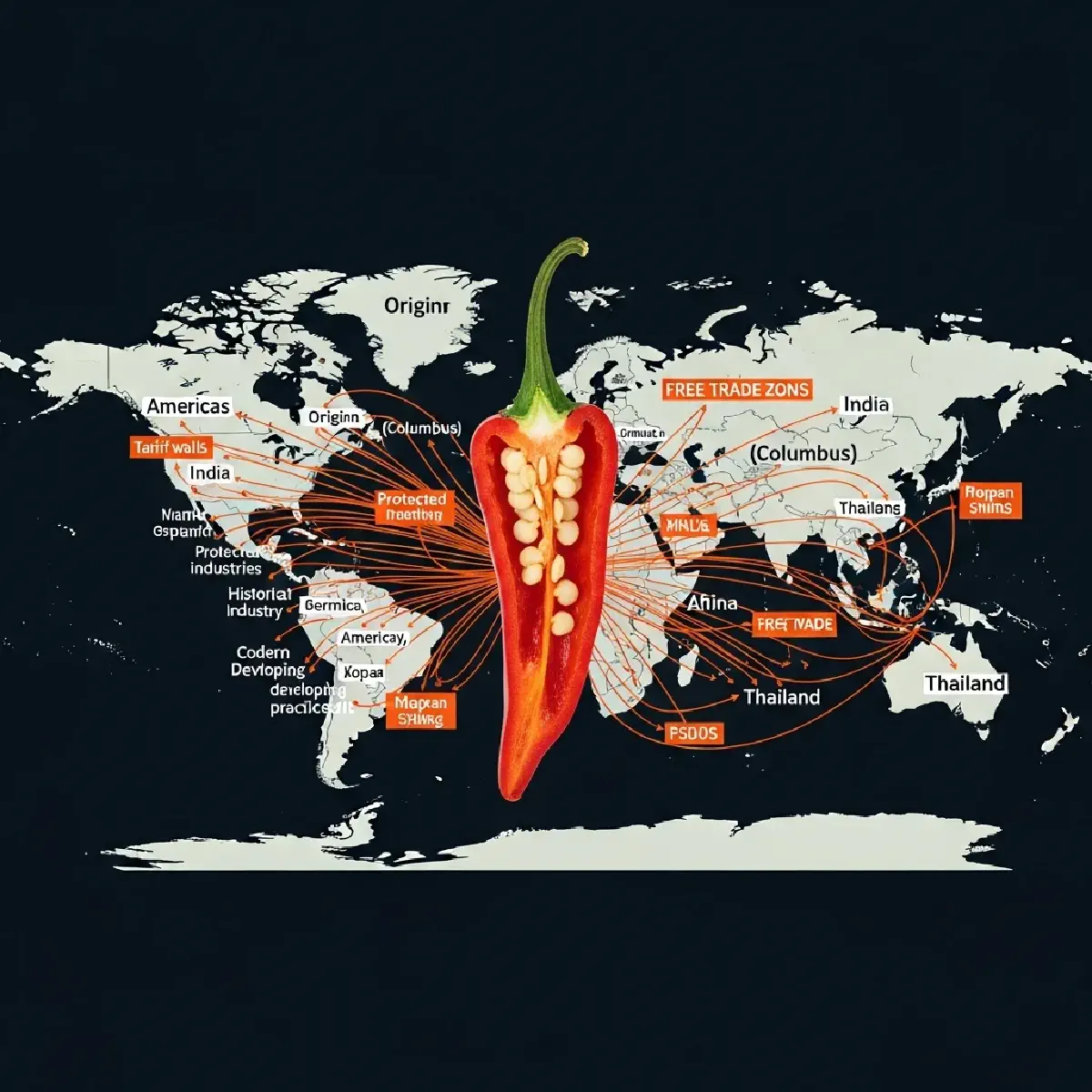
Chilli peppers originated in the Americas. Before Columbus, no one in Europe, Africa, or Asia had ever tasted chilli.
Within 50 years of 1492, chillis were growing across the globe. They became essential to cuisines from India to Thailand to Hungary to West Africa—cuisines that seem unimaginable without them.
This is globalization in action: crops, goods, and ideas spreading across the world.
But how did this spreading happen? Not through “free trade” as economists describe it.
The Story We’re Told#
The standard free-trade narrative:
Countries have different advantages (climate, skills, resources)
Each should specialize in what it does best
Trade lets everyone consume more than they could produce alone
Free trade maximizes global efficiency
Everyone benefits
This is the theory of comparative advantage, attributed to David Ricardo. It’s elegant, logical, and taught to every economics student.
It’s also misleading about how development actually works.
How Countries Actually Developed#
Britain#
Britain was the first industrial nation. How?
Protection: Britain protected its textile industry with high tariffs on imported cloth
Subsidies: Wool exports were banned to support domestic manufacturing
Monopoly: The East India Company had exclusive trading rights
Empire: Colonial markets were captive consumers for British goods
Britain practiced “free trade” only after it was already the world’s industrial leader. Then free trade advantaged Britain—it could outcompete anyone.
United States#
American development was emphatically protectionist:
Hamilton’s tariffs: Alexander Hamilton advocated protecting infant industries
High tariffs: The US had among the world’s highest tariffs through the 19th century
Government intervention: Railroads, education, and research were publicly supported
Free trade ideology came to America only in the 20th century—when American industry was globally dominant.
Germany#
German industrialization featured:
The Zollverein: A customs union that protected German industry from British competition
State support: Government investment in railroads, education, and research
Infant industry protection: New industries were shielded until competitive
Japan#
Japan’s modernization after 1868 was state-directed:
Protection: Foreign goods faced tariffs and restrictions
Subsidies: Government supported strategic industries
Technology acquisition: Japan imported technology, learned from it, then competed
South Korea#
Perhaps the clearest modern example:
Heavy protection: Korean industries were shielded from imports
Export discipline: Protection was conditional on export success
Government direction: The state picked winners and supported them
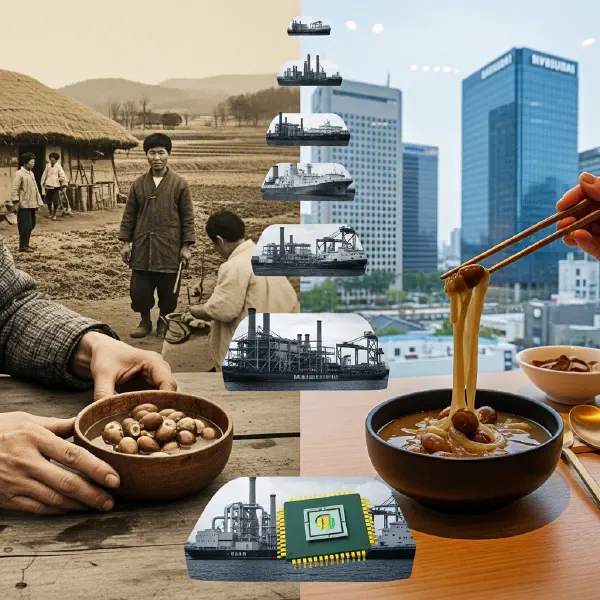
Korea went from one of the world’s poorest countries to a major industrial power in decades—behind protectionist walls.
The Ladder-Kicking Metaphor#
Ha-Joon Chang (the economist whose work inspires this series) uses a metaphor: rich countries are “kicking away the ladder.”
They climbed to prosperity using protection, subsidies, and state intervention. Now they’re telling developing countries that these tools are illegitimate.
“Do as we say, not as we did.”
This isn’t conspiracy—it’s interest. Rich countries benefit when developing countries can’t compete. Forcing premature opening keeps the hierarchy stable.
What Free Trade Theory Misses#
Comparative Advantage Is Static#
Ricardo’s theory takes current capabilities as given. Portugal is good at wine; England is good at cloth. They should specialize.
But capabilities can be built. Japan wasn’t good at cars in 1950. Korea wasn’t good at semiconductors in 1970. They became good through deliberate development—often behind protective barriers.
If Portugal had followed Ricardo’s advice, it would still be exporting wine while England exported manufactured goods. Is that the outcome Portugal should want?
Learning Takes Time#
New industries are inefficient. They need time to develop:
Learning by doing: Production experience improves productivity
Scale economies: Larger production lowers per-unit costs
Supplier networks: Industries develop supporting ecosystems
Infant industries need protection to survive the learning period. If forced to compete immediately with established industries, they die before becoming competitive.
Power Matters#
Trade negotiations aren’t between equals. Rich countries have leverage:
Access to their markets is valuable
They can impose conditions on trade deals
They control international institutions (WTO, IMF, World Bank)
“Free trade” agreements often aren’t free—they’re shaped by power, favoring those who have it.
Markets Need Creation#
The free-trade story assumes markets exist. But someone has to create them:
Infrastructure moves goods
Standards ensure quality
Finance enables transactions
Legal systems enforce contracts
These aren’t natural—they’re built. State capacity precedes market function.
The Chilli’s Journey#
Chillis didn’t spread through free trade. They spread through:
Empire#
Colonial networks moved plants, people, and goods across the globe. This wasn’t voluntary exchange—it was coerced integration.
State Action#
Colonial powers established crops that served their interests. Sometimes this meant introducing new plants; sometimes it meant forcing monocultures.
Adaptation#
Chillis succeeded because they adapted to local conditions and cuisines. This was cultural creativity, not market efficiency.
The chilli’s globalization was messier than textbook trade theory. It involved power, culture, and history—not just comparative advantage.
What Developing Countries Face#
Modern developing countries face constraints their predecessors didn’t:
Trade Agreements#
WTO rules limit the protectionist tools earlier developers used:
Tariffs are capped
Subsidies are restricted
Intellectual property is enforced
These rules were largely written by rich countries to protect their advantages.
Financial Pressures#
The IMF and World Bank often condition loans on market opening:
Reduce tariffs
Privatize state enterprises
Liberalize capital flows
These conditions are called “structural adjustment.” They implement free-trade ideology regardless of local conditions.
Multinational Competition#
Developing country firms must compete against giants with decades of experience, global supply chains, and deep pockets.
This isn’t a fair fight. Infant industries need protection to have any chance.
Climate Constraints#
Earlier developers could industrialize using fossil fuels freely. Today’s developers face climate constraints that add costs and limit options.
What Would Help#
If the goal is development, not just trade:
Policy Space#
Developing countries need room to experiment with policies that worked for earlier developers—infant industry protection, state direction, strategic subsidies.
Technology Transfer#
Rich countries should facilitate, not restrict, technology access. Patent rules that lock up knowledge harm development.
Differential Treatment#
Not all countries are equal. Trade rules should recognize different development levels, allowing poorer countries more flexibility.
Market Access#
Rich countries should open their markets to developing country exports—especially in areas (like agriculture) where they currently maintain protection.
The Free Trade Faith#
Free trade is often treated as self-evidently good—questioning it marks you as ignorant or corrupt.
But the evidence is more complicated:
Countries that developed used protection
Countries forced into premature opening often stagnated
The theory assumes what it needs to prove
Power shapes trade rules at least as much as economics
Free trade can benefit everyone—under certain conditions. But those conditions don’t magically exist. They’re created by policy, institution-building, and yes, sometimes protection.
The Chilli Lesson#
Chillis spread because they were valuable—tasty, preservative, nutritious. But their spread wasn’t free trade in action.
It was empire. It was cultural exchange. It was adaptation and innovation. It was a complex historical process that can’t be reduced to comparative advantage.
Economic development is similar. It’s messier than textbook models. It involves power, history, and politics. And the countries that insist loudest on free trade are usually those who used protection to get where they are.
The Protection Record
Britain: Protected textiles until industrial dominance
United States: Among world’s highest tariffs through 19th century
Germany: The Zollverein protected against British goods
Japan: State-directed development behind trade barriers
South Korea: Heavy protection with export discipline
Preaching point: Only after dominance did these countries advocate free trade
The pattern: “Do as we say, not as we did”