Key Takeaways
- Heroic entrepreneurs are myths: Every "self-made" success story omits the infrastructure, institutions, and accumulated knowledge that made success possible.
- Innovation is collective: Even inventions attributed to individuals build on public research, shared knowledge, and supportive ecosystems.
- Government creates markets: The instant noodle industry emerged from US food aid, Japanese industrial policy, and public infrastructure—not just private vision.
- The myth serves interests: Attributing success to individuals justifies their rewards and obscures the social conditions of innovation.
The Story They Tell#
Momofuku Ando, the founder of Nissin Foods, is celebrated as the inventor of instant noodles—a global industry now worth over $45 billion.
The story is irresistible: After World War II, Ando observed long lines of hungry Japanese waiting for noodle soup. He spent years in a backyard shed experimenting, until in 1958 he perfected instant ramen: flash-fried noodles that could be rehydrated with boiling water.
One man. One idea. One shed. A billion-dollar industry.
It’s a beautiful story. It’s also misleading.
What the Story Omits#
The American Flour#
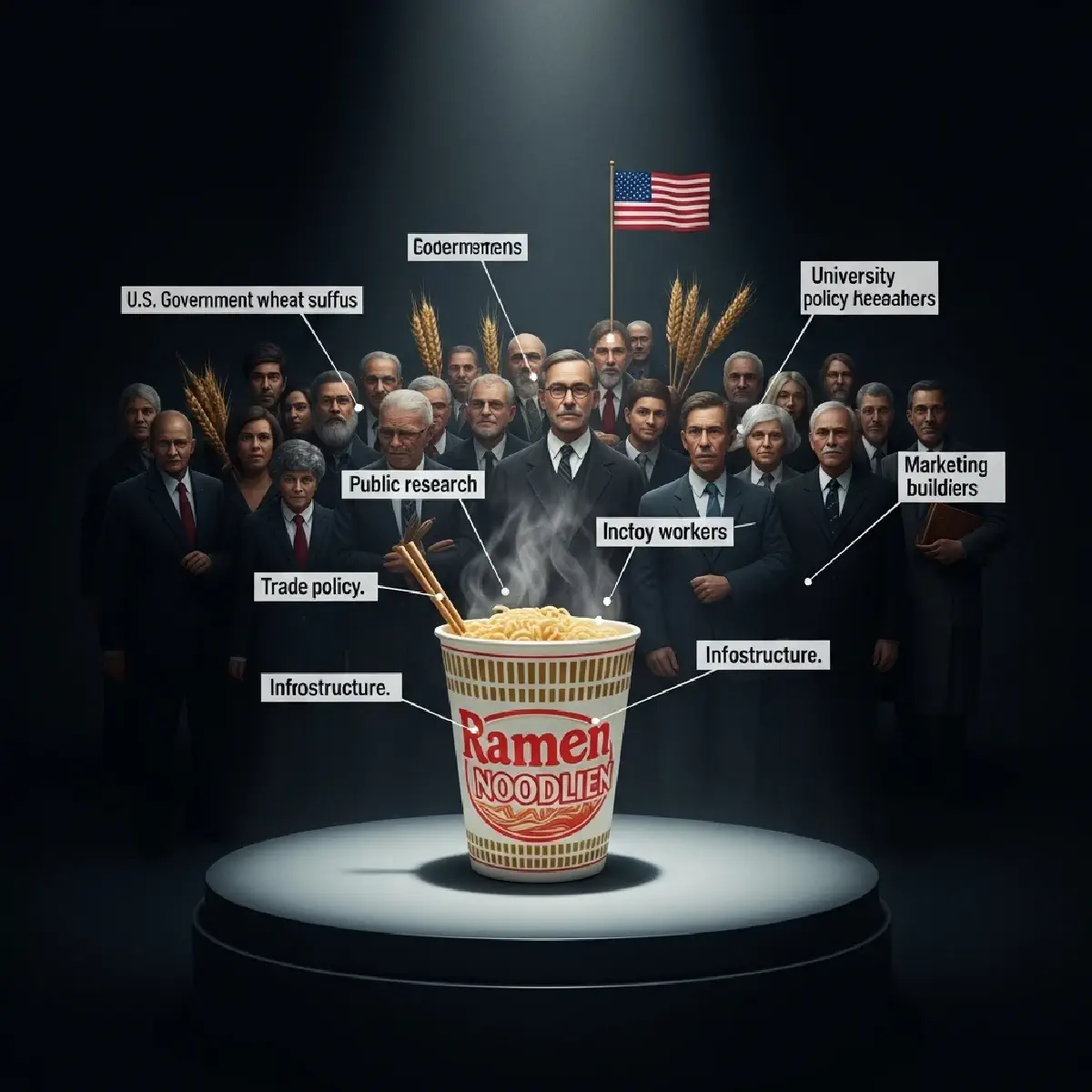
Postwar Japan received massive food aid from the United States. The US had wheat surpluses. Japan had rice shortages. The US shipped wheat.
But Japanese people weren’t used to eating bread. They were used to eating noodles.
So American wheat became Japanese noodles. This wasn’t Ando’s decision—it was the intersection of American agricultural policy, Japanese dietary culture, and the logistics of food aid.
Ando’s innovation was making those noodles instant. But the noodle market already existed because of policy decisions made in Washington.
The Technology#
Flash-frying noodles to dehydrate them wasn’t entirely new. Similar techniques existed in Southeast Asia. The technologies Ando used—the frying, the packaging, the seasoning packets—built on existing knowledge in food science.
Ando worked hard. He experimented extensively. But he was combining and refining, not inventing from nothing.
The Infrastructure#
By 1958, Japan had:
Reliable electricity (for manufacturing)
Clean water (for consumers to add)
A distribution network (to reach stores)
Retail outlets (to sell the product)
Media (to advertise)
A monetary economy (so people could buy)
None of this was Ando’s doing. It was public infrastructure built by government and collective effort.
The Workforce#
Nissin employed workers. Those workers were educated in public schools, healthy because of public health systems, and transported on public roads. Their capability was a social product, not Ando’s creation.
The Collective Nature of Innovation#
This pattern repeats across every innovation story:
The iPhone#
Steve Jobs is celebrated as the genius who created the smartphone. But:
The touchscreen came from publicly funded research
GPS was a military project
The internet emerged from DARPA funding
Siri used algorithms developed in academia
The lithium-ion battery came from DOE-funded research
Jobs (and Apple) brilliantly combined these technologies into a product. But the technologies themselves were publicly funded.
The Internet#
The internet emerged from ARPANET, a US Defense Department project. Tim Berners-Lee created the World Wide Web at CERN, a publicly funded research institution. The protocols that make the internet work were developed by academics and government researchers.
Facebook, Google, and Amazon built private empires on this public infrastructure. They’re entrepreneurial successes—but successes that were only possible because of collective investment they didn’t pay for.
Pharmaceuticals#
Drug companies claim to be innovation engines. But most basic research happens in universities, funded by public money. Companies often acquire small firms (themselves often university spinouts) rather than doing early-stage research.
The public bears the risk of failed research. Companies capture the profits of success.
The Mythology’s Function#
Why does the entrepreneur myth persist when the reality is collective innovation?
Justifying Inequality#
If entrepreneurs create value through individual genius, they deserve their rewards. If innovation is collective, the case for extreme inequality weakens.
The myth transforms social products into individual achievements, making billionaires look like benefactors rather than beneficiaries.
Obscuring Public Contribution#
If innovation comes from lone geniuses, we don’t need public investment in research, education, or infrastructure. Markets alone will produce progress.
This is convenient for those who prefer not to pay taxes. It’s false, but useful.
Maintaining Incentives#
We’re told that without massive rewards, innovators won’t innovate. But:
Scientists often work for modest salaries, motivated by curiosity
Most startup founders fail despite working hard
Countries with less extreme inequality still innovate
The incentive story justifies existing arrangements more than it describes motivation.
What Actually Produces Innovation#
If not heroic individuals, what drives innovation?
Ecosystems#
Innovation emerges from ecosystems: networks of universities, companies, government labs, and skilled workers who share knowledge, compete, and collaborate.
Silicon Valley isn’t successful because of individual geniuses—it’s successful because of Stanford, Berkeley, defense spending, venture capital networks, and a culture of job-hopping that spreads knowledge.
Public Investment#
Basic research—the foundation for applied innovation—is too risky and slow for private investment. It requires public funding.
The internet, GPS, the human genome, countless drugs and materials: public money funded the research that private companies later commercialized.
Accumulated Knowledge#
Every innovation builds on prior knowledge. Isaac Newton said he “stood on the shoulders of giants.” So does every entrepreneur, though they rarely acknowledge it.
The noodle-making knowledge Ando used had developed over centuries. The food science he applied came from research institutions. The business practices he followed had evolved through generations of commerce.
Supportive Institutions#
Property rights, contract law, reliable currency, public safety, educated workers, healthcare—all of these make entrepreneurship possible. They’re not background conditions; they’re preconditions.
Try starting a business where contracts aren’t enforceable, currency is unstable, and workers are unhealthy. Entrepreneurship requires functional societies.
Industrial Policy Works#
The entrepreneur myth supports a particular policy position: government should stay out of the economy and let entrepreneurs work their magic.
But successful economies have never worked this way.
Japan#
Japan’s postwar economic miracle was driven by industrial policy:
MITI (Ministry of International Trade and Industry) coordinated investment
Government protected infant industries
Public banks directed capital
Research was publicly funded
Nissin Foods thrived in this ecosystem. The instant noodle industry emerged from policy, not despite policy.
South Korea#
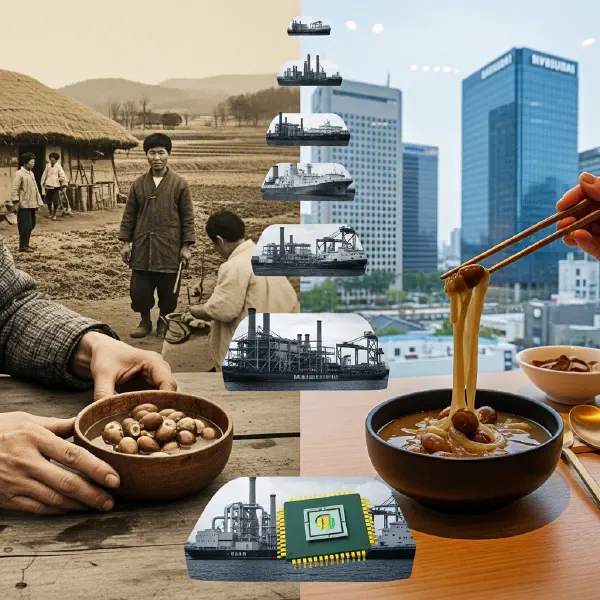
Korea went from one of the world’s poorest countries to a major economy in decades. How?
Government targeted industries for development
State banks funded chosen companies
Trade policy protected domestic industry
Public education created skilled workers
Samsung, Hyundai, and LG are “private” successes. They’re also products of aggressive industrial policy.
The United States#
Americans imagine their economy as a free-market success. But:
Defense spending funds massive research and development
Tax policies subsidize chosen industries
Federal funding built the interstate highway system
Land grants created the university system
Silicon Valley emerged from Cold War defense spending. American agriculture depends on subsidies. The pharmaceutical industry lives on NIH research.
The Noodle Lesson#
Momofuku Ando worked hard, took risks, and built a company. These are real achievements. He deserves credit.
But “credit” is different from sole ownership of an innovation that emerged from collective conditions.
Ando combined knowledge others developed. He used infrastructure others built. He employed workers others educated. He sold to markets others created.
The instant noodle—like every product—is a social achievement with an individual face.
What Changes If We See Clearly#
If innovation is collective:
Taxation of successful companies is returning social investment, not punishing success
Public spending on research, education, and infrastructure is investment, not cost
Inequality from innovation requires justification, not just celebration
Industrial policy is normal and necessary, not interference
The entrepreneur myth protects incumbent interests. Seeing innovation’s social nature opens space for different arrangements.
Innovation's Hidden Ingredients
Year 1: Publicly funded research creates basic knowledge
Year 10: Universities develop applications
Year 20: Government labs refine technologies
Year 30: Private companies commercialize products
Year 31: “Heroic entrepreneur” takes credit for the entire process
Result: Private capture of public investment