
Brief Biography of Heinz Guderian#
Early Life and Education
1888-1907
Kulm, West Prussia
Born June 17, 1888, in Kulm, West Prussia (now Poland), to a career Prussian military officer. He attended the Karlsruhe Cadet School (1901-1903) and the Gross-Lichterfelde Academy in Berlin (1903-1907). In 1907 he joined the 10th Hanoverian Light Infantry Battalion, then commanded by his father.World War I and the Interwar Years
1914-1938
Western Front to Reichswehr
Guderian served primarily as a signals and staff officer on the Western Front, where the stagnation of trench warfare planted the seed for his later theories on mobility. During the 1920s he focused on motorization in the Reichswehr, studying foreign tank doctrine despite Versailles restrictions. He published *Achtung! Panzer!* in 1937, and his ideas caught Hitler's attention, leading to the creation of the first three Panzer divisions in 1935.World War II Service
1939-1945
From Poland to the Eastern Front
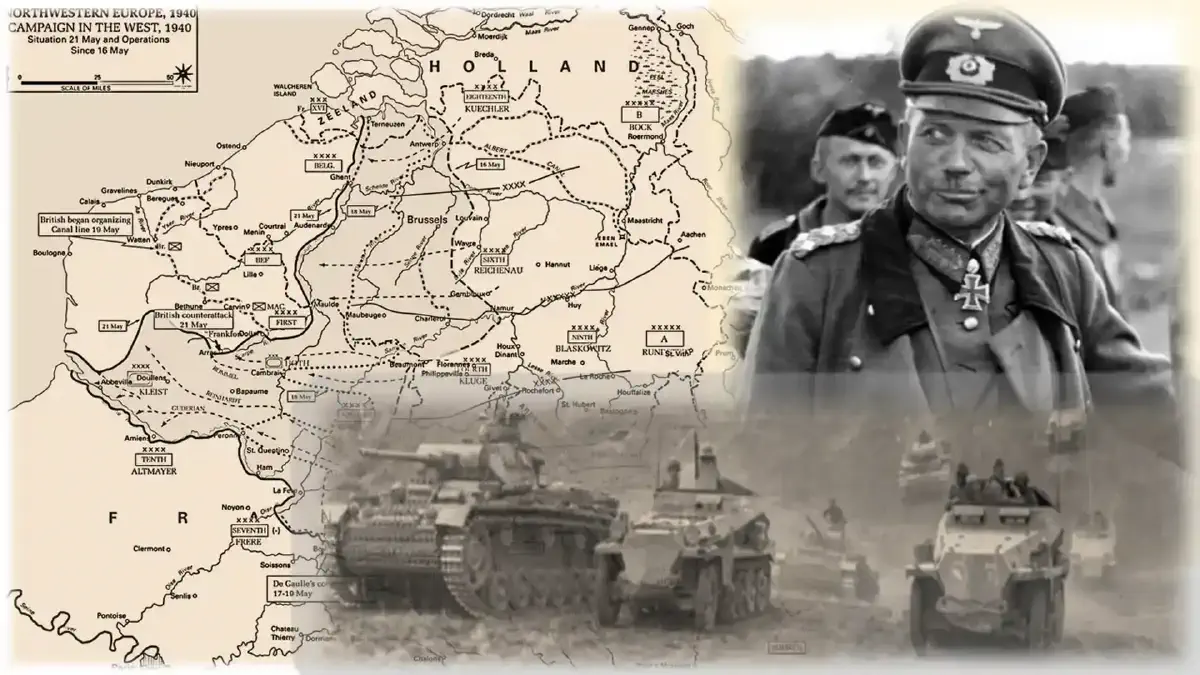
Guderian led the XIX Army Corps through the invasions of Poland (1939) and France (1940), where his breakthrough at Sedan established the Blitzkrieg reputation. He commanded Panzer Group 2 during Operation Barbarossa until December 1941, when Hitler dismissed him after he defied the no-retreat orders. Recalled in 1943 as Inspector General of Armored Troops, he was appointed Acting Chief of the General Staff after the July 20 plot. After repeated clashes with Hitler over the defense of the Eastern Front, he was sent on permanent leave on March 28, 1945.Post-War Life and Death
1945-1954
Captivity, memoirs, Bundeswehr
Guderian surrendered to U.S. forces on May 10, 1945, and was interned until 1948 without formal charges at Nuremberg. He published *Panzer Leader* in 1950, which became an international bestseller. Historians later criticized the book for promoting the Clean Wehrmacht myth, downplaying the army's role in Nazi atrocities. In the early 1950s he advised on the formation of the new West German army, the Bundeswehr. He died of heart disease on May 14, 1954, in Schwangau, Bavaria, age 65.
Key Lessons from Panzer Leader#
Strategy: Offense#
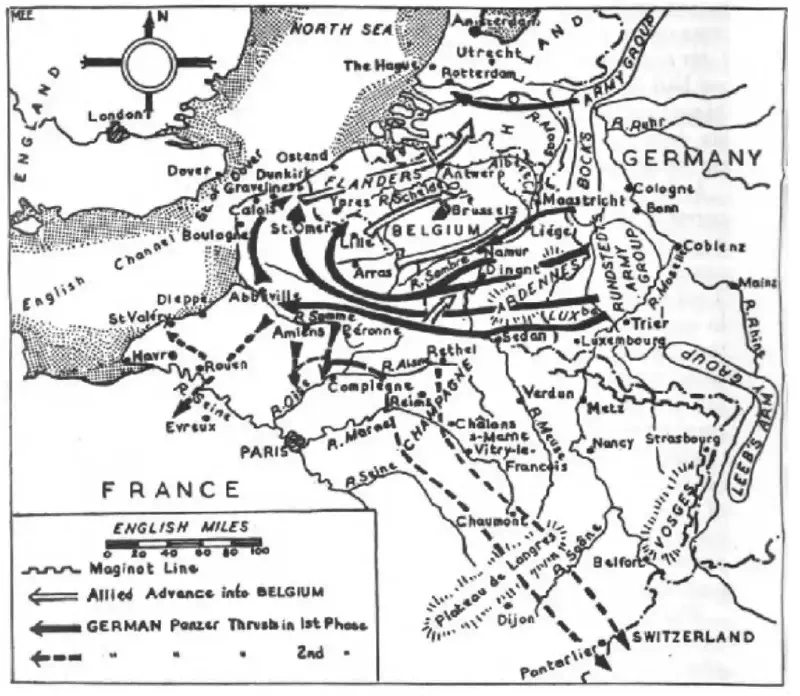
1. Concentrate force at the decisive point (Schwerpunkt)
2. Exploit success ruthlessly
3. Strike the enemy's communications and rear
4. Define clear, operational-level objectives
5. Surprise opens the door; speed prevents recovery
Strategy: Defense#
1. Mobile defense over rigid hold-at-all-costs
2. Create a deep operational reserve
3. Separate the forward line from the main defensive line
4. Fortify rearward lines before they are needed
5. Secure your flanks without stopping the main body
Tactics#
1. Combined arms integration
2. Command from the front
3. Decentralized execution (mission-type tactics)
4. Close air-ground cooperation
5. Klotzen, nicht kleckern
Structure of a 1940 Panzer Division — the integrated combined-arms formation that made these tactics possible:
graph LR
    DIV["Panzer Division"] --> COMBAT["Combat"]
    DIV --> FIRES["Fires"]
    DIV --> ENABLE["Enablers"]

    COMBAT --> PZB["Panzer Brigade\n~218 tanks\n2 × Panzer Regiments"]
    COMBAT --> MOTO["Motorized Infantry Brigade\n2 × Infantry Regiments"]

    FIRES --> ART["Artillery Regiment\n36 × motorized field guns"]
    FIRES --> AT["Anti-Tank Battalion\n36 × Pak 36/37 mm guns"]

    ENABLE --> REC["Reconnaissance Battalion\nArmored cars + motorcycles"]
    ENABLE --> ENG["Pioneer Battalion\nBridge-laying + demolitions"]
    ENABLE --> SIG["Signals Battalion\nRadio in every vehicle"]

    style DIV fill:#4a4a4a,color:#fff
    style COMBAT fill:#1e3a5f,color:#fff
    style FIRES fill:#5f1e1e,color:#fff
    style ENABLE fill:#1e4a2e,color:#fff
Tank Technology#
1. Armament, speed, armor: in that order
2. Never underestimate the enemy's technology
3. Build for mass production, not perfection
4. Crew ergonomics matter
5. A tank war is a logistics war
6. Do not commit new tanks prematurely or in small numbers
German tank production 1942–1944 — the numbers that make the mass-production argument concrete. Tiger and Panther combined never matched Panzer IV output, let alone Soviet T-34 volumes:
Guderian's Optimum Tank Design#
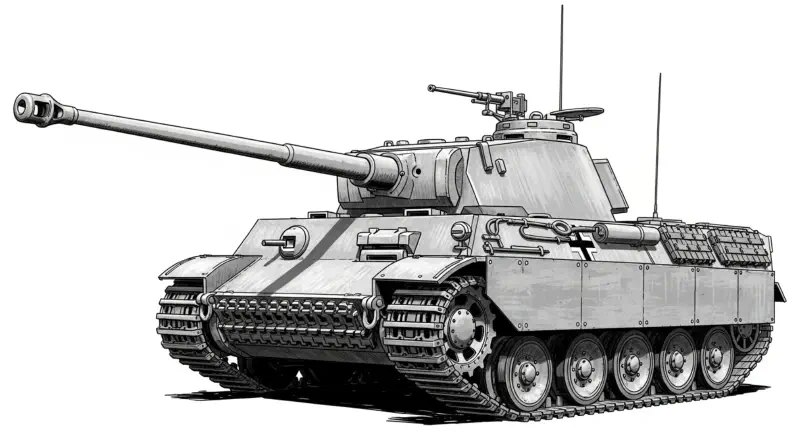
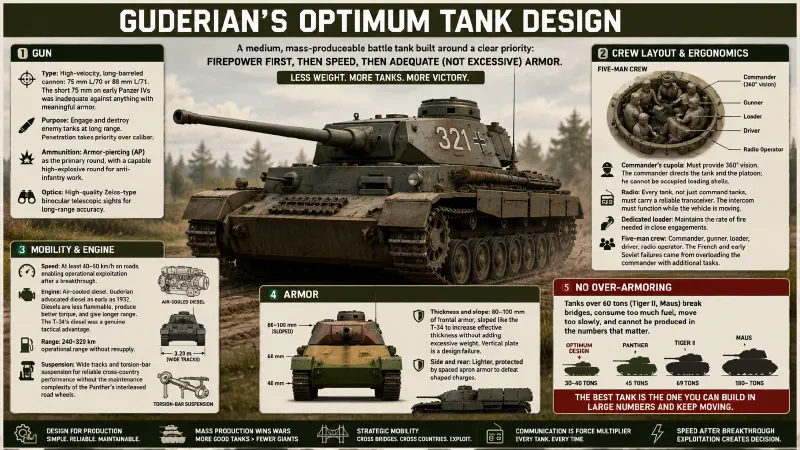
Based on his critiques in Panzer Leader, Guderian's ideal tank would be a medium, mass-produceable battle tank built around a clear priority: firepower first, then speed, then adequate (not excessive) armor. He learned this hierarchy from the shock of the T-34.
Gun#
- Type: High-velocity, long-barreled cannon: 75 mm L/70 or 88 mm L/71. The short 75 mm on early Panzer IVs was inadequate against anything with meaningful armor.
- Purpose: Engage and destroy enemy tanks at long range. Penetration takes priority over caliber.
- Ammunition: Armor-piercing (AP) as the primary round, with a capable high-explosive round for anti-infantry work.
- Optics: High-quality Zeiss-type binocular telescopic sights for long-range accuracy.
Crew Layout and Ergonomics#
- Five-man crew: Commander, gunner, loader, driver, radio operator. The French and early Soviet failures came from overloading the commander with additional tasks.
- Commander's cupola: Must provide 360-degree vision. The commander directs the tank and the platoon; he cannot be occupied loading shells.
- Radio: Every tank, not just command tanks, must carry a reliable transceiver. The intercom must function while the vehicle is moving.
- Dedicated loader: Maintains the rate of fire needed in close engagements.
Mobility and Engine#
- Speed: At least 40-50 km/h on roads, enabling operational exploitation after a breakthrough.
- Engine: Air-cooled diesel. Guderian advocated diesel as early as 1932. Diesels are less flammable, produce better torque, and give longer range. The T-34's diesel was a genuine tactical advantage.
- Range: 240-320 km operational range without resupply.
- Suspension: Wide tracks and torsion-bar suspension for reliable cross-country performance without the maintenance complexity of the Panther's interleaved road wheels.
Armor#
- Thickness and slope: 80-100 mm of frontal armor, sloped like the T-34 to increase effective thickness without adding excessive weight. Vertical plate is a design failure.
- Side and rear: Lighter, protected by spaced apron armor to defeat shaped charges.
- No over-armoring: Tanks over 60 tons (Tiger II, Maus) break bridges, consume too much fuel, move too slowly, and cannot be produced in the numbers that matter.
Reliability and Production#
- Mechanical reliability: A tank that breaks down before contact is useless. Reliability is a combat characteristic, not a production afterthought.
- Mass production: A single, proven chassis built in the thousands from multiple factories. Guderian was appalled by the proliferation of one-off special designs and competing production programs.
- Field maintenance: Interchangeable parts and procedures a field workshop can execute.
- Winter readiness: Antifreeze, engine heaters, and wide tracks from the first production batch, not as a retrofit.
Tactical Features#
- Hull machine gun: The Ferdinand (Porsche Tiger) lacked one and was defenseless against infantry at close range. This is not optional.
- Large hatches: For rapid crew escape and resupply under fire.
- Turret basket: The crew rotates with the turret and remains effective throughout a traverse.
- Smoke mortars: For immediate self-screening without relying on artillery support.
Summary Specifications#
| Feature | Specification |
|---|---|
| Weight | 35-45 tons |
| Gun | 75 mm L/70 or 88 mm L/71 |
| Front armor | 80-100 mm, heavily sloped |
| Speed | 45 km/h on road |
| Engine | 500-600 hp, air-cooled diesel |
| Crew | 5 men |
| Radio | Full transceiver in every tank |
| Reliability target | 2,000 km before major overhaul |
| Production target | 500+ per month from multiple factories |
This is essentially a reliable Panther, or a Panzer IV with heavily sloped frontal armor and a long 75 mm gun. Guderian would have copied the T-34's sloped armor and diesel engine immediately, while keeping German optics, the five-man crew, and a high-velocity gun.
Key quote from Panzer Leader: "In the country of the blind, the one-eyed man is king." Guderian knew that a reliable, well-armed medium tank built in large numbers, led by trained crews with radios, would defeat super-heavy wonder weapons every time.
Guderian in the Drone Age: Tanks in 2026#
The Core Argument#
Guderian would not declare the tank obsolete. He would recognize the FPV drone as the latest evolution in the century-long struggle between armor and anti-armor weapons: the same fundamental problem as the high-velocity anti-tank gun in 1941. His response would be pragmatic and systemic: adapt tactics, technology, and organization rather than abandon the platform.
Guderian's assessment, applied: "The FPV drone is no different from a well-camouflaged 37 mm Pak gun behind a ridge. It kills only if it gets the first shot. Therefore, we must not let it get the first shot."
1. Tactical Adaptations: Speed, Concentration, and Combined Arms#
| Guderian Principle | Adaptation to the Drone Threat |
|---|---|
| Speed | Never linger. Rapid advance means less time for drone acquisition. Static trench warfare is a drone's paradise. |
| Concentration | Mass tanks for the breakthrough, but every massed formation needs an electronic warfare (EW) umbrella. Klotzen, nicht kleckern applies to EW too. |
| Command from the front | Commanders in radio-equipped vehicles spot drones and order immediate countermeasures: smoke, jamming, maneuver. |
| Combined arms | Tanks need organic, mobile air defense and EW support traveling at the same speed as the assault echelon. |
2. Technological Solutions: The Tank as a Network Node#
Guderian would demand rapid development of countermeasures, exactly as he demanded the 50 mm L/60 from the Ordnance Office and was ignored until it was too late:
- Electronic warfare on every tank: Portable jammers to break video links. This is the tank's new 88 mm flak gun.
- 360-degree sensor fusion: Small drone-detecting radar or acoustic sensors mounted on the turret, feeding the commander's display in real time.
- Active protection systems (APS): Hard-kill systems such as Trophy that intercept incoming drones. An evolution of the Schurzen apron armor concept.
- Counter-drone aircraft: The modern Fieseler Storch becomes a drone-hunter clearing the route of advance.
- Cage armor and nets: Cheap, field-expedient standoff protection against shaped charges, available to every vehicle.
3. The Operational Answer: Maneuver Warfare#
Drones are most effective against static, predictable, slow-moving formations. The operational answer is deep, fast, combined-arms penetration into enemy rear areas: precisely Guderian's 1940 method. This disrupts drone supply chains, destroys operators positioned just behind the front line, and collapses logistics before they can sustain the defense.
On tempo: "Do not let the enemy's cheap drone dictate your tempo. If he can see you and strike you, move fast enough that his drone's battery runs out before the video reaches the operator."
4. Training and Organization#
- Every tank commander must recognize drone signatures, use terrain masking, deploy thermal and visual smoke on contact, maintain radio discipline, and never stop in the open.
- Dedicated anti-drone platoons at battalion level: mobile EW vehicles, laser effectors, and small radar units integrated into panzer divisions as organic assets, not attachments.
5. The Cost Argument#
Guderian would reject simplistic cost-exchange ratios. Losing a tank is a setback; losing a battle because you have no tanks is a catastrophe. Drones alone cannot hold ground, storm fortified positions, or exploit a rupture in a defense.
On cost comparisons: "A $500 drone kills a $5 million tank only if the tank is blind, deaf, and alone. Give that tank a $10,000 jammer, a $50,000 radar, and a $20,000 APS, and that drone becomes worthless. The problem is not the tank; it is the lack of investment in its protective envelope."
The Russo-Ukrainian War, May 2026: Lessons in Action#
State of the War#
The front remains locked in positional warfare characterized by drone dominance and heavy attrition on both sides. Competing ceasefire proposals have not produced genuine negotiations. Russian casualties exceed 1.28 million by Ukrainian estimates, with over 11,900 tanks destroyed across the conflict.
Key Technological Developments#
Fiber-optic FPV drones have materially altered the electronic warfare contest: physically tethered to a spool of cable, they are immune to radio-frequency jamming. Ukraine claims 93% neutralization of Russian drones in some attack waves through EW countermeasures; Russia fields vehicle-mounted systems including SERP-FPV. Remote-sniper systems capable of intercepting drones at up to 500 km are now operationally deployed on both sides.
Impact on Armor#
Tanks remain on the battlefield but have adapted considerably. Cope cages, slat armor, and vehicle-mounted jammers are now standard fittings rather than improvised upgrades. Doctrinally, heavy armor has shifted toward long-range artillery roles and small, distributed assault packages. Massed armored breakthroughs are rare; the Guderian model of concentrated tank attacks requires a complete combined-arms package including EW support that few units currently possess at scale.
The Artillery-Drone Complex#
Drones serve as the primary counter-battery and supply-interdiction tool on both sides. Ukraine produces 100,000 105mm shells per year and sources 155mm shells through Rheinmetall's Polish facility. Shoot-and-scoot within minutes, combined with mobile EW, is the new operational baseline for any artillery unit that intends to survive.
Long-Range Strikes#
Ukraine has developed domestic missiles with ranges of 500-1,000 km, striking Russian Baltic ports and oil refineries. Western-supplied systems (Storm Shadow, ATACMS) continue to be used at 200-250 km ranges, subject to varying restrictions on strikes inside Russian territory. Systematic targeting of Russian energy infrastructure has become a sustained economic warfare campaign, not a series of opportunistic strikes.
Drone-Assault Units#
Ukraine's Ministry of Defense has formalized drone-assault units: integrated formations combining aerial drones, ground drones, and infantry. These are a direct descendant of Guderian's panzer divisions, substituting aerial and ground autonomous systems for the motorized combined arms that defined Blitzkrieg. These units have liberated significant territory since February 2026 with substantially reduced infantry casualties compared to conventional assault formations.
Scale and Economics#
Conclusion: Updating Guderian for 2026#
| Domain | Updated Doctrine |
|---|---|
| Defense | "Hold fast" is a death sentence. Mobile, distributed defense with integrated EW and drone-hunting units is essential. Static positions are drone hunting grounds. |
| Technology | A tank is now a network node: armor, jammers, sensors, APS, and drone command capability in one platform. |
| Combined arms | The drone-assault unit is the heir to the panzer division: aerial and ground autonomous systems combined with infantry enable modern offensive operations. |
| Production | Mass production of reliable, affordable equipment beats expensive wonder weapons. A million drones per year outweigh a dozen super-tanks. |
Guderian would not abandon the tank. He would see the drone as a technical challenge to be overcome through innovation, organizational adaptation, and above all speed. His verdict would be direct: the tank's best defense is its tracks. Keep moving, keep attacking, and the drone becomes a nuisance rather than a decisive weapon.