The Granular Rush Reconsidered: A Synthesis#
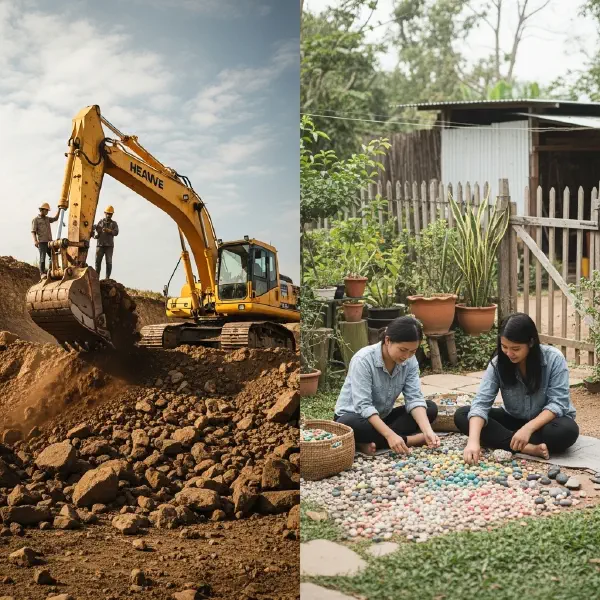
The story of sand extraction is, at its deepest level, a story about power. Who decides how landscapes will be transformed? Who benefits from urbanization? Who bears the costs? The “granular rush” is not inevitable. It is the result of specific policy choices, institutional arrangements, and power structures. Understanding this allows us to imagine alternatives.
Core Insights: What We Have Learned#
Sand as a Development Metaphor#
Sand is not just a construction material; it is a metaphor for how development operates in the contemporary world. Urbanization is presented as inevitable progress, but it is constructed through specific material relationships. Understanding sand extraction reveals the hidden logic of development: how the desires of the wealthy few in cities create cascading impacts that reshape landscapes thousands of kilometers away.
The False Choice Between Development and Environment#
We are often told we must choose between economic growth and environmental protection. Sand extraction exemplifies this false dichotomy. The growth achieved through rapid, sand-dependent urbanization has been highly unequal, concentrating wealth while externalizing costs. Sustainable development that uses alternatives to sand, employs circular construction practices, and centers community welfare would not sacrifice growth but would fundamentally change who benefits and who pays.
The Persistence of Colonial Patterns#
Despite formal independence and the rhetoric of development, the global sand trade reproduces colonial relationships. Extraction, unequal exchange, environmental colonialism—these are not new. What is new is that we can map them, quantify them, and demand change. The granular rush reveals that decolonization remains unfinished.
Toward a Just Transition: Necessary Changes#
Regulatory Reform at Multiple Scales#
National Level: Countries must enact and enforce comprehensive sand-mining regulations including mandatory environmental impact assessment, community benefit-sharing requirements, and extraction taxes that fund restoration. Regulations should prohibit extraction from riparian zones and wetlands and should set extraction limits based on environmental carrying capacity, not unlimited supply.
Regional Level: Regional organizations (African Union, ASEAN, Mercosur) should develop coordinated sand-management strategies preventing a “race to the bottom” where countries compete to relax regulations in exchange for foreign investment. Trade agreements should include environmental standards for exported materials, making “dirty sand” economically uncompetitive.
Global Level: International bodies including the UN Environment Programme should establish global standards for sand extraction, recognizing it as a shared environmental issue analogous to climate change. International finance institutions should condition development lending on compliance with sand-extraction standards, leveraging their considerable power.
Technological and Industrial Transition#
The construction industry must systematically transition from natural sand to alternatives. This requires:
- Building Code Reform: Update codes to permit and encourage manufactured sand, recycled aggregate, and alternative materials. Many codes are outdated, written when alternatives did not exist.
- Industry Support: Subsidize early-stage alternatives—recycled aggregate processing facilities, desert sand treatment plants, plastic composite manufacturers—helping them reach cost competitiveness.
- Research Funding: Expand research into reduced-concrete construction, modular design, and material innovation, redirecting construction research away from optimizing natural sand use toward eliminating it.
- Corporate Accountability: Require construction companies to disclose sand sourcing and environmental impacts, creating pressure to adopt alternatives.
Community Empowerment and Rights Recognition#
Communities in extraction zones must gain power over decisions affecting their land. This requires:
- Land Rights Formalization: Governments must formally recognize customary land rights, eliminating the legal ambiguity that corporations exploit to acquire extraction concessions.
- Community Veto Power: Implement “free, prior, and informed consent” protocols giving communities the right to reject extraction proposals.
- Benefit Distribution: Require that a substantial portion of extraction revenues flow to local communities, creating incentives for equitable management rather than elite capture.
- Environmental Monitoring: Fund community-based environmental monitoring systems, enabling communities to document impacts and hold extractors accountable.
Global Solidarity and Movement Building#
The global sand crisis cannot be solved by individual countries acting alone. It requires international solidarity:
- Knowledge Exchange: Communities resisting extraction in Kenya can learn from those in India; alternative construction advocates in Europe can share technology with those in Southeast Asia.
- Supply Chain Pressure: Consumer and corporate campaigns can reduce demand for sand from ecologically sensitive areas, supporting local resistance movements.
- Political Support: International advocacy organizations can amplify the voices of affected communities, helping local struggles achieve global resonance.
The Vision: Post-Extraction Urbanism#
Imagine a global construction industry decoupled from sand extraction—where cities are built from recycled materials, designed for longevity and disassembly, utilizing alternatives optimized for local conditions. Urban development is coordinated with land conservation, protecting riparian zones and agricultural systems. Communities exercise genuine power over land use decisions, and the benefits of urbanization are distributed equitably.
This is not fantasy; it is technically feasible and economically viable. What is required is political will—a commitment to prioritize environmental sustainability, community welfare, and global equity over the short-term profit maximization that currently drives sand extraction.
The Stakes: Why This Matters Now#
The global urbanization wave is not yet complete. Decisions made in the next decade about how to source materials for development will determine whether we head toward sustainability or toward catastrophic ecosystem collapse. The Global South is still urbanizing rapidly; the materials used in this urbanization will determine the trajectory of the 21st century.
Sand extraction is not marginal to global environmental and development challenges; it is central. We cannot address climate change without transforming how we build. We cannot achieve genuine development without empowering communities and protecting their environments. We cannot create global equity while perpetuating colonial extraction patterns.
The granular rush is not inevitable. It is a choice—repeated daily by governments, corporations, and consumers—to prioritize short-term growth over long-term sustainability. We can make different choices. We can build cities that nourish rather than deplete, that empower rather than displace, that unite the world through equitable exchange rather than divide it through extraction.
The work begins with recognizing that every concrete slab carries a history of extraction and displacement. It continues through demanding that our cities be built differently: justly, sustainably, and in solidarity with those whose lands and waters enable our urban futures.
Conclusion: The Granular Future#
The story of sand is the story of how the world is being remade through material extraction and urban expansion. It is a story written in the displacement of farmers, the degradation of rivers, the loss of ecosystems, and the concentration of wealth. But it is also a story not yet finished. The choices we make about how to build will determine whether the granular rush continues its extractive path or transitions toward something more just and sustainable. That choice is ours to make—if we choose to make it.