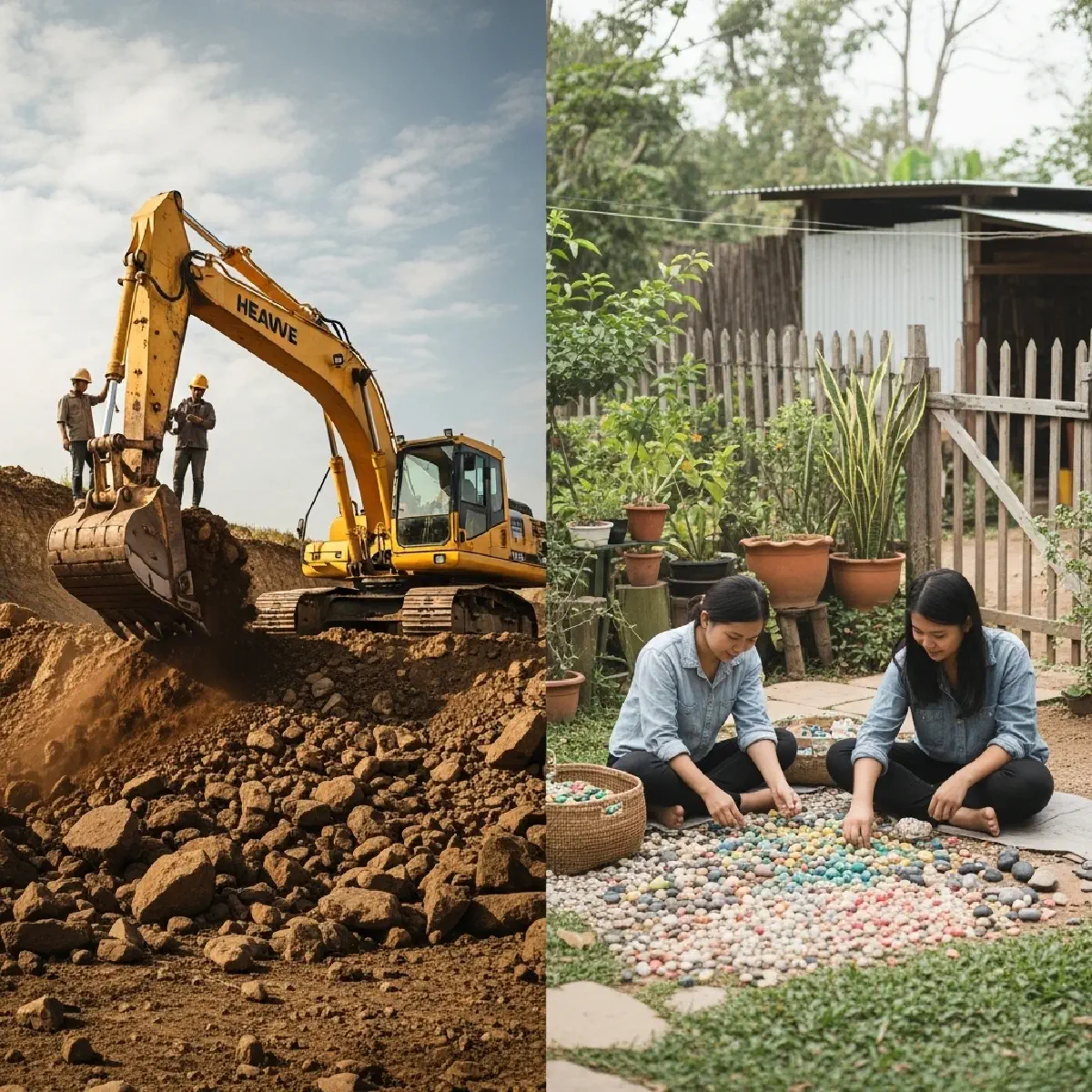
The Concentration of Power in Sand#
The global sand industry generates over $100 billion annually, yet remains one of the least regulated resource sectors. Large construction and mining conglomerates dominate sand extraction, distribution, and pricing, while small-scale miners and local communities have virtually no bargaining power. This power imbalance is not accidental; it is the result of deliberate policy choices by national governments and international development institutions that prioritize rapid urbanization over environmental protection and community welfare.
Corporate Structures: Consolidation and Control#
The Global Sand Supply Chain#
Major construction groups like CRH plc, Lafarge Holcim, and China’s State-Owned Enterprises control vast portions of the global sand supply. These corporations acquire extraction rights through licensing agreements that often involve minimal environmental assessment and community consultation. In many African and South Asian countries, extraction licenses are granted to foreign-owned companies with little transparency, creating a scenario where local communities discover mining operations only after extraction has begun.
Vertical Integration and Profit Accumulation#
Large corporations own not just extraction sites but also the trucks, loading equipment, and distribution networks. This vertical integration allows them to control prices at every stage of the supply chain. In Ghana, sand prices increased from $2 per cubic meter in 2010 to $12 by 2020, not due to scarcity, but due to cartelization by major mining companies. The markup is captured entirely by corporations, while extraction costs—environmental degradation and community displacement—are borne by society.
State Complicity: Weak Regulation and Captured Governance#
The Governance Gap#
Most countries lack comprehensive sand-mining legislation. India did not enact a national sand-mining policy until 2016, decades after industrial-scale extraction had begun. Even with laws on the books, enforcement is weak. In Ghana’s Mining Registry, fewer than 15% of licensed sand operations undergo regular environmental compliance inspections. Corruption at the local level allows unauthorized mining to flourish: in Kenya, local administrators receive bribes to overlook illegal mining in protected riparian zones.
The Development Imperative Justification#
National governments justify lax regulation by pointing to “development imperative”—the need for rapid urbanization and infrastructure expansion. This rhetoric obscures a fundamental truth: sand extraction creates short-term fiscal revenue for governments (through mining taxes and licenses) while environmental costs accumulate as unfunded liabilities for future generations. In the Philippines, sand mining contributed $500 million in government revenue over a decade but caused an estimated $2 billion in environmental damage.
International Finance and Structural Adjustment#
The World Bank and Asian Development Bank have consistently promoted rapid urbanization in developing countries as a poverty-reduction strategy. This support comes with structural adjustment conditions requiring countries to open resource sectors to foreign investment and minimize environmental regulation. In Mozambique, sand mining expansion was explicitly funded as part of World Bank-supported urban development programs, despite available evidence of severe environmental impacts in similar contexts.
Asymmetric Power: Communities Versus Corporations#
Land Acquisition and Dispossession#
In many countries, customary land rights are not recognized legally, creating opportunities for corporations to acquire land at minimal cost. In Tanzania, a farmer’s customary claim to land is worth perhaps $1,000 per hectare, but the same land might generate $100,000 in sand mining revenue over five years. Corporations exploit this gap, purchasing or leasing land from vulnerable individuals, often through intermediaries who conceal the true intentions.
Labor Exploitation#
Sand mining on corporate sites employs workers under precarious conditions. In India’s riverbed mining operations, workers earn below minimum wage and lack safety equipment. In Ghana, a 2019 study found that 40% of sand miners had experienced workplace injuries related to equipment or unstable excavations, yet 100% lacked formal worker compensation. This creates a disposable workforce that corporations can exploit with impunity.
Suppression of Community Resistance#
When communities attempt to resist sand mining, corporations and complicit state actors respond with legal intimidation, threats, and occasionally violence. Environmental activists in India, Kenya, and the Philippines have faced arrest on fabricated charges. In Uganda, a community leader opposing sand mining on his village lands was killed in 2018; the case remains unsolved. This pattern of suppression signals to other communities that resistance is futile.
Synthesis: Structural Injustice Embedded in Policy#
The dominance of corporations in sand extraction is not the result of market efficiency; it is the product of deliberate policy choices that have privileged capital accumulation over environmental protection and community rights. Governments have created a system where short-term revenue generation justifies long-term ecological and social costs. The “granular rush” is ultimately a story about power: whose interests are served by rapid urbanization, who profits from resource extraction, and who bears the costs of environmental degradation. Understanding this political economy is essential to any discussion of alternatives.