Building Upward by Digging Outward#
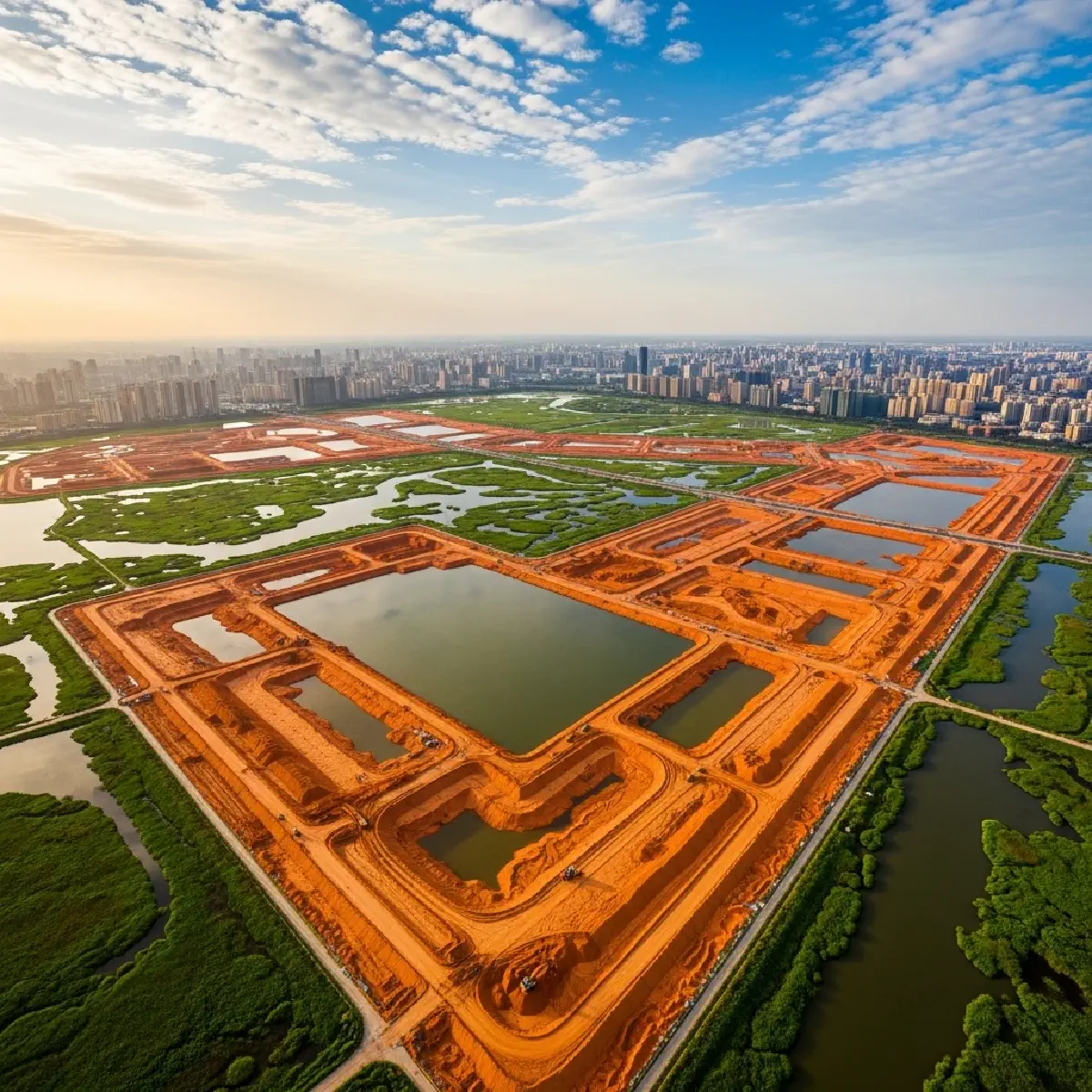
In the early 1960s, a triangular embankment was constructed to protect Dhaka, the capital of Bangladesh, from the monsoon rains. This Dhaka-Narayanganj-Demra (DND) project turned marshy lowlands into buildable urban territory. However, the city needed more than just a wall; it needed solid ground. Between 1980 and 2000, nearly 70% of Dhaka’s land infilling was performed by depositing river sand in the “fringe areas”. This process represents “sand urbanism,” where the city is literally raised from the muck by the granular remains of the mountains.
The Recursive Constitution of Sand and Urbanity#
The central argument of this post is that urban formation and sand extraction are recursively constituted; sand makes the city, while the city’s growth continuously forces sand extraction to move to more distant, peripheral frontiers.
The Systemic Cycle of Infilling and Insecurity#
Explaining the System: Sand Infilling and Urban Expansion#
Modern urbanity requires massive volumes of aggregates to create roads, schools, hospitals, and housing. In peri-urban areas like Accra, Ghana, sand is extracted from agricultural land before that land is repurposed for residential buildings. This “interstitial moment” between farming and building varies in duration but is fundamental to urban expansion. In Dhaka, the build-up area in fringe zones increased from 612 hectares (1,512 acres) in 1990 to 1,720 hectares (4,250 acres) in 2000.
Complicating Factors: The Sand-Security Nexus#
While sand provides housing security for urban residents, its extraction produces a host of insecurities for those in the spaces of production. This “sand-security nexus” reveals that tenure security is often sacrificed for urban densification. In Accra, 95% of surveyed household heads in mining areas experienced a reduction in farm size. Landholding medians dropped from 1.6 hectares (3.95 acres) in 2015 to just 0.4 hectares (0.98 acres) by 2020. Powerful actors often dispose of land for sand winning or residential development, prompting the displacement of those unable to pay high market prices.
Tracing the Consequences: Food and Economic Shockwaves#
The displacement of agriculture has dire consequences for local livelihoods and nutrition. In Ghana, 88% of respondents reported that their farms were destroyed by sand miners, resulting in the loss of cassava, yam, and maize. This led to an 86% reduction in average meals per day for some households, dropping from three meals to two. Furthermore, heavy sand-bearing trucks degrade local road networks, creating safety concerns and high maintenance costs for local transporters. In Dhaka’s DND zone, the uncontrolled sand filling blocked drainage canals, paradoxically leading to chronic waterlogging and flooding in the very areas sand was meant to secure.
Synthesis: The Distance of Extraction#
Sand urbanism forces us to look beyond the city center and recognize that urban expansion is a “circuit of extraction”. As local supplies are exhausted, the source of materials shifts to increasingly distant places, creating new “sand boomtowns” in the periphery. This movement consolidates inequalities between sites of consumption and sites of extraction. To understand contemporary urbanity, we must acknowledge that every concrete slab is a record of displacement somewhere else. The “granular rush” is not just about building up; it is about the power to transform the landscape hundreds of kilometers away.